
Last updated on July 21st, 2026 at 10:00 am
Have you ever finally spoken up about something, only to be told you sounded rude or aggressive? You were not trying to hurt anyone. You were just being honest. This happens more often than people realize.
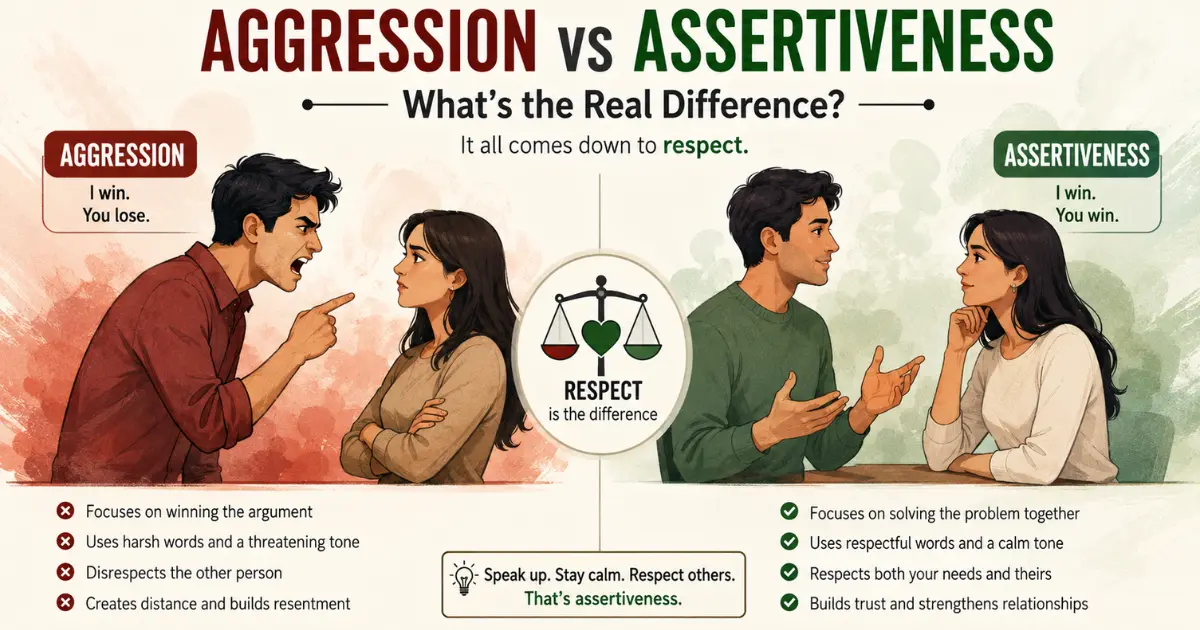
Many people confuse standing up for themselves with attacking someone else. The real difference between aggression vs assertiveness is simple. It comes down to respect.
Assertiveness means expressing your needs while still respecting the other person. Aggression means getting your needs met at someone else’s expense. This guide breaks down the difference between aggression and assertiveness with clear, real examples. By the end of this guide, you will know exactly how to navigate aggression vs assertiveness in your own life.
Key Takeaways
- Assertiveness means expressing your needs while respecting others.
- Aggression means overpowering others to get your way.
- The real difference is respect, not confidence or loudness.
- Many people in Indian families confuse staying quiet with being respectful.
- The 3 C’s of assertiveness are clarity, confidence, and control.
- Assertiveness is a learnable skill that improves with practice.
What Is Assertiveness?
Assertiveness means expressing your thoughts, needs, and boundaries clearly and honestly. At the same time, it respects the other person’s feelings and rights.
An assertive person is confident without being controlling. They speak openly. They listen too. Their goal is not to win the conversation. Their goal is to be heard without taking away someone else’s voice.
For example, imagine a coworker interrupts you in a meeting. An assertive response sounds like this. “I would like to finish my point first.” This is direct. It is also respectful.
What Is Aggression?
Aggression means trying to get your point across by overpowering the other person. It shows up through tone, through harsh words, or even through cold silence used as a weapon.
An aggressive response to that same meeting interruption might sound like this. “Stop cutting me off, you always do this.” The frustration is valid. The delivery is not.
Anger itself is a normal human emotion. It only becomes harmful when it turns into hostile or destructive behavior. We have covered this distinction in detail in our complete guide on aggression management in personality development.
Aggression vs Assertiveness: What Is the Core Difference?
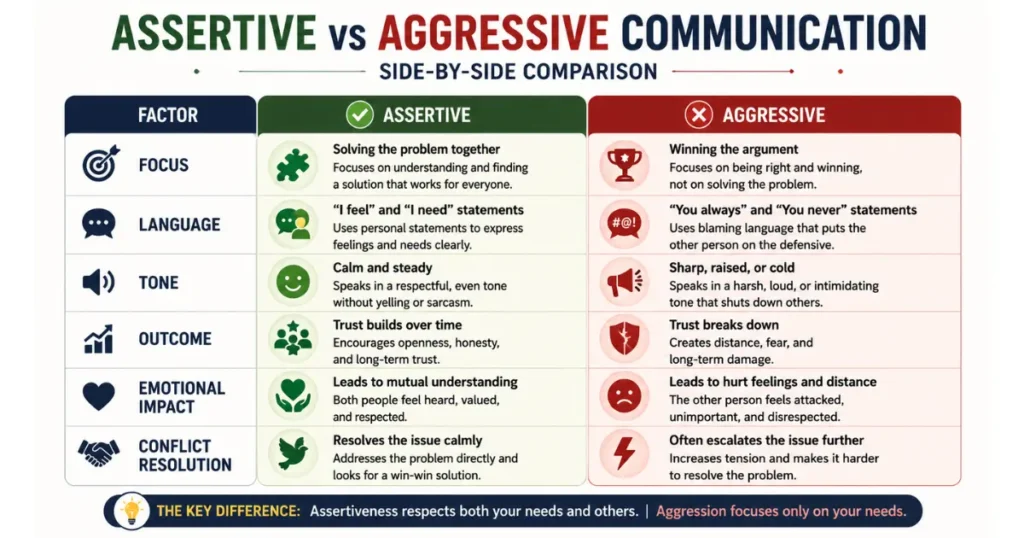
| Factor | Assertive | Aggressive |
|---|---|---|
| Focus | Solving the problem together | Winning the argument |
| Language | “I feel” and “I need” statements | “You always” and “You never” statements |
| Tone | Calm and steady | Sharp, raised, or cold |
| Outcome | Trust builds over time | Trust breaks down |
| Emotional impact | Leads to mutual understanding | Leads to hurt feelings and distance |
| Conflict resolution | Resolves the issue calmly | Often escalates the issue further |
The words matter. But intention matters more. “I feel unheard when I am interrupted” is assertive. “You never let me speak” is aggressive. Same frustration. Different impact. This is the heart of assertive vs aggressive communication.
Can You Be Assertive Without Being Aggressive?
Yes. Most people are fully capable of it. The real obstacle is rarely ability. It is fear.
Why is being assertive so difficult?
Most people avoid speaking up for a few common reasons:
- Fear of conflict. They worry that honesty will upset the other person.
- Fear of being disliked. They want to stay likable, even at their own cost.
- Childhood conditioning. Many were raised to believe that saying no is rude or selfish.
- Cultural upbringing. In many Indian families, children are taught to stay quiet around elders and avoid questioning authority.
This conditioning builds adults who find it hard to speak honestly, even when they have every right to.
How to be polite but assertive
Being polite does not mean staying silent. You can protect your boundary and stay kind at the same time. Follow these three steps:
- State the issue calmly, without blame.
- Use “I” language instead of “you” language.
- Hold your ground without raising your voice.
For a deeper look at why this feels so hard, read our guide on factors affecting assertiveness in personality development.
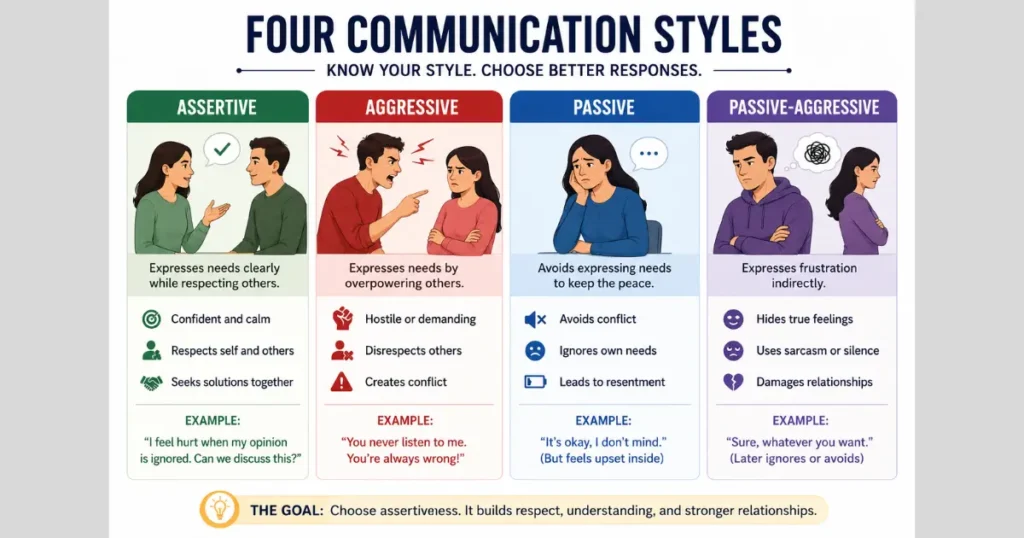
Assertive vs Aggressive vs Passive vs Passive Aggressive: Which One Are You?
Most people are not locked into one style. The style often shifts depending on the situation.
- Assertive means expressing your needs while respecting others. Example: telling a friend directly that a comment hurt your feelings.
- Aggressive means expressing needs by overpowering others. Example: snapping at the same friend in front of a group.
- Passive means avoiding your needs completely. Example: saying nothing and quietly feeling hurt for days.
- Passive-aggressive means showing frustration indirectly. Example: going cold and distant without explaining why.
Awareness is the first step toward change. If you want to explore the broader types of communication, read our complete guide on communication skills and their importance.
What Are the Signs of Low Assertiveness?
Low assertiveness often hides behind kindness. It can look like politeness on the surface.
- You apologize even when you have done nothing wrong.
- You agree with people just to avoid an uncomfortable moment.
- Saying no feels almost impossible, even when you are overwhelmed.
- Resentment quietly builds up over things you never said out loud.
Real Examples: Assertive vs Aggressive Response
1. A coworker interrupts you during a meeting
- Assertive: “I would like to finish my point before we move on.”
- Aggressive: “Stop cutting me off, you do this every time.”
2. Your partner is not helping with household responsibilities
- Assertive: “I am feeling stretched thin managing the house alone. Can we split the tasks this week?”
- Aggressive: “You never help with anything. I am tired of doing it all.”
3. A relative keeps overstepping a boundary you have already set
- Assertive: “I have asked you not to bring this up. I need you to respect that.”
- Aggressive: “Why can you never just listen to me?”
4. A manager gives you an unrealistic deadline
- Assertive: “I can complete this by Tuesday with good quality. Friday is not realistic if I want to do this properly.”
- Aggressive: “This deadline makes no sense. You are setting me up to fail.”
The situation stays the same in each example. Only the delivery changes. These examples show why understanding aggression vs assertiveness matters in everyday conversations.
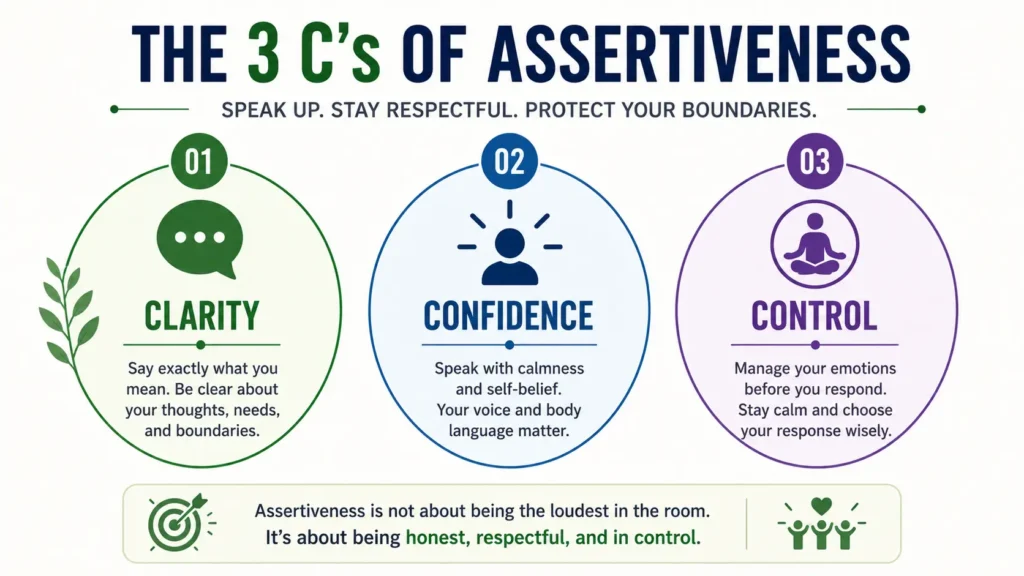
What Are the 3 C’s of Assertiveness?
- Clarity means saying exactly what you mean, instead of hinting and hoping the other person understands. Instead of “Can you help me?” try “I need help finishing this by 5 PM.”
- Confidence means keeping your tone calm and your body language steady, even when the moment feels tense. Keep steady eye contact, even if your voice feels shaky inside.
- Control means managing your emotional reaction before you speak. Take one slow breath and count to three before you respond in a tense moment.
Assertiveness training is widely used in cognitive behavioral therapy to help people communicate more effectively without aggression or passivity.
How to Be Assertive Without Being Aggressive
- Use “I” statements instead of accusations.
- Pause for a few seconds before responding.
- Separate the issue from the person. Address the behavior, not the character.
- Keep your tone calm, even if the other person raises theirs.
- State your boundary once, clearly, and stop overexplaining it.
Quick Tips to Build Assertiveness
- Practice saying no in small, low-stakes situations first.
- Rehearse what you want to say out loud before a difficult conversation.
- Write your boundary down in one clear sentence before you say it.
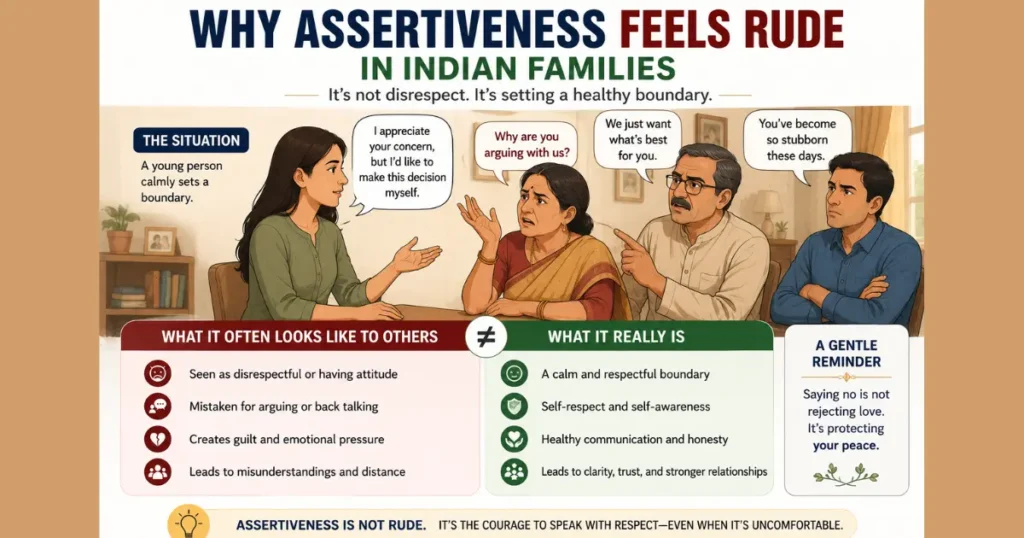
Why Indians Often Mistake Assertiveness for Rudeness
This is a conversation most articles never have, and it deserves attention.
In many Indian households, respect often means staying quiet, especially around elders. Children are praised for being adaptable and obedient. Questioning anything, even politely, is sometimes seen as disrespectful.
This conditioning carries into adulthood. So when someone finally sets a boundary or speaks honestly, it gets misread as attitude. It is not an attitude. It is someone trying to be heard for the first time.
Saying no to a relative who keeps pushing unsolicited advice about marriage or career choices is not disrespectful either. It is a boundary.
Understanding this cultural pattern is the first step toward unlearning it without guilt.
Final Thoughts
Aggression vs assertiveness is not about who speaks louder. It is about who speaks with respect.
Assertiveness lets you protect your needs without damaging your relationships. Aggression might win the moment, but it usually costs you trust in the long run.
Start small. Practice one assertive sentence today, at home, at work, or with a friend. Over time, it gets easier, and your relationships get stronger.
“Want to build a stronger personality overall? Check out our complete guide to personality development for the full roadmap.”
Frequently Asked Questions
1. Can you be assertive without being aggressive?
Yes. Assertiveness focuses on expressing yourself honestly while still respecting the other person. Aggression focuses on overpowering them.
2. What are the signs of low assertiveness?
Common signs include over apologizing, difficulty saying no, agreeing just to avoid conflict, and quiet resentment that builds up over time.
3. What are the 3 C’s of assertiveness?
Clarity, confidence, and control. Together they help you express yourself honestly without losing composure.
4. How can I be polite but assertive?
State the issue calmly, use “I” statements instead of blame, and hold your boundary without raising your voice.
5. Why is being assertive so difficult?
Many people fear conflict or being disliked. They were raised to believe that speaking up is impolite. This makes silence feel safer, even when it is not.
6. What is the difference between assertive and aggressive communication?
Assertive communication respects both people in the conversation. Aggressive communication tries to win at the expense of the other person.

Ayanshi is the founder of PersonaGuru.in, a blog dedicated to personality development, relationships, and mental health. With 3+ years of writing experience and 250+ published articles, she simplifies psychology into practical, everyday advice for real people.