
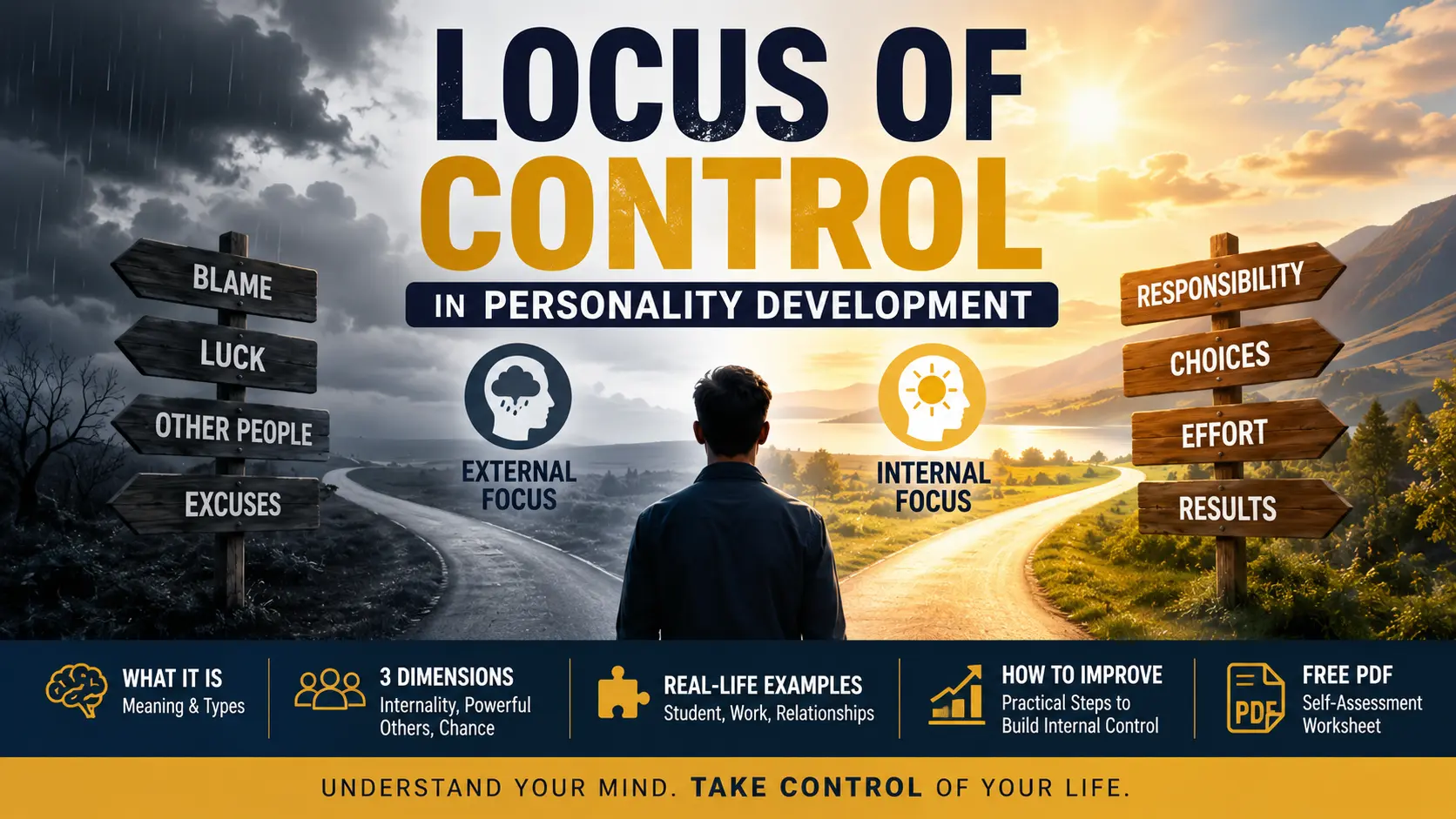
Last updated on July 21st, 2026 at 09:53 am
Have you ever failed at something and blamed bad luck right away?
Now think of someone you know who does the opposite. They fail, they sit with it for a minute, and then they ask, “What can I do differently next time?”
That gap between the two of you is not just an attitude. It has a name. Locus of control in personality development is the psychological term for exactly this gap, and it plays a bigger role in your life than most people realize.
Your locus of control shapes how you handle stress, how you chase your goals, and how satisfied you feel at work and in life. Once you understand your own locus of control, you stop letting it run on autopilot. You start shaping it on purpose.
This guide breaks down what locus of control in personality development really means, the two main types, a third dimension most articles skip completely, real examples with real people, and simple steps to build a stronger internal locus of control.
This is part of a bigger picture — read our complete Personality Development Guide to understand how self-awareness, communication, and confidence all connect.”
Key Takeaways
- Locus of control is your belief about whether your own actions or outside forces shape your life outcomes.
- It comes in two broad types: internal locus of control and external locus of control.
- A Leadership IQ study of over 11,000 employees found that people with a high internal locus of control are 113% more likely to give their best effort at work.
- There is also a third, lesser-known locus of control model with three dimensions: internality, powerful others, and chance.
- Locus of control is not fixed. It can shift with age, experience, and practice.
- A healthy locus of control is not 100% internal. Balance matters more than extremes.
What Is Locus of Control?
Locus of control is a personality concept developed by psychologist Julian Rotter in 1954. It describes how much you believe you control the events in your life.
The word “locus” just means place. So the question behind locus of control is simple. Where do you place the control over your life? Inside yourself, or outside, in the world?
Rotter built locus of control as part of his social learning theory. He believed people learn how much control they have through their own experiences, especially the rewards and punishments they grew up with.
In plain words: if you think your choices shape your outcomes, you lean internal. If you think luck, fate, or other people run your life, you lean external.
How Locus of Control Shapes Personality Development
Locus of control is not a one-time test result you take and forget. It grows into your personality over time and quietly shapes how you respond to everything life throws at you.
Internal vs External Locus of Control
Most people sit somewhere between two extremes on the locus of control scale.
| Internal Locus of Control | External Locus of Control | |
|---|---|---|
| Core belief | My actions cause my outcomes | Outside forces cause my outcomes |
| Response to failure | Reflects, then adjusts | Blames luck or other people |
| Motivation | Stays high, effort feels worth it | Drops, effort feels pointless |
| Stress handling | Usually calmer, more proactive | Usually harder, more passive |
| Common trap | Can slide into self-blame | Can slide into learned helplessness |
Neither side is purely good or bad. Most emotionally healthy people lean toward an internal locus of control, but still know some things are genuinely out of their hands.
Is Locus of Control a Fixed Trait?
Locus of control is a stable personality trait, similar to a Big Five trait. But stable does not mean permanent.
Think of your locus of control as a thinking habit, not a label stuck on you forever. Like any habit, you can reshape it with steady effort. A growth mindset makes this reshaping much easier, since you already believe change is possible in the first place.
The Link Between Locus of Control and the Big Five
Studies have found real overlap between locus of control and Big Five personality traits. People with a stronger internal locus of control tend to score higher on conscientiousness and lower on neuroticism.
That makes sense. Conscientious people believe their effort matters, so they put more of it in. And a stronger internal locus of control usually lowers anxiety too, since you feel less like a passenger in your own life.
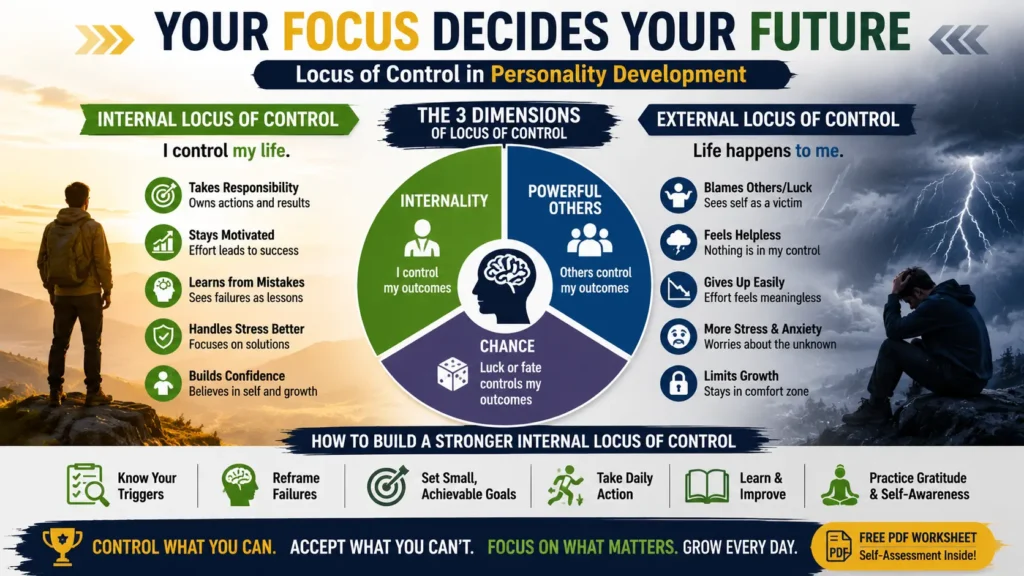
What Are the Three Dimensions of Locus of Control?
Most articles online stop at internal versus external locus of control. But psychologist Hanna Levenson took Rotter’s original idea further and split locus of control into three separate dimensions, using what is called the IPC Scale.
- Internality: how much you believe your own actions and abilities control your outcomes.
- Powerful Others: how much you believe other people, like a boss, a doctor, or an authority figure, control your outcomes.
- Chance: how much you believe luck or random fate controls your outcomes.
Here is why the three dimensions of locus of control matter. Two people can both score “external” on a simple test, yet mean completely different things. One feels controlled by the people around them. The other genuinely believes everything comes down to luck. Levenson’s model separates those two experiences instead of lumping them together under one label.
Real-Life Examples of Locus of Control
Seeing locus of control play out in real situations makes it far easier to spot in yourself.
- Rohan and the exam he failed. Rohan, a second-year engineering student, scored badly in his mechanics exam. His first thought was, “The paper was unfair; half the questions were out of the syllabus.” A week later, his friend Ananya, who failed the same exam, sat down with her notes and said, “I skipped two full chapters; that is on me. Let me fix my study plan.” Same exam, same result, two very different loci of control.
2. Priya and the promotion that went to someone else. Priya works in marketing and has been expecting a promotion for over a year. When it went to a colleague instead, her first reaction was to blame office politics and stop putting in extra hours. A few months later, she asked her manager directly what skills she was missing. That single question, driven by a shift toward an internal locus of control, is what eventually got her the next promotion.
3. Vikram and the breakup. After a long relationship ended, Vikram spent weeks blaming his ex-partner entirely, convinced she was simply “never serious enough.” His brother pointed out, gently, that Vikram had cancelled plans with her for months because of work. Once Vikram accepted his own part in it, without spiraling into guilt, he started making real changes in his next relationship instead of repeating the same pattern.
What Causes a Person’s Locus of Control?
You are not born with your locus of control fixed in place. It develops early, mostly shaped by your surroundings.
Childhood and Parenting
According to Psychology Today’s overview of locus of control, children raised by parents who connect effort to consistent results, and who praise real effort usually grow a stronger internal locus of control. Children raised in unpredictable homes, or under parents who control everything, often lean externally instead.
Can Parents Influence a Child’s Locus of Control?
Yes, quite a lot. Encouraging independence, letting kids make age-appropriate decisions, and following through on consequences consistently all build a more internal locus of control over time.
How to Improve Your Locus of Control
If you feel like life keeps happening to you instead of because of you, here is where to start. These steps are the practical side of locus of control in personality development, the part you can actually act on this week.
- Catch the blame pattern. Notice the exact moment you blame luck, fate, or someone else.
- Ask what part was actually yours. Not all of it. Just your piece of it.
- Reframe the failure. Turn “this happened to me” into “here is what I will try differently.”
- Start with tiny decisions. Plan your own day. Handle a small disagreement without waiting for someone else to step in.
- Track small wins. Write down moments where your own effort changed an outcome. This builds real proof, not just a positive feeling.
- Set one small goal this week. Hitting it, even a small one, strengthens your belief that your actions matter. A clear sense of your aspirations makes this step much easier, since you are working toward something specific instead of drifting.
- Get comfortable with discomfort. Every time you embrace a challenge instead of avoiding it, you train your brain to trust your own effort a little more.
- Build your self-awareness. You cannot fix a pattern you cannot see. Working on your emotional intelligence helps you notice these blame patterns as they happen, not three days later.
- Protect your own decisions. Setting clear personal boundaries stops other people from making choices for you, which is one of the fastest ways to feel a stronger internal locus of control again.
Locus of Control Test: How to Check Yours
Julian Rotter created the original I-E Scale in 1966, a 29-item questionnaire that places people on the internal-external spectrum. Later psychologists, including Levenson, built more detailed locus of control scales that separate powerful others and chance.
You do not need a clinical test to get a rough sense of where you stand. Just listen to your own language for a week. Do you say “let me figure this out” more often, or “there was nothing I could do”?
Take our free self-check. We have put together a simple, printable Locus of Control Self-Check Worksheet. It has 10 short statements to rate, a scoring guide, and three reflection questions to help you spot your own pattern in under 10 minutes.
Download the free Locus of Control Self-Check Worksheet (PDF)
Is a Healthy Locus of Control Always Internal?
Not entirely, and this is the part most articles skip.
Push internal locus of control too far, and it backfires. If you believe you control absolutely everything, you end up blaming yourself for things that were never in your hands, like an illness, a layoff, or someone else’s decision.
Real control is not about believing you control everything. It is about knowing where your actual influence starts and where it stops.
The healthiest version of locus of control is not 100% internal. It is internal enough to keep you motivated, with enough realism to accept what genuinely sits outside your hands. This kind of holistic personal growth is exactly what makes a strong internal locus of control sustainable instead of exhausting.
Final Thoughts
Locus of control in personality development decides a lot more than most people give it credit for. It shapes how hard you try, how fast you bounce back from failure, and how much stress you carry through an ordinary day.
You will not change your locus of control overnight, and you do not need to. One small decision at a time is enough. Start there, and let the rest follow.
FAQs
1. Who introduced the concept of locus of control?
Psychologist Julian B. Rotter introduced locus of control in 1954, as part of his social learning theory.
2. What are the two types of locus of control?
Internal locus of control, where you believe your own actions shape outcomes, and external locus of control, where you believe outside forces like luck or other people shape outcomes.
3. Is locus of control a personality trait?
Yes. Locus of control is a stable personality trait, linked to Big Five dimensions like conscientiousness and neuroticism, though it can still shift over time.
4. How is locus of control related to self-esteem?
A stronger internal locus of control is usually linked to higher self-esteem, since success feels earned rather than accidental. But taken too far, an extreme internal locus can hurt self-esteem too, if every failure gets pinned entirely on yourself.
5. Can your locus of control change?
Yes. People often move toward a more internal locus of control as they gain life experience, and it can also shift through therapy, coaching, or steady self-reflection.

Ayanshi is the founder of PersonaGuru.in, a blog dedicated to personality development, relationships, and mental health. With 3+ years of writing experience and 250+ published articles, she simplifies psychology into practical, everyday advice for real people.