
Meera’s son turned six last month. Overnight, he stopped asking her to tie his shoelaces. He wanted to do it himself, even when it took ten extra minutes and three tries.
Meera almost stepped in to help. Then she remembered something from her own college psychology class. This was not stubbornness. This was a stage. A real, well-documented one.
That single memory changed how she handled the next few months. She let him struggle a little. She praised the effort, not just the result. Today, her son ties his own shoes without a second thought, and he does it with a small, proud smile.
This is what understanding the stages of personality development actually gives you. Not textbook theory. A way to read what is really happening, in yourself and in the people you love.
Key Takeaways
- The stages of personality development happen one after another, not all at once, and two major theories explain how.
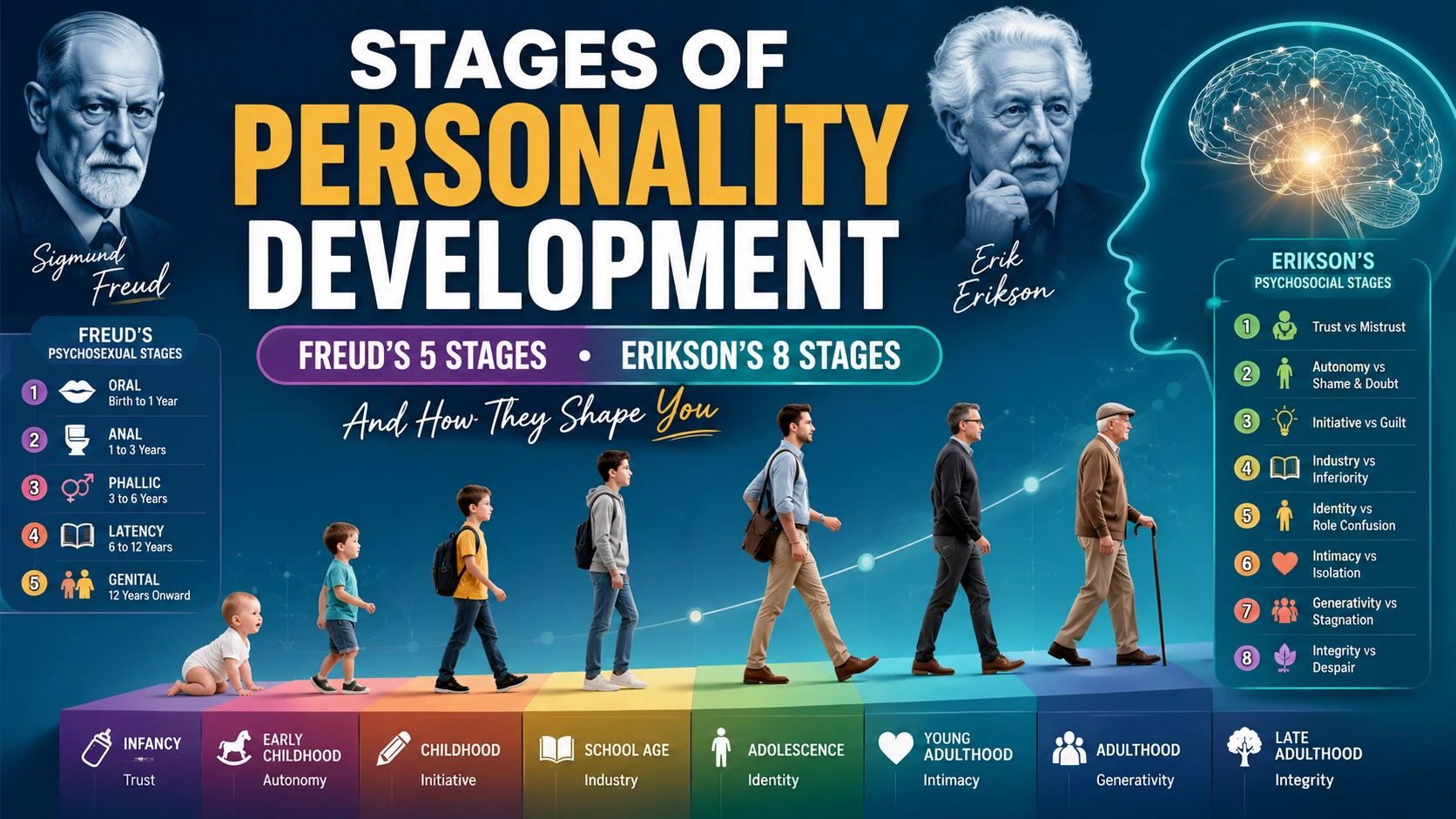
- Sigmund Freud proposed 5 psychosexual stages, focused mainly on childhood.
- Erik Erikson proposed 8 psychosocial stages that cover the entire human lifespan, from infancy to old age.
- According to the APA Dictionary of Psychology, each of Erikson’s stages centers on a conflict that must be resolved for healthy development to continue.
- Research published on NCBI’s StatPearls shows that early development does not lock in your future. Life experiences later on can still reshape unresolved stages.
- Knowing which stage you or someone else is in helps you respond with patience instead of frustration.
What Are the Stages of Personality Development?
Personality does not appear fully formed. It builds up over years, through the stages of personality development, each shaped by a specific challenge you have to work through.
Two psychologists shaped most of what we know about this today. Sigmund Freud looked at early childhood and proposed that personality forms through five stages tied to different parts of the body. Erik Erikson took a wider view. He argued that personality keeps developing throughout your entire life, not just in childhood, through eight stages built around social relationships.
Both theories try to answer the same question. Why do we become who we become? They just look at different pieces of the puzzle.
3 Major Theories at a Glance
Before going deep into each one, here is a quick side-by-side comparison.
| Theory | Proposed By | Number of Stages | Age Range Covered | Main Focus |
|---|---|---|---|---|
| Psychosexual Theory | Sigmund Freud | 5 | Birth to adolescence | Biological drives and body-focused pleasure zones |
| Psychosocial Theory | Erik Erikson | 8 | Birth to old age | Social relationships and identity |
| Simplified Life-Stage Model | Various educators and textbooks | 5 | Birth to adolescence | A broad, easy-to-teach overview of childhood growth |
Freud’s 5 Stages of Personality Development
Sigmund Freud believed that personality forms in childhood through five stages, each centered on a different source of pleasure and conflict. This is the first major theory behind the stages of personality development, and he called it the psychosexual theory. If you want to understand how genetics and Freud’s ideas connect to your traits more broadly, our guide on personality development: a journey from genes to Freud covers that ground well.
Here is a quick look at all five stages before we go deeper into each one:
- Oral Stage — Birth to 1 year
- Anal Stage — 1 to 3 years
- Phallic Stage — 3 to 6 years
- Latency Stage — 6 to 12 years
- Genital Stage — 12 years onward. Getting stuck, or fixated, at any stage could shape adult personality traits later.
Oral Stage (Birth to 1 Year)
The infant’s main source of pleasure is the mouth. Feeding, sucking, and biting are how the baby explores the world and finds comfort.
Freud believed that fixation here could later show up as nail biting, overeating, or excessive dependence on others as an adult.
Anal Stage (1 to 3 Years)
This stage lines up with toilet training. The child’s pleasure and control now center on bowel and bladder control.
Freud proposed that how parents handle this stage matters. Too strict an approach could create an adult who is overly rigid or obsessed with order. Too relaxed an approach could create someone messy and disorganized.
Phallic Stage (3 to 6 Years)
Children start noticing physical differences between boys and girls at this stage. Freud introduced the controversial Oedipus and Electra complex ideas here, describing a child’s attachment to the opposite-sex parent.
This is the most debated and criticized part of Freud’s theory, and modern psychology treats it mostly as historical context rather than an accepted clinical model.
Latency Stage (6 to 12 Years)
Sexual urges go quiet during this stage. Children instead focus their energy on school, friendships, hobbies, and building skills.
This matches closely with what Erikson later called Industry vs Inferiority, just from a different angle.
Genital Stage (12 Years Onward)
Puberty restarts sexual interest, but this time directed outward, toward mature, adult relationships. Freud considered this the final stage, where a person ideally becomes capable of balanced, healthy adult relationships.
Erikson’s 8 Stages of Personality Development
Erik Erikson trained under Freud’s daughter, Anna Freud, but built a very different theory. His version of the stages of personality development argues that personality keeps changing across your whole life, driven by social relationships rather than biological drives alone.
Each stage centers on one specific conflict. Winning that conflict builds a psychological strength Erikson called a virtue. According to the APA Dictionary of Psychology’s entry on Erikson’s eight stages of psychosocial development, each stage must be worked through successfully for healthy personality growth to continue into the next one.
| Stage | Age Range | Core Conflict | Virtue Gained |
|---|---|---|---|
| 1 | Birth to 18 months | Trust vs Mistrust | Hope |
| 2 | 18 months to 3 years | Autonomy vs Shame and Doubt | Will |
| 3 | 3 to 6 years | Initiative vs Guilt | Purpose |
| 4 | 6 to 12 years | Industry vs Inferiority | Competence |
| 5 | 12 to 18 years | Identity vs Role Confusion | Fidelity |
| 6 | 18 to 40 years | Intimacy vs Isolation | Love |
| 7 | 40 to 65 years | Generativity vs Stagnation | Care |
| 8 | 65 years onward | Integrity vs Despair | Wisdom |
Stage 1: Trust vs Mistrust
A newborn depends completely on a caregiver. If that care is steady and reliable, the baby learns the world is safe. If not, mistrust and anxiety take root early.
Stage 2: Autonomy vs Shame and Doubt
Toddlers start testing independence here, from choosing their own clothes to insisting on doing things their own way. Support this, and they build confidence. Shame them for mistakes, and self-doubt creeps in instead.
Stage 3: Initiative vs Guilt
Preschoolers start planning their own games, asking constant questions, and taking the lead in play. Encouraging this builds a sense of purpose. Constant criticism at this age can create lasting guilt around taking initiative.
Stage 4: Industry vs Inferiority
School-age children compare themselves to classmates constantly, in academics, sports, and friendships. Success here builds real competence and confidence. Repeated failure or harsh comparison can create a lasting sense of inferiority.
We have covered this exact stage in far more depth, including research-backed ways to support a child through it, in our guide on Erikson’s stage of Industry vs Inferiority in personality development.
Stage 5: Identity vs Role Confusion
Teenagers try on different identities, friend groups, styles, beliefs, almost like trying on clothes. Erikson believed a strong sense of identity built here becomes the foundation for every adult relationship that follows.
As Erikson put it, “There is no feeling of being alive without a sense of identity.”
Stage 6: Intimacy vs Isolation
Young adults now focus on forming close, committed relationships. Skipping this, or avoiding real closeness, often leads to isolation and loneliness later in life.
Stage 7: Generativity vs Stagnation
Middle-aged adults look for ways to contribute, through parenting, mentoring, or meaningful work. Without this sense of contribution, people can feel stuck or stagnant.
Stage 8: Integrity vs Despair
In later life, people look back and reflect. Those who feel their life had meaning develop integrity and wisdom. Those who feel regret often struggle with despair instead.
Simplified 5 Life-Stage Model
Many schools and textbooks use an easier, broader version of childhood development for quick teaching. It is not tied to one single psychologist. It simply groups the early years into five practical phases.
- Infancy (Birth to 2 Years): Building basic trust and attachment with caregivers.
- Early Childhood (2 to 6 Years): Developing independence, language, and early social skills.
- Late Childhood (6 to 12 Years): Building confidence through school, friendships, and skill mastery.
- Adolescence (12 to 18 Years): Exploring identity, values, and peer relationships.
- Adulthood (18 Years Onward): Applying and refining personality through work, relationships, and life choices.
This model is useful for a quick overview. For real depth, Freud’s and Erikson’s full theories still explain far more.
Freud vs Erikson: What Is the Real Difference?
People often confuse these two theories because both talk about childhood stages. Here is the real difference.
| Point of Comparison | Freud | Erikson |
|---|---|---|
| Number of stages | 5 | 8 |
| Age range | Birth to adolescence only | Birth to old age |
| Driving force | Biological, body-focused drives | Social relationships and identity |
| Scientific standing today | Largely historical, many ideas disputed | Still widely used in psychology and education |
| Best used for | Understanding Freud’s historical influence | Practical, real-world personal development |
Which Theory Should You Actually Use?
If you are a student preparing for an exam, you need both, since most syllabi cover Freud and Erikson side by side.
If you are trying to understand your own personality or support a child’s growth, Erikson’s model is far more useful. It covers a longer stretch of life, it is less controversial, and it maps directly onto real situations like school pressure, teenage identity struggles, or a midlife career change.
A 2026 clinical review published on NCBI’s StatPearls platform on Erikson’s stages of psychosocial development notes something reassuring. Early identity struggles do not lock in your future. People who struggled with intimacy or purpose in early adulthood can still catch up later, through new relationships, parenting, or meaningful community involvement.
In simple words, you are not stuck just because one of the stages of personality development did not go well the first time.
Download the Free Cheat Sheet
Want a quick printable reference? [Download the Stages of Personality Development Cheat Sheet (PDF)] and keep both theories handy for quick revision.
Stages of Personality Development for Class 12 Students
If you are studying Class 12 Psychology, this exact topic appears in your NCERT chapter on Self and Personality. Here is what you need to remember for your exam.
- Freud’s theory is called the psychosexual theory of personality development, with 5 stages: oral, anal, phallic, latency, and genital.
- Erikson’s theory is called the psychosocial theory of development, with 8 stages built around social conflicts, not biological drives.
- Erikson is grouped under Neo-Freudian theories, along with Carl Jung, Alfred Adler, Karen Horney, and Erich Fromm, since they all built on and moved beyond Freud’s original ideas.
- A common exam question asks you to compare Freud and Erikson directly. Use the comparison table above as your quick revision aid.
How This Helps Your Own Personal Growth
Knowing these stages is not just theory for a test. Rohan, whose story about a missed promotion we shared in an earlier guide, later realized his own struggle with speaking up at work traced back to a shaky Identity vs Role Confusion stage during his teenage years. He had never fully worked through it. Once he saw that pattern, he stopped blaming his personality and started actively working on it instead.
This is exactly why learning the stages of personality development matters. You are not fixed. You are a work in progress, one stage at a time.
If you want a complete, practical roadmap covering self-awareness, communication, emotional intelligence, and every skill that builds on top of these childhood stages, read our complete guide to personality development.
For a deeper look at how early experiences specifically shape adult behavior, our guide on how childhood experiences shape personality development is a strong next read.
Final Thoughts
Meera’s son will hit new stages every few years. So will you, whether you notice it or not.
The value in these theories is not memorizing names and ages. It is recognizing the pattern. Every stage is a chance to build something: trust, confidence, purpose, or identity. And every stage you missed earlier can still be revisited later.
Want to keep building from here? Explore our complete personality development guide for the full roadmap, one skill at a time.
FAQs
What are the 5 stages of personality development?
There are two common answers. Freud’s 5 psychosexual stages are oral, anal, phallic, latency, and genital. A separate, simplified model used in many schools breaks childhood into infancy, early childhood, late childhood, adolescence, and adulthood.
What are the 8 stages of personality development?
These come from Erik Erikson’s psychosocial theory: Trust vs Mistrust, Autonomy vs Shame and Doubt, Initiative vs Guilt, Industry vs Inferiority, Identity vs Role Confusion, Intimacy vs Isolation, Generativity vs Stagnation, and Integrity vs Despair.
What are Freud’s three components of personality?
Separate from his 5 stages, Freud also proposed that personality is made up of three parts: the id, driven by instinct and desire, the ego, which deals with reality, and the superego, which holds our sense of morals and values.
Which of Erikson’s 8 stages is considered most important?
Many psychologists point to Identity vs Role Confusion, the teenage stage, as especially important, since a stable identity built here directly shapes how well a person handles intimacy, purpose, and reflection in every stage that follows.
What is the correct order of Freud’s stages?
The correct order is oral, anal, phallic, latency, and genital, moving from birth through adolescence.

Ayanshi is the founder of PersonaGuru.in, a blog dedicated to personality development, relationships, and mental health. With 3+ years of writing experience and 250+ published articles, she simplifies psychology into practical, everyday advice for real people.