
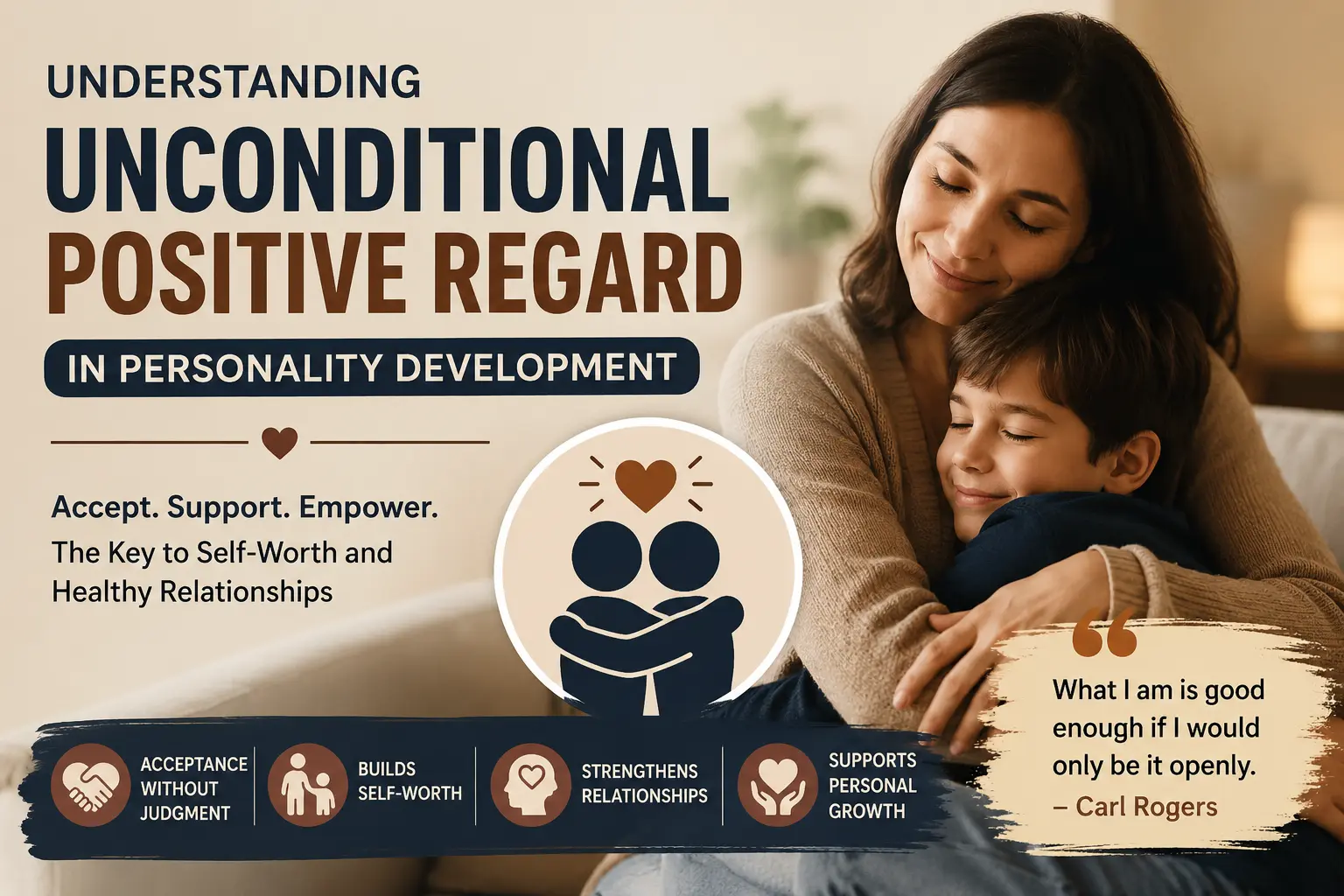
Have you ever felt loved only when you did everything right? That feeling has a name in psychology. Understanding it can change how you raise your children, treat your partner, and talk to yourself.
Unconditional positive regard in personality development is the practice of accepting a person completely, without judgment, no matter what they say, feel, or do. Carl Rogers, the psychologist who introduced this idea in 1957, believed it was one of the strongest forces behind a healthy, confident personality.
This article breaks down what it means, where it comes from, and how you can use it in real life. No jargon. Just clear explanations and real examples.
Key Takeaways
- Unconditional positive regard means accepting someone fully, without conditions attached to their behavior.
- Carl Rogers introduced the concept in 1957 as part of his person-centered therapy.
- It plays a major role in building self-worth, especially during childhood.
- It is not the same as unconditional love or blind approval.
- You can practice it in parenting, relationships, friendships, and even with yourself.
What Is Unconditional Positive Regard? (Meaning and Definition)
Unconditional positive regard means accepting and valuing a person exactly as they are. Their mistakes, flaws, and bad days do not change how much they are respected or cared for.
The American Psychological Association describes it as a core condition of humanistic and person-centered therapy. In this approach, the client feels valued regardless of what they share. It is not about approving every action. It is about separating the person from the behavior.
Think of it this way. You can feel disappointed in what someone did. You can still hold onto the belief that they matter as a human being. That combination is unconditional positive regard in action.
Who Introduced Unconditional Positive Regard?
Carl Rogers, an American psychologist and one of the founders of humanistic psychology, introduced unconditional positive regard in his 1957 paper on the conditions needed for personality change. He argued that judged or conditionally accepted people build walls. Unconditionally accepted people open up and grow instead.
This is the answer many psychology students look for when they see the question, “Who emphasized the importance of unconditional positive regard in healthy personality development?” The answer is Carl Rogers.
Carl Rogers’ Three Core Conditions for Personality Change
Rogers believed three conditions, present together, create the right setting for a person to change and grow.
- Unconditional Positive Regard. Complete acceptance without judgment.
- Genuineness (Congruence). Being real and honest, not hiding behind a mask.
- Empathy. Understanding what someone feels from their own point of view.
Rogers once wrote, “The curious paradox is that when I accept myself just as I am, then I can change.” That single line captures the heart of his theory.
Benefits of Unconditional Positive Regard in Personality Development
Personality does not form in isolation. It is shaped by the people around us, especially during childhood. Unconditional positive regard is one of the strongest influences on how a person’s self-concept develops.
Conditions of Worth vs Unconditional Acceptance
Rogers used the term “conditions of worth” for what happens when love or approval comes with strings attached. A child praised only for good grades, good behavior, or good looks starts to believe their worth depends on performance.
Over time, this creates a gap between who they really are and who they think they need to be to stay loved. Rogers called this incongruence. He believed it sat at the root of many emotional struggles later in life.
Unconditional acceptance removes those strings. It tells a child, and later an adult, “You are enough, even on your worst day.” In the following sections, you’ll learn why unconditional positive regard in personality development matters and how to apply it in everyday life.
How Childhood Acceptance Builds Self-Worth
A 2019 meta-analysis in the Journal of Child and Family Studies reviewed more than 100 studies on parenting and self-esteem. It found a clear pattern. Children raised with warmth, acceptance, and steady support showed stronger self-esteem than children raised with strict, conditional, or neglectful parenting. A child’s self-worth is strongly shaped by early experiences, as explained in how childhood experiences shape personality development.
Take Kavya, a mother of two in Bengaluru. She noticed something simple. Whenever she corrected her son’s behavior without adding lines like “you always mess things up,” he recovered from mistakes faster. He also opened up about problems instead of hiding them. That is unconditional positive regard working in a real home, not just in a textbook.
What Happens Without Unconditional Positive Regard
Without it, people often grow up chasing approval instead of building genuine self-worth. This can surface later as people pleasing, fear of failure, or a nagging feeling of never being good enough. If this sounds familiar, our guide on how to overcome an inferiority complex breaks down practical steps to rebuild that lost sense of worth.
Is Unconditional Positive Regard the Same as Unconditional Love?
No, and this is one of the most common mix-ups. Unconditional love is a feeling. Unconditional positive regard is an attitude and a practice, most often discussed in therapy, parenting, and personal growth.
You can love someone unconditionally and still feel disappointed by their choices. Unconditional positive regard simply means your basic acceptance of them as a person does not disappear, even when you disagree with what they did.
It also does not mean approving of harmful behavior or ignoring boundaries. A parent practicing unconditional positive regard can still say no, set limits, and hold their child accountable. The child’s sense of being loved just stays intact through it.
Real Life Examples of Unconditional Positive Regard
Theory is easier to grasp with real situations. Here are a few everyday examples.
In Parenting
Aryan, a father in Chennai, once caught his teenage daughter lying about where she had been. He avoided saying, “You always lie; I cannot trust you.” Instead, he said, “I am upset about the lying, but I still love you and want to understand why.” That response addressed the behavior without attacking her worth as a person.
In Relationships
Naina’s partner once lost a big project at work and felt like a failure. She avoided listing what went wrong. She simply said, “This does not change how I see you.” That one sentence gave him space to process the setback instead of spiraling into shame.
In Friendships and at Work
A manager named Kabir once told his team member, “This report needs work, but I know you are capable of better.” That is unconditional positive regard in a workplace. The feedback stays honest while the employee’s sense of competence stays intact.
Unconditional Positive Regard in Counselling and Therapy
Unconditional positive regard is a foundation of person-centred therapy, an approach developed by Carl Rogers. In this method, the therapist avoids judging the client’s choices, feelings, or past actions.
This builds a safe space where clients feel comfortable sharing things they might otherwise hide out of fear or shame. According to Rogers, this safety often allows real healing and self-understanding to begin.
Many other therapy styles, including some forms of cognitive behavioral therapy, now borrow this principle even where it is not their central technique.
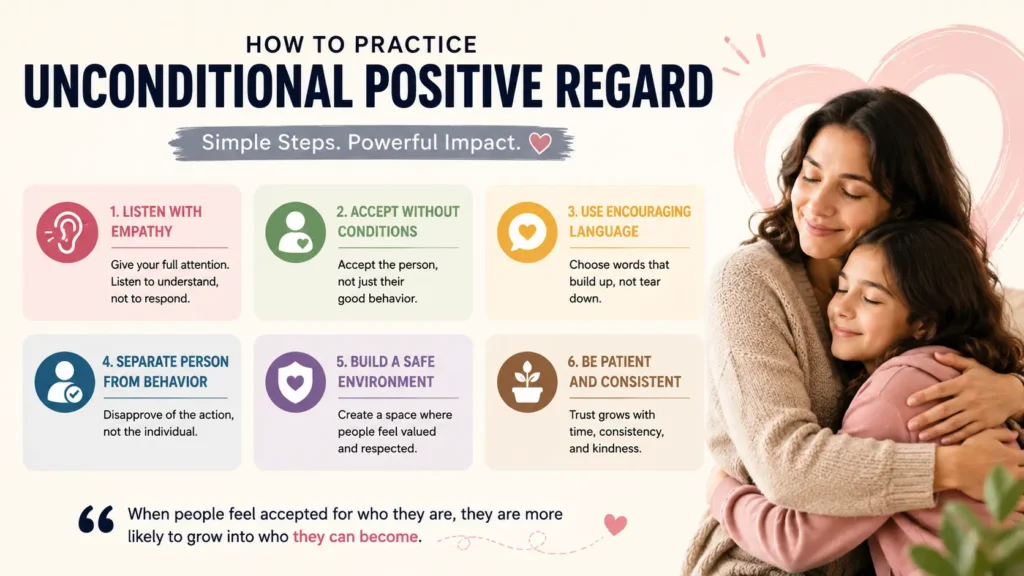
How to Practice Unconditional Positive Regard
You do not need to be a therapist to use this in daily life. Here are five practical ways to build the habit.
| Technique | What It Looks Like |
|---|---|
| Separate the person from the behavior | Say “this choice was not okay” instead of “you are a bad person” |
| Give specific, honest praise | Point out exact effort or actions, not vague flattery |
| Focus on feelings first | Ask “how do you feel about this” before jumping to advice |
| Respect their right to choose | Offer guidance, but let them own the final decision |
| Practice it on yourself | Replace self-criticism with self-acceptance after a mistake |
Start with one technique this week. Most people notice a shift in how open their children, partners, or friends become within a few conversations.
📥 Download: Download Free Unconditional Positive Regard Worksheet
Criticisms of Unconditional Positive Regard
Not every psychologist agrees this approach works in every situation. A few common criticisms include the following.
- Some behaviorists argue that acceptance without any consequences could unintentionally reinforce harmful behavior.
- Critics point out that true unconditional positive regard is hard for any human to sustain, since personal bias and frustration naturally creep in.
- In clinical settings, some argue it works better alongside clear boundaries rather than as a standalone approach.
Rogers himself called it an ideal to work toward, not something any therapist or parent could achieve perfectly, every single time.
Final Thought
Unconditional positive regard is not about ignoring problems or pretending everything is fine. It is about making sure a person’s worth never becomes a bargaining chip.
Whether you are raising a child, supporting a partner, or trying to be kinder to yourself, practicing unconditional positive regard in personality development can transform relationships and strengthen self-worth over time. The idea is simple: separate the person from their mistakes, not their worth. Living by this principle consistently takes patience, but the long-term impact on healthy personality growth is significant.
As Rogers put it, “What I am is good enough if I would only be it openly.” That is the true message behind unconditional positive regard in personality development. It encourages us to accept ourselves and others with empathy while still supporting growth and positive change.
If you want to build a stronger foundation of self-acceptance, our guide on how to find yourself when you feel lost is a good next read.
Frequently Asked Questions
1. Who emphasized the importance of unconditional positive regard in healthy personality development?
Carl Rogers, the founder of person-centered therapy, emphasized unconditional positive regard as essential for healthy personality development. His 1957 paper laid out three conditions for growth:
1. Unconditional positive regard
2. Genuineness
3. Empathy
2. What are Carl Rogers’ three core conditions?
Rogers listed three conditions that work together to support personality change:
1. Unconditional positive regard, or full acceptance without judgment
2. Genuineness, or being honest and real with the other person
3. Empathy, or understanding their experience from their side
3. Is unconditional positive regard the same as unconditional love?
No. Although the two concepts are closely related, they are not the same. Unconditional love is an emotional feeling of caring for someone regardless of their flaws or mistakes. Unconditional positive regard, on the other hand, is an attitude of accepting and respecting a person’s worth without judging them. It is most commonly discussed in person-centered therapy, parenting, education, and personal development. In simple terms, you can love someone unconditionally, but unconditional positive regard focuses on showing acceptance and respect through your words, actions, and behavior, even when you disagree with their choices.
4. What is an example of unconditional positive regard?
A parent who disagrees with a child’s choice but still says “I love you and I am here for you” is showing unconditional positive regard. The same idea applies to a manager who gives honest feedback while still affirming an employee’s worth.
5. Which therapeutic approach is associated with unconditional positive regard?
Person-centered therapy, developed by Carl Rogers, is the therapeutic approach most closely linked to this concept. It remains a core idea in humanistic psychology today.

Ayanshi is the founder of PersonaGuru.in, a blog focused on personality development, career, relationships, and mental well-being. With over 3 years of writing experience, she turns psychology and everyday experiences into practical, easy-to-understand advice for real life.