
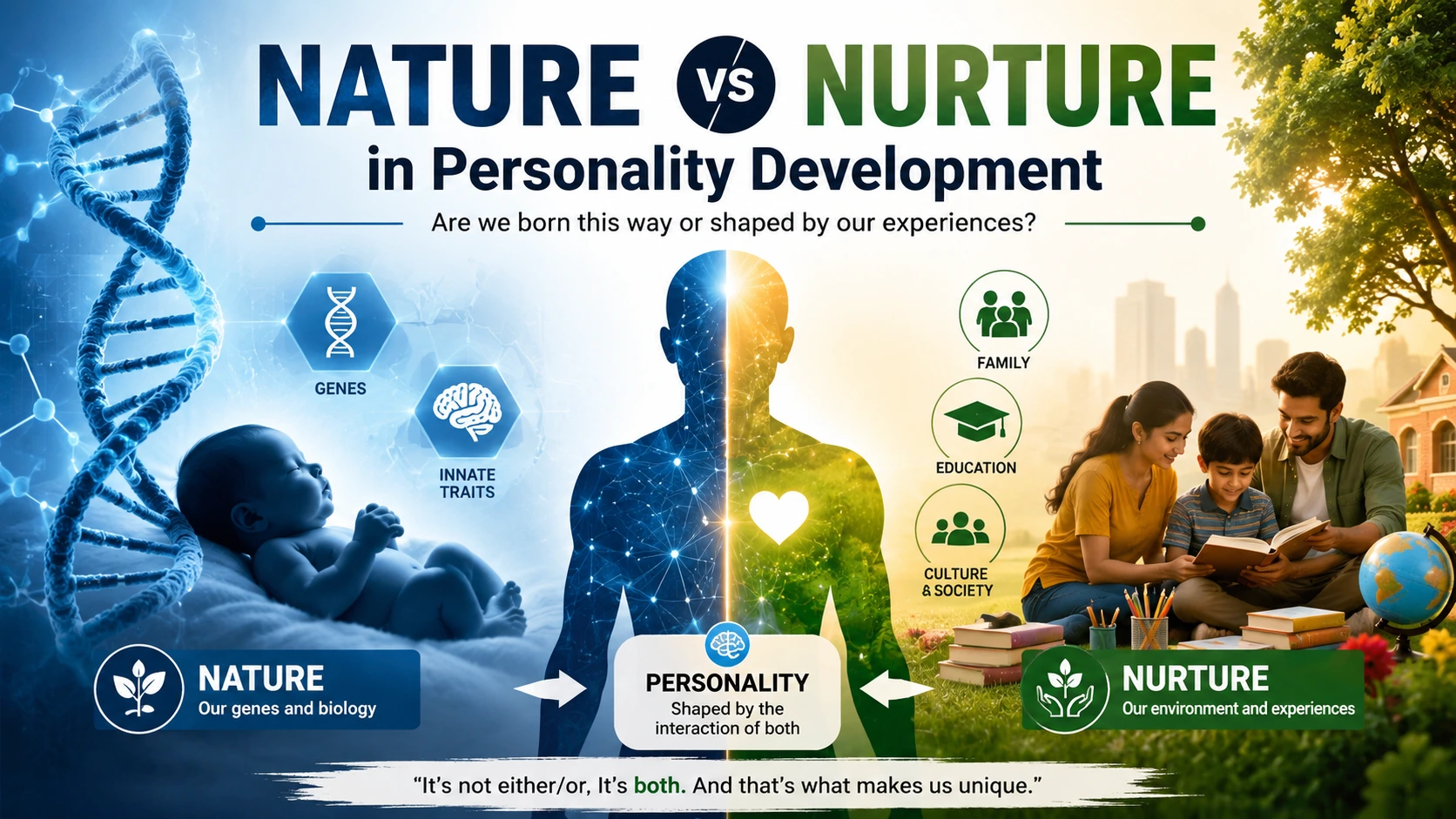
Are you the way you are because of your genes? Or because of how you were raised? This question has divided psychologists for more than a century.
The nature vs nurture debate in personality development looks at how much of who we are comes from biology, and how much comes from our environment. Nature covers your genes and inherited traits. Nurture covers your upbringing, culture, and life experiences. Modern research shows both work together.
This guide breaks down the nature vs nurture debate in personality development in plain language. You will find the science, the key theories, real examples, and a quick section for students preparing for exams.
Key Takeaways
- The nature vs nurture debate in personality development asks how much of personality comes from genetics versus environment.
- Twin studies suggest genetics account for roughly 40 to 60 percent of major personality traits.
- Locke, Chomsky, Skinner, and Bandura each took different sides of this debate.
- Modern psychology favors interactionism. Genes and environment shape each other.
- Epigenetics shows that environment can switch certain genes on or off.
What Is the Nature vs Nurture Debate in Personality Development?
The nature vs nurture debate in personality development is the long-running question of whether our traits and character come from biology or from life experience. It is one of the oldest debates in psychology.
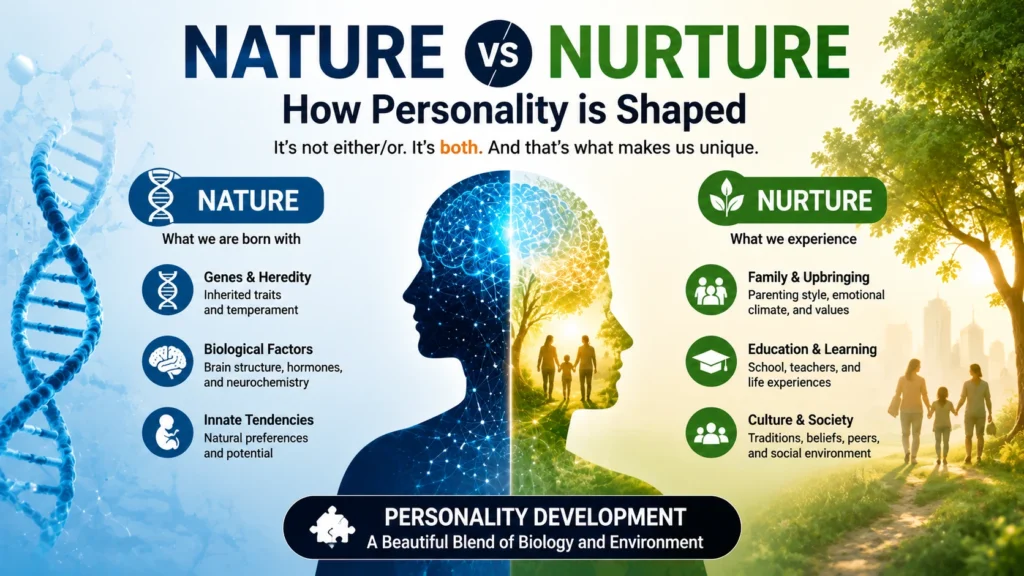
Nature refers to what you are born with. This includes your genetic code and inherited temperament. Nurture refers to everything you learn after birth. This includes parenting, culture, education, and relationships.
Most psychologists today reject a strict either-or answer. Personality is the product of a constant back and forth between biology and environment. You can read more about this exact process in our piece on the genetic roots of personality development, which traces how genes and early psychology theories connect.
The Nature Side: Biological and Genetic Influences
The nature vs nurture debate in psychology has long examined whether personality is shaped more by biology or life experiences. Nature supporters are sometimes called nativists. They argue that personality is largely hardwired from birth.
What Twin Studies Reveal About Personality
Twin studies are strong evidence for the nature side. Researchers compare identical twins with fraternal twins. Identical twins share nearly all their genes. Fraternal twins share about half.
Psychologist Thomas Bouchard studied twins raised apart for decades. His research found that identical twins raised apart often show strikingly similar personality traits. Across several studies on the Big Five personality traits, genetics are estimated to account for roughly 40 to 60 percent of the variation between people.
That leaves a large share of personality shaped by environment. This brings us to the other side of the debate.
The Nurture Side: Environmental and Social Influences
Nurture supporters are often called empiricists. They argue that we are born as a blank slate. Every trait and habit is shaped by what happens after birth.
Parenting Styles and Family Environment
Family is usually the first environmental influence on personality. A child raised in a warm home tends to develop stronger self-esteem than a child raised in a harsh one.
Meher, a schoolteacher in Kolkata, saw this play out with her own two children. Both grew up in the same house with the same rules. But her elder child received more patience during his early tantrums. He grew into a calmer teenager. Her younger child was often compared to his brother. He grew up more anxious and less confident. Same home, different emotional experience inside it.
Our guide on how childhood experiences shape personality development goes deeper into this pattern, with more real cases like Meher’s family.
Culture, Peers, and Socioeconomic Status
Culture teaches us whether to value independence or group harmony. Peer groups shape confidence and communication style, especially during the teenage years. Socioeconomic status affects the opportunities and stability a child grows up with.
Peer influence also shapes traits like assertiveness. If you want to see how, our article on factors affecting assertiveness in personality development breaks this down further.
What Did Famous Psychologists Say About Nature vs Nurture?
Some of the biggest names in psychology built entire theories around one side of this debate.
John Locke and the Blank Slate Theory
John Locke was a 17th-century philosopher. He argued that the human mind begins as a blank slate, or tabula rasa. According to Locke, we are not born with fixed character traits. Experience writes everything we become.
Chomsky vs Skinner on Language and Behavior
This is one of the most famous arguments in psychology. Noam Chomsky argued that humans are born with an innate capacity for language. He called this universal grammar. He believed this proved that some abilities are hardwired into the brain.
B.F. Skinner took the opposite position. As a behaviorist, he argued that language and behavior are learned entirely through environmental reinforcement. In his view, we repeat what gets rewarded and avoid what gets punished.
Albert Bandura’s Social Learning Theory
Albert Bandura leaned toward nurture, with an important twist. His famous Bobo doll experiment showed that children learn aggressive behavior simply by watching adults act aggressively. This proved that personality traits can be picked up through observation alone.
Bandura once said, “Learning would be exceedingly laborious, not to mention hazardous, if people had to rely solely on the effects of their own actions.” His work remains one of the strongest arguments for the power of nurture.
How Do Nature and Nurture Actually Interact in Personality Development?
Most modern psychologists have moved past a strict either-or argument. Instead, they study how nature and nurture constantly interact. This view is called interactionism.
What Is Epigenetics?
Epigenetics is the study of how the environment can switch certain genes on or off. This happens without changing the genetic code itself. A person can be genetically prone to anxiety. But a stable, supportive upbringing can prevent that gene from fully expressing itself.
This is one of the most important discoveries in modern psychology. It shows that nature and nurture are not separate forces. They work through each other.
A Real Example: Genes, Environment, and Behavior
Psychologist Avshalom Caspi led a well-known 2003 study on this exact interaction. His team found that a gene variant called MAOA was linked to higher aggression in adulthood. But this link only held for people who had also faced childhood maltreatment.
People with the same gene who grew up in safe homes did not show the same pattern. The gene alone did not cause the outcome. Gene plus harsh environment created it.
What Are Real Life Examples of the Nature vs Nurture Debate?
Theory becomes clearer with everyday situations. Here are a few nature vs nurture examples in personality development:
| Situation | Nature Explanation | Nurture Explanation |
|---|---|---|
| A shy child in a loud, outgoing family | Inherited a quieter temperament | Learned to stay reserved around dominant personalities |
| A naturally anxious teenager who becomes confident | Genetic tendency toward anxiety | Supportive coaching and small wins built confidence over time |
| Two siblings with very different tempers | Different inherited baseline reactivity | Different treatment or birth order roles at home |
Rehan, a father in Jaipur, says his son “came out stubborn from day one.” His wife disagrees. She believes constantly giving in to the toddler’s demands is what built the stubborn streak. Both are partly right. That is the whole point of this debate.
Which Traits in You Are Nature, and Which Are Nurture?
Reading about Rehan’s stubborn toddler or Meher’s two children probably made you think of your own traits. Before you move on, take a few minutes to trace your own patterns.
Download the free Nature vs Nurture Self-Assessment Worksheet. Track ten common traits, reflect with four guided questions, and use the quick-reference table of Locke, Chomsky, Skinner, Bandura, Bouchard, and Caspi to see which theory matches your own experience.
What Are the Main Debates in Developmental Psychology?
Nature versus nurture is one of four classic debates that shape how psychologists study development.
- Nature vs Nurture. Is development driven by biology or environment?
- Continuity vs Discontinuity. Does development happen gradually, or in distinct stages? This connects to stage theories such as Erikson’s stage of industry versus inferiority, which marks a clear developmental turning point in childhood.
- Stability vs Change. Do early traits stay fixed for life, or can personality change with age?
- Active vs Passive. Do we actively shape our own development, or are we shaped mainly by outside forces?
Nature versus nurture remains the most discussed of the four. It touches every other debate in some way.
Nature vs Nurture for Students: Class 12, IGNOU, and Competitive Exams
If you are studying the nature vs nurture debate in personality development for Class 12 Psychology, IGNOU coursework, or a competitive exam, here is a quick revision-friendly summary.
Arguments supporting nature:
- Twin and adoption studies show strong genetic influence on personality traits
- Some temperaments appear from early infancy, before much environmental input
- Certain abilities, such as language acquisition, may have an innate biological basis
Arguments supporting nurture:
- Parenting style strongly predicts self-esteem and emotional regulation
- Cultural upbringing shapes values, communication style, and behavior
- Social learning theory shows behavior can be picked up through observation alone
Exam-ready one-line answer: Personality development is best explained by an interaction between nature and nurture, not by either factor alone.
Final Thought
The nature vs nurture debate in personality development is no longer about picking a side. It is about understanding how biology and environment work together.
Your genes hand you a starting point. This includes your temperament, sensitivity, and baseline mood. How you are raised decides how that starting point grows. So do the people around you and the experiences you go through.
If you want a broader map of everything that shapes who you are, our guide on the key aspects of personality development is a good next stop. You can also explore how much control you feel over your own life in our article on locus of control in personality development, which builds directly on the ideas covered here.
FAQs
1. Do psychologists believe in nature or nurture, or both?
Most modern psychologists support an interactionist view. They believe personality comes from a constant interplay between genetics and environment, not from one factor alone.
2. Does nature or nurture affect IQ more?
Research suggests both matter, though their weight shifts with age. Genetic influence on intelligence tends to become clearer in adulthood. Early childhood environment plays a larger role in a young child’s cognitive growth.
3. Which plays a stronger role in shaping personality, nature or nurture?
Neither factor works alone. Genetics may set a baseline for traits such as temperament. Environment shapes how those traits are expressed, regulated, and lived out day to day.
4. What is an example of the nature vs nurture debate in real life?
Two siblings raised in the same home who develop very different personalities is a classic example. Their shared genetics represent nature. Their different experiences within that same household represent nurture.

Ayanshi is the founder of PersonaGuru.in, a blog focused on personality development, career, relationships, and mental well-being. With over 3 years of writing experience, she turns psychology and everyday experiences into practical, easy-to-understand advice for real life.