
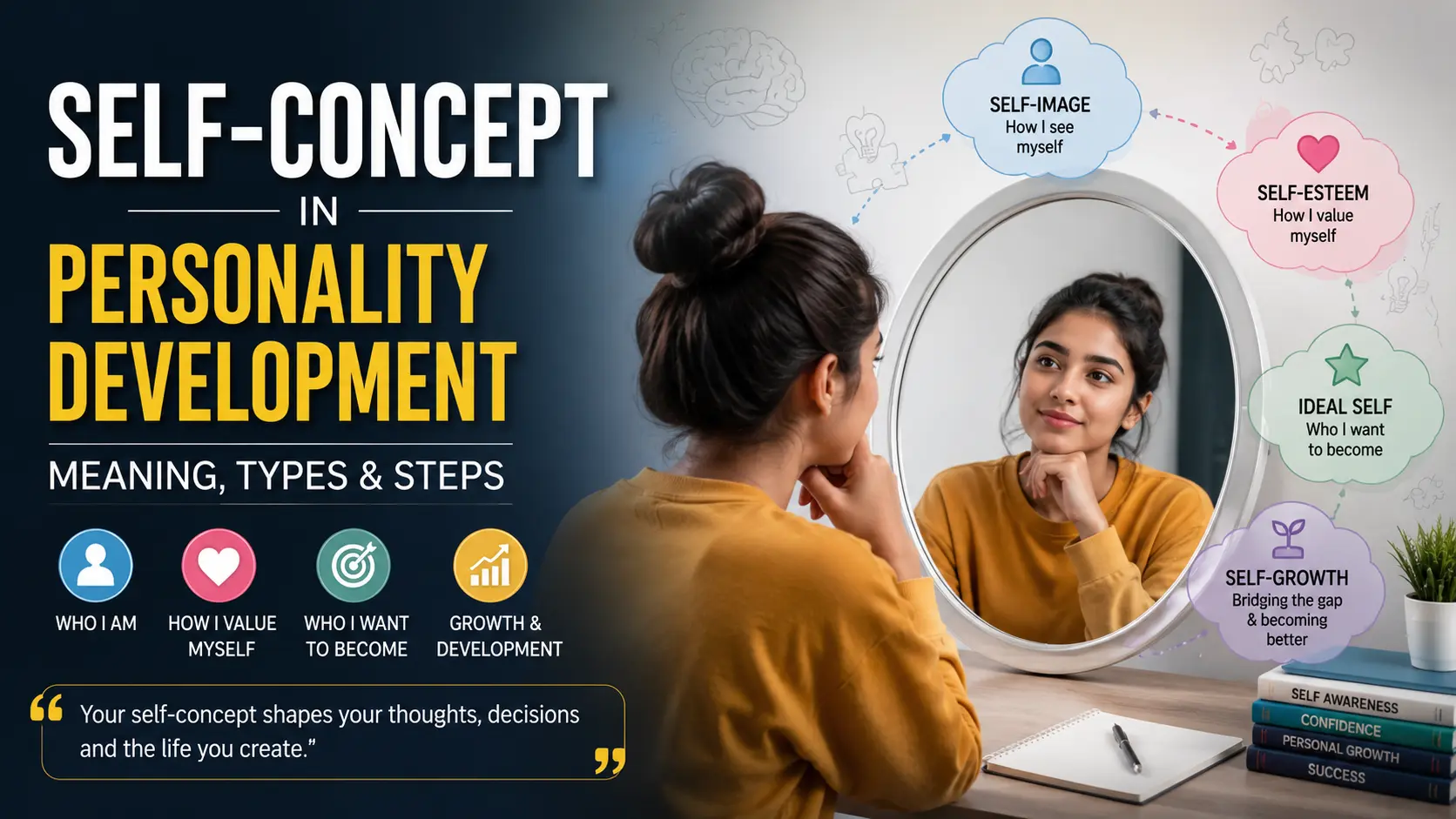
Ask yourself a simple question. Who am I?
Your answer says a lot about your self-concept in personality development. It is not just a psychology term from a textbook. It is the quiet voice inside your head that decides how confident you feel, how you handle criticism, and how far you push yourself.
Priya, a 24-year-old marketing executive from Pune, once told me she avoided every promotion interview for two years. Not because she lacked skill. She simply believed she was “not leadership material.” That belief was her self-concept talking, and it was holding her back more than her resume ever could.
This guide breaks down what self-concept in personality development really means, how it forms, and how you can reshape it, using real research and practical steps you can start today.
Key Takeaways
- Self-concept in personality development is your overall belief about who you are, built from self-image, self-esteem, and your ideal self.
- Carl Rogers, the founder of humanistic psychology, linked self-concept directly to personality development through his theory of congruence.
- A healthy self-concept improves decision-making, relationships, and career growth.
- Self-concept keeps changing across childhood, adolescence, and adulthood. It is never fixed.
- Small daily habits, not big overnight changes, rebuild a weak self-concept.
What Is Self-Concept in Personality Development?
Self-concept in personality development is the complete picture you hold of yourself. It includes your beliefs about your abilities, your personality traits, your social roles, and your values.
Psychologist Roy Baumeister described it simply. He called it a person’s belief about their own attributes and about who and what the self actually is.
In personality development, self-concept works as an internal blueprint. It shapes how you speak in a meeting, how you react to failure, and how you introduce yourself to strangers. If your self-concept is strong, your personality tends to feel stable and grounded. If it is shaky, your personality can feel inconsistent, one day confident and the next day full of doubt.
Self-concept is not something you are born with. It is learned through experience, feedback, and reflection, and it keeps evolving your entire life.
Carl Rogers’ Theory of Self-Concept
Carl Rogers, the psychologist behind client-centered therapy, gave one of the most influential theories on self-concept in personality development. He argued that personality forms around three connected parts.
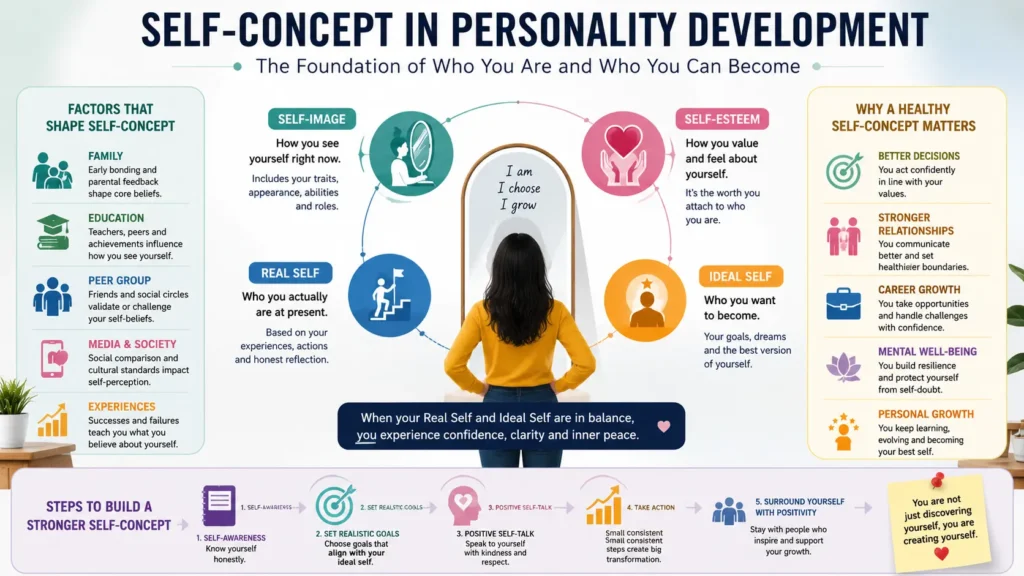
3 Core Components (Self-Image, Self-Esteem, Ideal Self)
1. Self-Image
Self-image is how you see yourself right now. It covers your physical appearance, your skills, and the roles you play, such as daughter, manager, or friend.
Self-image does not always match reality. A person can be genuinely talented at public speaking yet still see themselves as awkward and nervous.
2. Self-Esteem
Self-esteem is the value you place on yourself. It answers a different question than self-image. Self-image asks “who am I,” while self-esteem asks “how do I feel about who I am.”
A software engineer might have a clear self-image of being detail-oriented, but low self-esteem could still make them dismiss their own work as average.
3. Ideal Self
Ideal self is the person you want to become. It includes your goals, your ambitions, and the qualities you admire and hope to build.
Rogers believed that personal growth happens when the gap between your current self-image and your ideal self starts to shrink. This gap is the single biggest factor behind how self-concept in personality development changes over time.
Congruence vs Incongruence (The Key to Growth)
When your self-image and your ideal self are closely aligned, Rogers called this congruence. It brings peace of mind and confidence.
When the gap is wide, it is called incongruence. This usually shows up as anxiety, low self-worth, or constant self-criticism. Managing this gap well is the practical core of self-concept in personality development.
“The good life is a process, not a state of being. It is a direction, not a destination.” Carl Rogers
This single idea captures the entire philosophy behind healthy self-concept. It is not about reaching a fixed, perfect self. It is about the ongoing work of aligning who you are with who you want to be.
Self-Concept vs Self-Esteem vs Self-Image
People often use these three words as if they mean the same thing. They do not. Here is a clear comparison.
| Term | What It Means | Simple Example |
|---|---|---|
| Self-Concept | Your complete, overall belief about who you are | “I am a hardworking, introverted person who is good with numbers” |
| Self Image | How you currently see your traits and appearance | “I see myself as overweight, even though my friends disagree” |
| Self Esteem | How much you value or approve of yourself | “I feel proud of the person I have become” |
| Ideal Self | The person you hope to become in the future | “I want to become a confident public speaker” |
Understanding this difference matters. You cannot fix low self-esteem by changing your self-image alone. Real change in personality development needs work on all three fronts together. This distinction is central to understanding self-concept in personality development correctly.
4 Main Types of Self-Concept
Self-concept is not a single block. Psychologists usually break it into a few working types.
1. Real Self
Your real self is who you actually are right now, based on honest self-reflection rather than assumptions.
2. Ideal Self
Your ideal self is who you want to become. It includes the goals and qualities you are working toward.
3. Social Self
Your social self is how you behave and present yourself in front of others, such as at work or with friends.
4. Physical Self
Your physical self is how you view your body, health, and appearance.
Most people carry all four at once, and friction between them is completely normal. The goal is not to erase the gaps. The goal is to notice them and slowly close the ones that matter most. These four types work together to shape self-concept in personality development throughout your life.
How Self-Concept Develops Across Life Stages
Self-concept in personality development does not appear overnight. It builds in stages.
Early Childhood
Infants begin developing a basic sense of self as early as a few months old, when they realize they exist separately from the world around them. By age two or three, most toddlers can use the word “me” and start forming simple preferences.
Middle Childhood
Between roughly age seven and eleven, children start comparing themselves to classmates and siblings. This is when academic self-concept, meaning how a child sees their own ability to learn, starts forming strongly. Children who receive encouraging feedback from parents and teachers during this stage usually build a steadier self-concept later in life.
Adolescence
Adolescence is where self-concept development speeds up the most. Teenagers experiment with identity, compare themselves constantly to peers, and become highly sensitive to social approval. This is a key reason self-concept in personality development is taught in depth in the NCERT Class 12 Psychology curriculum, since Indian students study Rogers’ theory closely during board exam preparation.
Adulthood
In adulthood, self-concept becomes more stable but never fully fixed. Career milestones, relationships, and even health changes can reshape how a person sees themselves well into their 40s, 50s, and beyond.
Why Self-Concept Matters in Personality Development
A strong self-concept affects far more areas of life than most people realize. This section breaks down why self-concept in personality development deserves your daily attention.
- Decision Making: People with a clear self-concept make faster, more confident choices because they already know their values.
- Relationships: A healthy self-concept reduces neediness and people-pleasing in friendships and romantic relationships.
- Career Growth: Employees with a positive self-concept are more likely to ask for raises, apply for promotions, and handle feedback without spiraling.
- Mental Health: A stable self-concept acts as a buffer against anxiety and chronic self-doubt.
Recent research backs this connection between digital habits and self-concept. A 2026 study published in the journal Healthcare found a small but measurable negative link between daily social media use and adult self-esteem, even after accounting for age and gender differences. A separate university study of over 400 students found that more than 22 percent showed low self-esteem, and over half showed only moderate self-esteem, alongside high rates of social media dependence.
This tells us something practical. In 2026, protecting your self-concept means paying attention to your screen habits, not just your inner thoughts.
Signs of a Positive vs Negative Self-Concept
It helps to spot these patterns in daily behavior, not just in theory. Recognizing these signs early makes self-concept in personality development far easier to manage.
Signs of a healthy self-concept:
- Accepting compliments without deflecting them
- Admitting mistakes without spiraling into shame
- Setting boundaries without guilt
- Comparing yourself to your own past, not to strangers online
Signs of a negative self-concept:
- Constant self-criticism, even after small mistakes
- Difficulty naming your own strengths
- Seeking excessive validation from others
- Avoiding challenges out of fear of failure
Rahul, a 19-year-old first-year college student, once described his self-concept as “whatever the last person said about me.” That single sentence explained his constant mood swings after every conversation. Recognizing this pattern was the first step toward change for him.
How to Improve Your Self-Concept
Building a healthier self-concept is not about affirmations in the mirror. It is about consistent, honest practice. These steps build a stronger self-concept in personality development over time.
- Start a short daily journal. Write three things you handled well that day, however small.
- Separate feedback from identity. A criticized project is not proof that you are a failure.
- Track your real self honestly. List five traits you actually have, based on evidence, not assumptions.
- Shrink the ideal self gap gradually. Pick one specific skill linked to your ideal self and practice it weekly.
- Limit passive social media scrolling. Replace comparison scrolling with content that teaches or inspires you.
- Surround yourself with honest, supportive people. Rogers called this unconditional positive regard, and it directly strengthens congruence between self-image and ideal self.
None of these steps require perfection. Self-concept in personality development grows the same way personality grows, through small, repeated actions over months, not through one dramatic change.
Self-Concept Self-Check Worksheet
To make this practical, use this simple three-question check every week. This worksheet is one of the fastest ways to strengthen self-concept in personality development every week.
- How did I actually behave this week? (Real self)
- How did I want to behave? (Ideal self)
- What is one small action that closes that gap next week?
Answering these honestly, even in a notes app, builds self-awareness faster than most personality quizzes.
Download the free Self-Concept in Personality Development Worksheet (PDF) to keep this weekly check, the congruence gap exercise, and the signs checklist in one printable page.
👉 Download the Self-Concept Worksheet (PDF)
Final Thought
Self-concept in personality development is not a fixed label you carry for life. It is closer to a living document, one that you edit through your choices, your reflections, and your relationships.
Priya, from the beginning of this article, eventually gave that promotion interview a try. She did not become a different person overnight. She simply closed a small part of the gap between how she saw herself and who she wanted to become. That is the entire idea behind self-concept, one honest step at a time.
If you want to build a stronger foundation before working on self-concept in personality development, start with understanding your self-career perception in personality development, since it shapes how confidently you view your own growth and potential at work. It also helps to understand your locus of control in personality development, since believing your actions genuinely shape your outcomes makes it far easier to close the gap between your real self and your ideal self.
For a deeper academic breakdown of self-image, self-esteem, and the ideal self, Simply Psychology’s guide on self-concept is a solid reference. For the latest research connecting digital habits to self-esteem, the 2026 study on social media and adult self-esteem published in Healthcare is worth a read.
FAQs
1. What are the components of self-concept?
Self-concept in personality development generally includes three main components. These are self-image, which is how you currently see yourself, self-esteem, which is how much you value yourself, and ideal self, which is who you hope to become.

Ayanshi is the founder of PersonaGuru.in, a blog dedicated to personality development, relationships, and mental health. With 3+ years of writing experience and 250+ published articles, she simplifies psychology into practical, everyday advice for real people.