
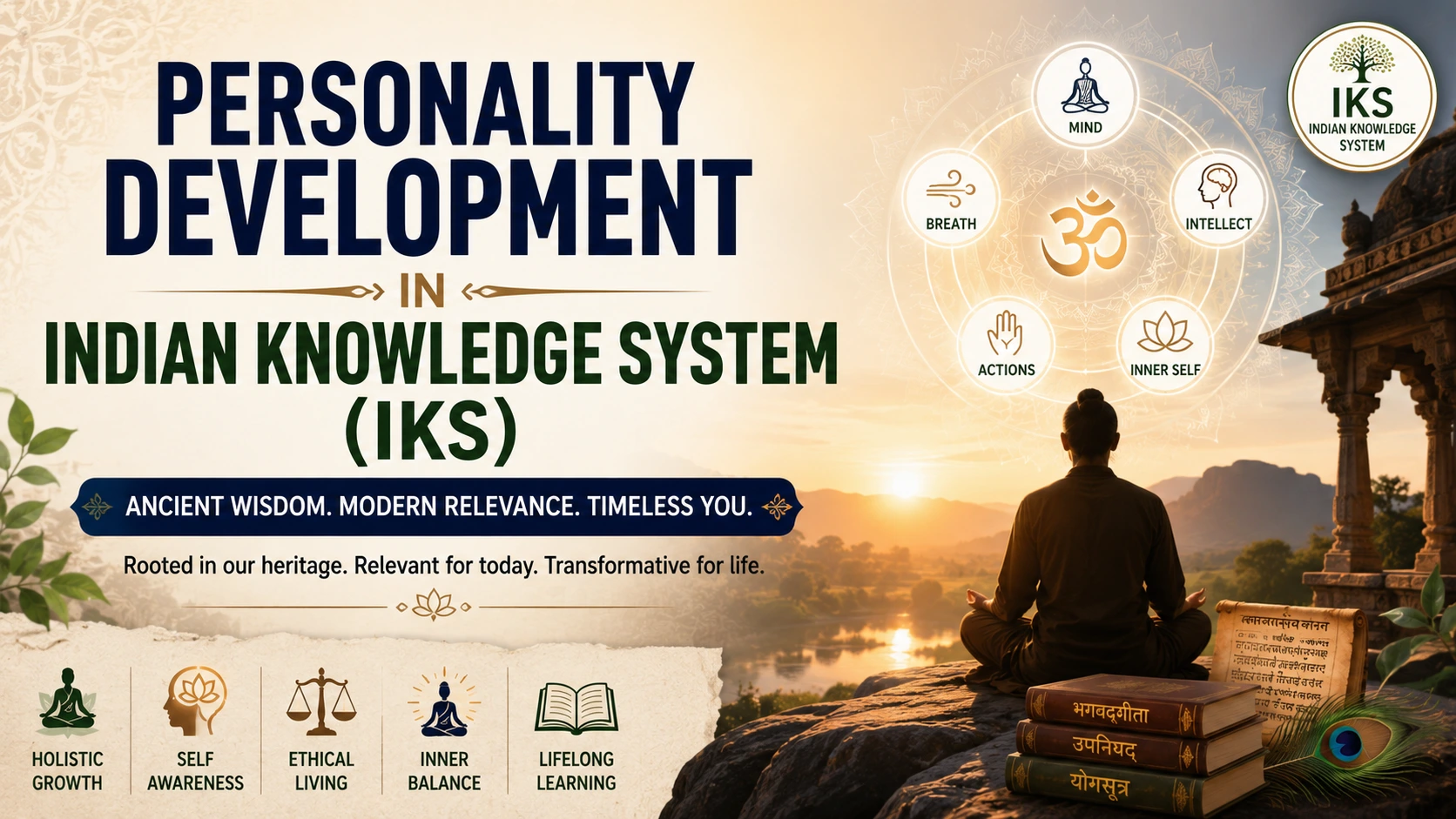
In March 2023, the University Grants Commission made something official that Indian gurus taught for thousands of years. Every UG and PG student in India must now take credit courses rooted in the Indian Knowledge System, as part of the National Education Policy 2020.
Personality development in Indian Knowledge System is not a new trend. It is one of the oldest ideas in the world, now finding its way back into modern classrooms.
Most personality models you read about today focus on behaviour. Personality development in the Indian Knowledge System takes a different route. It looks at the mind, the breath, the intellect, and the inner self together, not just outward habits.
This guide breaks down personality development in the Indian Knowledge System in plain language. You will find the core frameworks, real examples, current NEP 2020 relevance, and practical steps you can use today.
Key Takeaways
- Personality development in the Indian Knowledge System focuses on inner growth, not just outward soft skills.
- The Triguna theory explains personality through three qualities: Sattva, Rajas, and Tamas.
- The Panchakosha model describes personality across five layers, from the physical body to inner bliss.
- Karma Yoga teaches acting without attachment to results, which builds emotional resilience.
- The UGC mandated IKS credit courses for all UG and PG students starting March 2023.
- You can apply these ideas in daily life through simple habits, not just classroom study.
What Is Personality Development in Indian Knowledge System?
Personality development in Indian Knowledge System means growing as a whole person. It is not only about confidence or communication skills. It is about aligning your mind, your actions, and your inner awareness.
Western psychology often measures personality through traits like extraversion or conscientiousness. Personality development in Indian Knowledge System asks a deeper question instead. It asks what your true nature is, beneath your habits and moods.
Ancient texts such as the Bhagavad Gita and the Upanishads treat personality as something that can be refined, not just described.
What Are the Core Pillars of IKS?
Personality development in Indian Knowledge System uses several frameworks to explain and build personality. Two of these stand out the most.
Triguna Theory
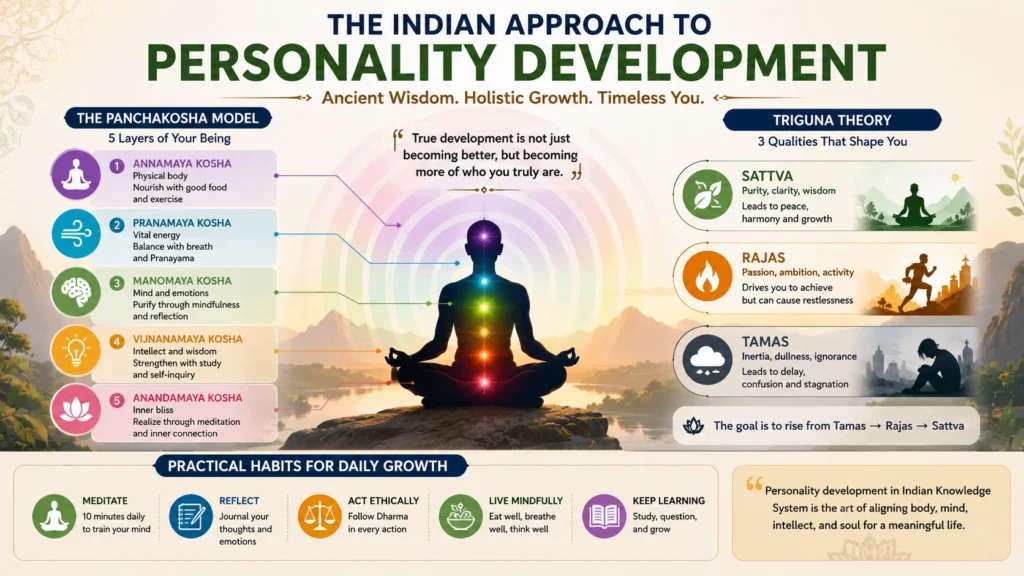
The Triguna theory classifies human behaviour into three fundamental qualities, known as gunas.
| Guna | What It Represents | Everyday Sign |
|---|---|---|
| Sattva | Purity, clarity, and calm wisdom | Feeling peaceful after helping someone without expecting anything back |
| Rajas | Passion, ambition, and restlessness | Feeling driven to chase a promotion, even at the cost of sleep |
| Tamas | Inertia, dullness, and avoidance | Scrolling on your phone for hours instead of finishing a task |
The goal in Indian Knowledge System is not to erase Rajas and Tamas completely. The goal is to move steadily toward Sattva, using awareness and practice.
Panchakosha Model
The Panchakosha model describes personality as five layers, moving from the physical body to the innermost self.
- Annamaya Kosha. The physical body, shaped by food and physical discipline.
- Pranamaya Kosha. The vital energy layer, managed through breath control, or Pranayama.
- Manomaya Kosha. The mental and emotional layer, handled through introspection.
- Vijnanamaya Kosha. The intellect and wisdom layer, sharpened through study and reflection.
- Anandamaya Kosha. The innermost layer of peace and bliss.
Think of these five layers like the layers of an onion. You cannot reach the centre by working on only one layer. Real personality development in Indian Knowledge System works through all five together.
Karma Yoga and Dharma
Karma Yoga teaches one simple idea. Do your duty, called Dharma, without obsessing over the outcome.
A shopkeeper in Varanasi once told a researcher something that captures this perfectly. “I open my shop every morning, rain or shine. What happens after that is not fully in my hands.” This is Karma Yoga in daily life, not just a verse from a book.
This mindset builds real resilience. When your sense of worth does not depend only on results, setbacks hurt less.
Yogic Practices and Mindfulness
Meditation, or Dhyana, and concentration practices are core tools in Indian Knowledge System. These are not just relaxation techniques. They train attention, which is one of the most valuable personality skills in a distracted world.
What Are the Key Aspects of IKS?
Components of Personality Development in the Indian Knowledge System
Personality development in Indian Knowledge System usually involves these components working together.
- Self-awareness through introspection and journaling thoughts.
- Discipline through daily routines, called Dinacharya.
- Ethical conduct guided by Dharma.
- Emotional regulation through breath and meditation practices.
- Continuous learning through study, called Svadhyaya.
Agencies of Personality Development
In personality development in Indian Knowledge System, growth is shaped by more than just the individual.
- Family, which passes down values and daily habits.
- Guru or teacher, who guides inner refinement, not just information.
- Community, which reinforces ethical behaviour through shared practice.
- Self-effort, called Purushartha, which remains the most important agency of all.
Indian Approach to Personality vs Western Concept of Personality
| Aspect | Western Concept | Indian Approach |
|---|---|---|
| Focus | Observable traits and behaviour | Inner consciousness and awareness |
| Goal | Self-expression and achievement | Self-realisation and balance |
| Measurement | Personality tests and trait scores | Reflection, meditation, and self-study |
| Change | Behaviour modification | Inner transformation through practice |
Neither approach is wrong. They simply answer different questions. Western models are useful for workplace behaviour. The Indian approach adds a deeper, quieter layer underneath.
Vedic Theory of Personality
Vedic thought, one of the oldest roots of personality development in Indian Knowledge System, describes personality through the three gunas rather than fixed traits. Where the Big Five model measures how open, agreeable, or conscientious you are, Vedic theory asks which guna currently dominates your mind, and how you can shift it. This makes it less of a label and more of a daily practice.
Why Is IKS Important Today?
Personality development in Indian Knowledge System is not a theoretical debate anymore. In March 2023, the UGC issued clear guidelines asking every UG and PG student to complete IKS credit courses, amounting to at least 5 percent of their total mandated credits. At least half of these credits must connect to the student’s own major subject.
IITs and central universities are now building dedicated centres for Indian Knowledge System, covering subjects from Indian psychology to traditional wellness practices.
A 2026 academic paper on IKS in personality assessment describes this shift as building a culturally rooted framework that goes beyond imported Western models.
A Real Example
Priya’s story shows personality development in Indian Knowledge System in action. A second-year college student in Bangalore, she used to panic before every exam. Her hands would shake and her mind would race.
Her mentor introduced her to two simple practices. First, five minutes of Pranayama every morning, to steady the Pranamaya Kosha. Second, a nightly journal entry naming which guna felt strongest that day.
Within a month, Priya noticed something different. She still felt nervous before exams. But the nervousness no longer controlled her hands or her decisions. She had not changed her personality overnight. She had simply become aware of it, layer by layer.
How to Apply IKS Principles in Daily Life
- Start your day with five minutes of quiet breathing before checking your phone.
- Each evening, name one moment where Sattva, Rajas, or Tamas showed up in your behaviour.
- Pick one small duty each day and do it fully, without checking the outcome constantly.
- Read one page of a text that challenges your thinking, to build the Vijnanamaya Kosha.
- Spend ten minutes in silence once a week, with no phone or distraction nearby.
None of these steps require a classroom. Personality development in Indian Knowledge System works through consistency, not intensity.
📥 Download the Free Personality Development in Indian Knowledge System (IKS) PDF
Want a quick summary you can revisit anytime?
Download our free Personality Development in Indian Knowledge System (IKS) PDF. It includes the Triguna Theory, Panchakosha Model, Karma Yoga, Dharma, practical daily habits, and key takeaways in an easy-to-read format.
Whether you’re a student, teacher, or lifelong learner, this PDF is a handy reference for understanding and applying the core principles of the Indian Knowledge System in everyday life.
👉 Download the Free IKS Personality Development PDF
What Are the 5 Points of Personality Development?
In the Indian Knowledge System, personality development commonly rests on five points.
- Physical discipline, through the Annamaya Kosha.
- Energy management, through breath and the Pranamaya Kosha.
- Emotional balance, through the Manomaya Kosha.
- Intellectual growth, through the Vijnanamaya Kosha.
- Inner peace, through the Anandamaya Kosha.
What Is the Concept of Personality Development?
Personality development is the ongoing process of refining how a person thinks, feels, and acts. In the Indian Knowledge System, this concept extends further. It includes refining the inner self, not only outward behaviour, through consistent daily practice.
Final Thought
Personality development in Indian Knowledge System does not ask you to become someone else. It asks you to notice who you already are, layer by layer, and to gently move that self toward calm and clarity.
You do not need an ashram or a university course to begin. A quiet morning, one honest journal entry, and one duty done fully are often enough to start.
If you want to understand how much control you feel over your own choices, our guide on Locus of Control in Personality Development connects closely with the idea of Purushartha covered here. You can also read about the Corresponsive Principle in Personality Development to see how modern psychology arrives at a surprisingly similar idea: that your daily environment and habits shape who you become.

Ayanshi is the founder of PersonaGuru.in, a blog focused on personality development, career, relationships, and mental well-being. With over 3 years of writing experience, she turns psychology and everyday experiences into practical, easy-to-understand advice for real life.