
Last updated on September 13th, 2026 at 12:15 pm
Every conversation you have is built on a hidden structure, and most people never learn to read it. That structure is exactly what transactional analysis in personality development studies. It explains why the same sentence can calm one person down and set another person off completely.
Psychiatrist Eric Berne created this theory in the 1950s. He trained under Freud’s psychoanalytic methods first, then broke away to build something more practical. He wanted a tool people could actually use in daily life, not just discuss in a therapy session.
That practical focus is why transactional analysis in personality development has stayed relevant for over seventy years. It gives you a working map of your own mind: which part of you is speaking, why the other person reacted the way they did, and how to change the pattern the next time.
Key Takeaways
- Transactional analysis in personality development is built on three ego states: Parent, Adult, and Child.
- Every exchange between two people is a “transaction,” and transactions can be complementary, crossed, or ulterior.
- Your life position, formed early in childhood, quietly shapes how you see yourself and others as an adult.
- Life scripts written in childhood run in the background of adult decisions until you consciously rewrite them.
- Research published between 2022 and 2025 confirms transactional analysis improves emotional regulation and self-awareness, especially when paired with other proven methods.
What Is Transactional Analysis in Personality Development?
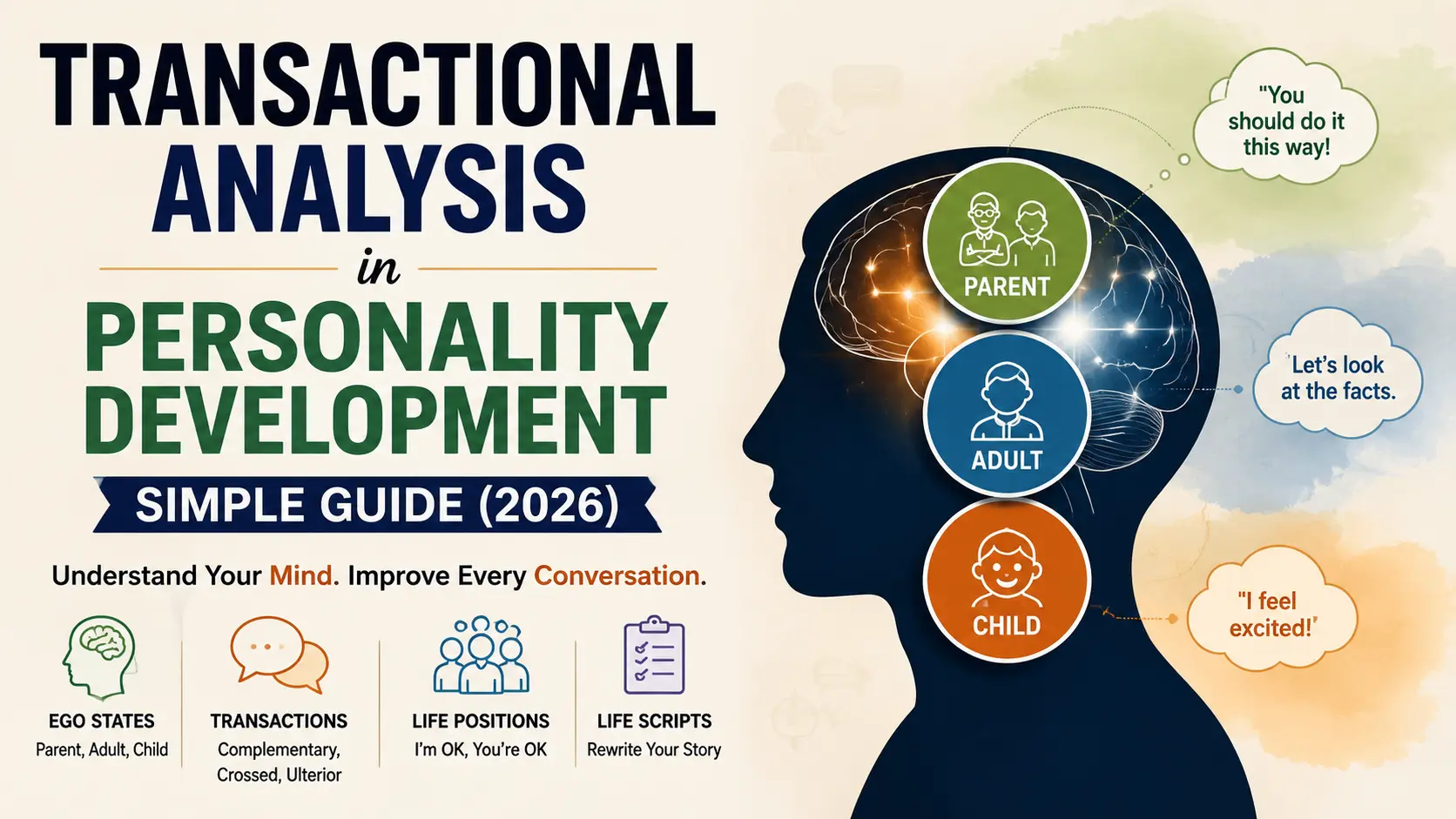
Transactional analysis in personality development is the study of how three ego states, Parent, Adult, and Child, control the way you think, speak, and react. Berne believed personality was not fixed at birth. He believed it was shaped by decisions people made in childhood, and those decisions could be identified and changed by adults willing to look closely at their own behavior.
This is exactly why transactional analysis in personality development sits at the center of so many coaching and counseling programs today. It gives people a simple, visible language for something that usually feels invisible: their own emotional reactions.
Three Ego States in Transactional Analysis (PAC Model)
At the core of transactional analysis in personality development are three ego states. You shift between them constantly, often without noticing which one is driving your words.
| Ego State | What It Sounds Like | When It Shows Up |
|---|---|---|
| Parent | “You should always…” or “Let me handle that for you.” | Giving advice, setting rules, comforting someone |
| Adult | “Let us look at the facts and decide.” | Solving problems, negotiating, staying calm under pressure |
| Child | “This is so much fun!” or “I do not want to do this.” | Feeling excited, feeling hurt, resisting instructions |
Parent Ego State
The Parent ego state holds every rule, value, and habit copied from the adults you grew up around. It has two sides.
The Nurturing Parent comforts, encourages, and protects. The Critical Parent judges, corrects, and enforces boundaries. Both sides matter, but an overused Critical Parent is one of the fastest ways to damage a relationship.
Adult Ego State
The Adult ego state is calm, logical, and focused on the present moment. It gathers facts before reacting. Most personality development work aims to strengthen this state, because it gives you control over your own responses instead of letting old habits decide for you.
Child Ego State
The Child ego state carries your earliest emotions, curiosity, and instincts. The Free Child is playful and spontaneous. The Adapted Child learned to comply, please, or rebel just to survive childhood rules.
Rohan, a 29-year-old marketing manager in Pune, used to freeze every time his boss raised his voice in meetings. He later realized his Adapted Child was reacting exactly the way he had reacted to his strict father as a child. Once he named the pattern using transactional analysis in personality development concepts, he trained himself to shift into his Adult state before responding, and his meetings changed within weeks.
If you want to strengthen your Adult state further, improving your emotional intelligence is one of the fastest ways to do it, since both skills depend on catching your reaction before it controls you.
Transactional Analysis Examples:
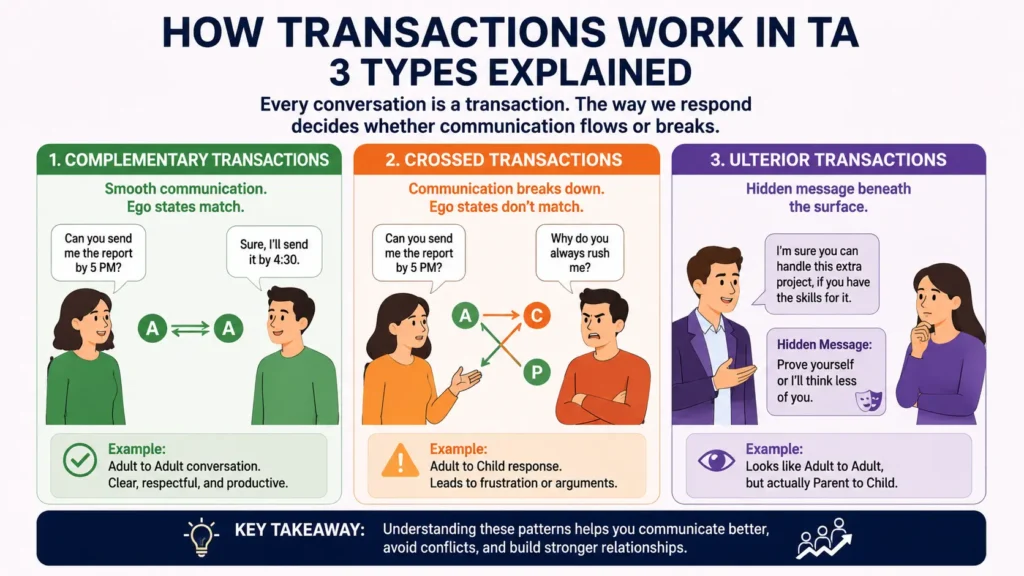
A “transaction” is one exchange between two people, one message and one response. Every real-world use of transactional analysis in personality development starts with sorting transactions into three categories.
1. Complementary Transactions
Both people respond from the expected ego state, so the exchange flows smoothly.
Example: Meera asks a colleague, “Can you send me the report by 5 PM?” (Adult to Adult). Her colleague replies, “Sure, I will send it by 4:30.” (Adult to Adult). No friction, no confusion.
2. Crossed Transactions
One person expects a certain response but receives a completely different ego state instead. This is where most arguments begin.
Example: Meera asks the same Adult question. Her colleague snaps, “Why do you always rush me?” (a Child response). The conversation derails instantly, because Meera spoke Adult to Adult but received Child to Parent in return. Understanding the difference between aggression and assertiveness helps you spot exactly this kind of crossed transaction before it escalates.
3. Ulterior Transactions
The surface message hides a second, unspoken message underneath.
Example: A manager says, “I am sure you can handle this extra project, if you have the skills for it.” On the surface, it sounds Adult to Adult. Underneath, it is a Parent-to-Child challenge, daring the employee to prove themselves.
What Are the 4 Life Positions in Transactional Analysis?
Your life position is the quiet belief you hold about yourself and other people. Most of it forms before age seven, and it keeps shaping your relationships for decades unless you actively notice it. This is one of the most practical parts of transactional analysis in personality development, because it explains patterns that repeat across completely different relationships.
| Life Position | Core Belief | Typical Result |
|---|---|---|
| I’m OK, You’re OK | Healthy self-respect and respect for others | Balanced relationships, secure communication |
| I’m OK, You’re Not OK | Superiority, distrust of others | Controlling behavior, blaming, arrogance |
| I’m Not OK, You’re OK | Low self-worth, over-dependence on others | People-pleasing, chronic self-doubt |
| I’m Not OK, You’re Not OK | Hopelessness about self and others | Withdrawal, giving up on relationships |
Most personality development work, including this look at self-career perception and how you see your own worth, aims at the same goal: shifting a person toward the “I’m OK, You’re OK” position, one honest conversation at a time.
How Childhood Stories Shape Your Personality
A life script is an unconscious plan you wrote for yourself as a child, based on messages absorbed from parents, teachers, and early experiences. Some scripts sound like, “I have to be perfect to be loved.” Others sound like, “People always leave, so do not get too close.”
You did not choose these scripts consciously. You built them to survive your early environment, and this connects directly to how childhood experiences shape personality development long after childhood ends. For a wider view of how early influences and even genetics play into who you become, this piece on the journey of personality development from genes to Freud’s theories is worth reading alongside this one.
The good news is that scripts can be rewritten. Transactional analysis calls this a “redecision,” a conscious choice to replace an old childhood belief with one that actually serves your adult life.
Devika, a 34-year-old teacher from Mumbai, grew up believing she had to earn every bit of approval. In her thirties, she noticed she was still overworking to please people who never asked her to. Once she named her script using transactional analysis in personality development tools, she started setting boundaries without guilt. It took months, not days, but the shift was real.
Strokes: Why Recognition Shapes Who You Become
A “stroke” is any unit of recognition you give or receive: a compliment, a smile, criticism, or even silence. Berne believed people need strokes the way they need food. When positive strokes are missing, people settle for negative attention rather than none at all.
This single idea explains a lot of workplace and family conflict, including patterns you can see clearly in how an avoidant partner communicates under stress. A child who gets ignored when calm but scolded when acting out learns that misbehaving is the only reliable way to get noticed. Adults repeat the same pattern without realizing it.
Is Transactional Analysis Outdated?
Critics of transactional analysis in personality development raise fair points. Some of its concepts are hard to test in a controlled lab setting, and it does not yet have the massive clinical trial base that cognitive behavioral therapy has built up over decades.
At the same time, research has not stood still. A 2022 systematic review and meta-analysis published in the Journal of Humanistic Psychology examined decades of treatment studies and found consistent improvements in psychological health, self-efficacy, and general well-being among clients using this approach. A newer 2025 evidence-based handbook on transactional analysis psychotherapy has continued building on that research base, giving practitioners more structured, testable treatment models than Berne’s original era ever had.
So transactional analysis in personality development is not outdated. It has matured, moving from a purely descriptive theory into something researchers are actively working to measure and refine. For a deeper academic breakdown of the original theory, Simply Psychology’s detailed explanation of transactional analysis is a strong next read, and the International Transactional Analysis Association publishes the official professional standards behind the practice.
How to Apply Transactional Analysis in Your Daily Personality Development
You do not need a therapist’s office to start using transactional analysis in personality development. Try this simple five-step practice for one week.
- Notice your ego state before you respond. Pause for two seconds. Ask yourself, “Am I reacting as my Parent, my Adult, or my Child right now?”
- Name crossed transactions when they happen. If a conversation suddenly feels tense, ask, “Did I expect an Adult response and get a Child one instead?”
- Check your life position daily. At the end of each day, ask, “Did I treat myself and others as OK today, or did one side slip?”
- Track your strokes. Notice where you seek recognition. Is it healthy attention, or are you chasing conflict just to feel noticed?
- Write down one script you want to rewrite. Pick one childhood belief that no longer fits your adult life, and write one small action that contradicts it.
Free Download: Identify Your Ego State Worksheet (PDF)
To make this practical, we have created a free one-page worksheet. It helps you track which ego state shows up most often in your daily conversations, spot your most common crossed transactions, and note down one life script you want to rewrite this month.
Download the Identify Your Ego State Worksheet (PDF)
Final Thoughts
Transactional analysis in personality development gives you something rare: a visible, usable map of why your conversations succeed or collapse. Once you can name your ego state, your life position, and your old scripts, you get to choose your response instead of repeating the same reaction on loop.
Start small. Notice one conversation today. Ask yourself which ego state showed up. That single habit, practiced daily, is where real transactional analysis in personality development begins to change how you live.
FAQs
1. What is the transactional analysis theory of personality?
It is a theory created by Eric Berne that explains personality through three ego states, Parent, Adult, and Child, and studies how these states interact in everyday conversations.
2. What are the three types of transactions in TA?
Complementary, crossed, and ulterior transactions. Complementary transactions flow smoothly, crossed transactions cause conflict, and ulterior transactions carry a hidden message underneath the words.
3. Is transactional analysis evidence-based?
Partially. Recent systematic reviews show measurable benefits for self-awareness and emotional health, though transactional analysis in personality development still has a smaller research base than therapies like CBT.
4. Who is the father of transactional analysis?
Eric Berne, a Canadian-American psychiatrist, developed the theory in the 1950s after training in traditional psychoanalysis.
5. What are the 4 life positions in transactional analysis?
I’m OK You’re OK, I’m OK You’re Not OK, I’m Not OK You’re OK, and I’m Not OK You’re Not OK. These positions describe your core belief about your own worth compared to others.

Ayanshi is the founder of PersonaGuru.in, a blog dedicated to personality development, relationships, and mental health. With 3+ years of writing experience and 250+ published articles, she simplifies psychology into practical, everyday advice for real people.