
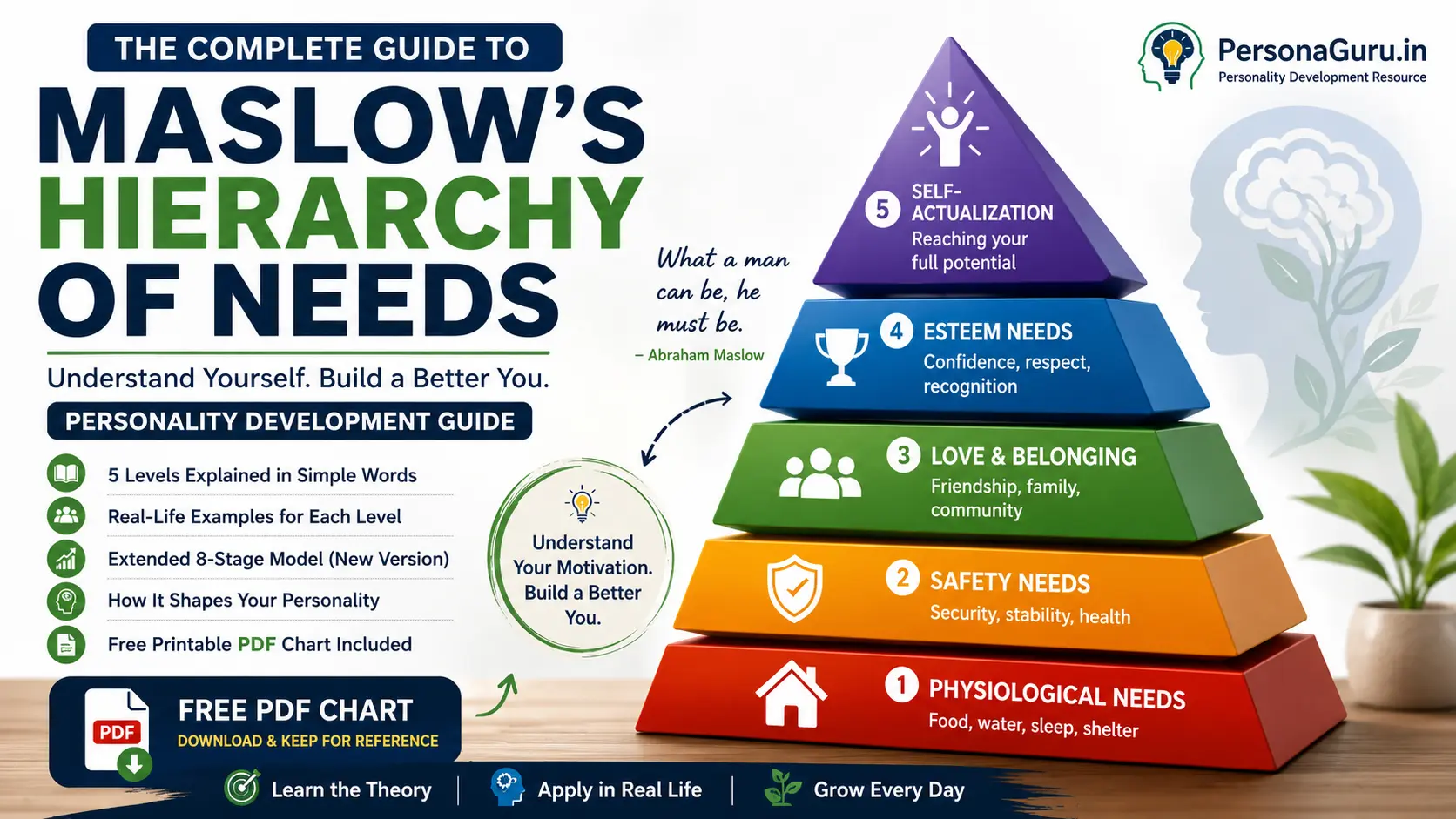
Have you ever wondered why you cannot focus on a big presentation when you are hungry, tired, or worried about rent? That is not weak willpower. That is Maslow’s hierarchy of needs working exactly as Abraham Maslow described it in 1943.
At PersonaGuru, readers often ask us for a simple way to understand their own motivation. This is why we built a complete Maslow’s hierarchy of needs PDF chart you can download and keep for reference. It is one of the most practical tools you can use for real personality development, not just an old textbook diagram.
This guide breaks down every level of the pyramid in plain words, covers the extended version most articles skip, and gives you the free downloadable PDF at the end.
Key Takeaways
- Maslow’s hierarchy of needs has five core levels: physiological, safety, love and belonging, esteem, and self-actualization.
- Maslow later expanded this into an 8-stage model, which very few articles cover in detail.
- Maslow himself estimated that only about 2 percent of people ever reach full self-actualization.
- Each level of the pyramid directly shapes specific personality traits, from confidence to empathy.
- The theory is still used today in workplaces, classrooms, and hospitals, even though it has real limitations.
- Grab the free Maslow’s hierarchy of needs PDF chart further down this guide to track your own progress.
What Is Maslow’s Hierarchy of Needs?
Maslow’s hierarchy of needs is a theory of human motivation. Abraham Maslow, an American psychologist, first proposed it in his 1943 paper, “A Theory of Human Motivation.”
In simple words, Maslow said people are driven by a set order of needs. You focus on food, water, and safety first. Once those needs feel secure, your attention naturally shifts toward relationships, self-respect, and finally toward becoming the best version of yourself.
As Maslow himself once put it, “What a man can be, he must be.” That single line captures the whole idea behind the top of his pyramid.
Maslow’s Hierarchy of Needs in a Nutshell
If you want Maslow’s hierarchy of needs explained in one line: think of it like building a house. You cannot install a nice roof before you have a solid foundation. Your basic survival needs are the foundation. Your sense of purpose and potential is the roof.
How to Explain It to a Child
Tell them it works like levels in a video game. You cannot unlock level five until you finish level one. First you need food and rest. Then you need to feel safe. Then you need friends. Then you need to feel good about yourself. Only after all of that can you chase your biggest dreams.
Maslow’s Hierarchy of Needs PDF Chart: The 5 Levels in Order
Here is a clear breakdown of each level, from the base of the pyramid to the top. This is exactly what you will find in the downloadable Maslow’s hierarchy of needs PDF chart, laid out in table form for quick reference.
| Level | Name | What It Includes | Real-Life Example |
|---|---|---|---|
| 1 | Physiological Needs | Food, water, sleep, air, shelter | A student cannot study on an empty stomach |
| 2 | Safety Needs | Job security, health, a stable home | An employee staying in a boring job during a recession |
| 3 | Love and Belonging | Friendship, family, intimacy, community | Feeling accepted in a new city after moving there |
| 4 | Esteem Needs | Self-respect, recognition, confidence | Feeling proud after a promotion at work |
| 5 | Self-Actualization | Reaching your full potential | An artist quitting a stable job to paint full time |
1. Physiological Needs
These are your body’s basic survival requirements. Food, water, sleep, and shelter sit here. Until these are met, almost nothing else matters to your brain.
2. Safety Needs
Once your body is fed and rested, your mind starts looking for stability. This includes financial security, physical safety, and good health. This is why so many people stay in jobs they do not enjoy. The safety need often speaks louder than the desire for growth.
3. Love and Belonging Needs
Humans are social by nature. This level covers friendship, family bonds, romantic relationships, and a sense of community. Loneliness at this stage can quietly damage every level above it, and it often connects back to how a person sees themselves. Our guide on self-concept in personality development explains this link in more detail.
4. Esteem Needs
This is where confidence and self-respect live. Maslow split this into two parts: respect from others, and respect for yourself. A person can look successful on the outside and still struggle here if their self-worth depends only on external praise.
5. Self-Actualization Needs
This is the top of the pyramid. It is the drive to become everything you are capable of becoming. Maslow believed very few people reach this stage fully. His original estimate is still quoted in psychology classrooms today: roughly 2 percent of people, based on his own research on high-achieving individuals.
Examples of Self-Actualization
Here are a few real Maslow’s hierarchy of needs examples at the top level of the pyramid:
- An engineer who leaves a stable career to build something original
- A parent who returns to college in their forties to finish a long-delayed degree
- A shy employee who eventually starts mentoring junior colleagues
How to Achieve Self-Actualization
- Get honest about what actually excites you, not what looks impressive to others.
- Build small, consistent habits around that interest, instead of waiting for the perfect moment.
- Accept setbacks as part of the process, not proof that you are on the wrong path.
- Protect time for reflection, since self-actualization rarely happens on a rushed schedule. This is closely tied to how much control you feel over your own life, a concept we unpack in our piece on locus of control in personality development.
Extended Version: Maslow’s Later 8-Stage Model
Most articles stop at five levels. Maslow himself did not, and Maslow’s hierarchy of needs new version in this guide covers both the original pyramid and the extended model side by side.
In his later work, he added three more layers between esteem and self-actualization, plus one final stage beyond it. Few Indian blogs cover this properly, so here is the complete, updated picture.
- Cognitive Needs — the desire to learn, explore, and understand
- Aesthetic Needs — the appreciation of beauty, art, and order
- Self-Actualization — reaching your personal potential
- Self-Transcendence — helping others reach their potential, beyond your own
This new version explains why some highly successful people eventually move into mentoring, teaching, or philanthropy. They are not done growing. They have simply moved to the final, most selfless stage of the pyramid.
How Maslow’s Hierarchy Shapes Personality Development
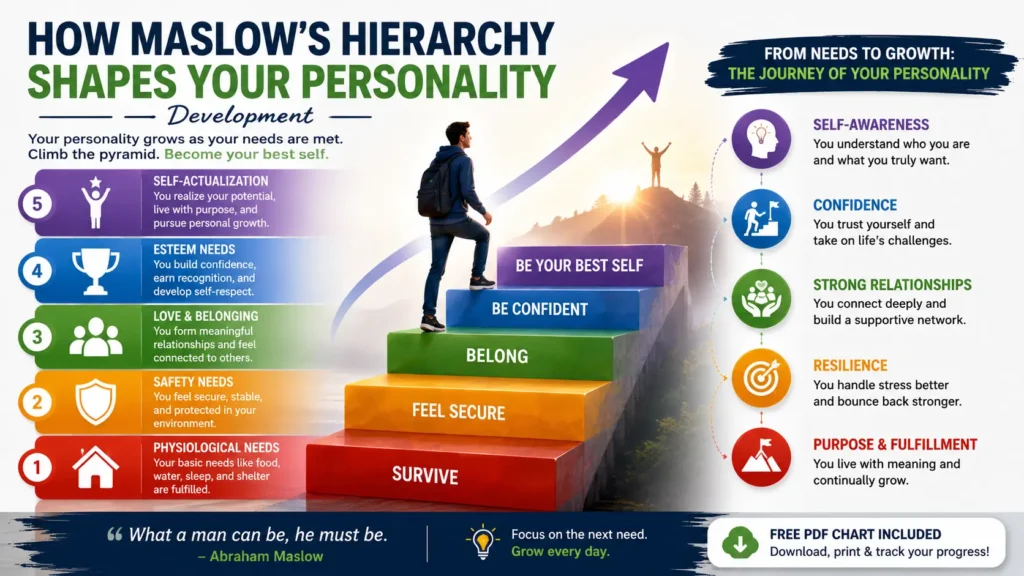
Every level of this pyramid quietly builds a specific part of your personality.
- Unmet physiological needs often show up as irritability or a short temper.
- Weak safety needs create anxious, risk-avoidant personalities.
- Unmet belonging needs are strongly linked to low trust in relationships.
- Unmet esteem needs create people-pleasing behavior, since self-worth starts depending entirely on outside approval.
- Strong self-actualization is linked to resilience, creativity, and emotional stability.
A study on Maslow’s needs and the Big Five personality traits published by the National Institutes of Health examined how satisfaction across Maslow’s five needs connects with core personality traits and found a real, measurable relationship between the two. It is one of the few pieces of hard data confirming what personality coaches have long observed in practice.
How to Apply Maslow’s Theory to Your Own Life
Try this simple exercise. Write down which level of the pyramid feels the shakiest for you right now, not the one that sounds most impressive to work on, but the one that is actually unstable. Most personal growth stalls not because people lack ambition, but because a lower level is quietly unresolved.
Is Maslow’s Hierarchy of Needs Still Valid Today?
This is one of the most searched questions about the theory, and it deserves an honest answer.
Common Criticisms and Limitations
- Weak scientific methodology: Maslow built this theory by studying a small group of famous, high-achieving individuals, not a broad or diverse population.
- Not always linear: Real life rarely moves neatly from one level to the next. People often pursue love or esteem while their safety needs are still shaky.
- Cultural bias: The model reflects an individualistic, Western view of achievement. Many collectivist cultures prioritize community belonging over personal esteem.
- Hard to measure: Concepts like self-actualization are difficult to test scientifically, which limits how much hard data supports the theory.
A 2023 study at a Canadian university asked more than 100 students to rank the five needs by personal importance. Physiological and safety needs were ranked highest by most students, while self-actualization was ranked least important by over 40 percent of them. This shows the theory’s neat pyramid shape does not always match how people actually prioritize their own lives.
What Alternatives Exist
- ERG Theory (Existence, Relatedness, Growth) by Clayton Alderfer, which allows needs to be pursued in any order
- Herzberg’s Two-Factor Theory, which separates workplace satisfaction from workplace dissatisfaction
- Self-Determination Theory, which focuses on autonomy, competence, and relatedness instead of a strict hierarchy
For a deeper academic breakdown of these five levels and their history, Simply Psychology’s detailed explainer on Maslow’s theory is a solid reference if you want to go further into the original research.
How Businesses Still Use It Today
Large companies, including major retail and fast-food chains, quietly design their hiring and employee benefits around this pyramid. Fair wages address physiological and safety needs. Team events address belonging. Recognition programs and promotions address esteem.
It is one reason the theory has survived in HR and management training for more than 80 years, even without perfect scientific backing. Many HR teams even print the Maslow’s hierarchy of needs PDF chart and pin it up during onboarding sessions.
Real-Life Applications of Maslow’s Hierarchy of Needs
In the Workplace
Managers use this pyramid to understand why perks like free snacks do not fix a team’s motivation problem if employees feel unsafe about job security. Address the right level, not just any level.
In Healthcare and Nursing
Nurses are trained to use this hierarchy when prioritizing patient care. A patient struggling to breathe, which is a physiological need, is always treated before a patient’s emotional or social concerns. This is a core part of many nursing school curricula even today.
In Education
Teachers who understand this model know that a hungry, tired, or scared student cannot focus on algebra. Addressing a child’s basic comfort and safety in the classroom often improves learning faster than any new teaching method.
Free Maslow’s Hierarchy of Needs PDF Chart Download
To make all of this easier to apply, we built a simple, printable Maslow’s hierarchy of needs PDF chart. It includes:
- The original 5-level pyramid, fully illustrated
- The extended 8-stage version explained
- A short self-check worksheet to identify your current weakest level
Click here to download the free Maslow’s Hierarchy of Needs PDF Chart
Final Thoughts
Maslow’s hierarchy of needs is more than 80 years old, and it still shapes how we understand motivation, personality, and personal growth today. Download the Maslow’s hierarchy of needs PDF chart above, run through the self-check worksheet honestly, and revisit it every few months. Your weakest level rarely stays the same for long.
This article is part of PersonaGuru’s Personality Development series. For a complete overview of how personality traits are formed and shaped, read our complete guide to personality development.
FAQs
1. What are the 5 levels of Maslow’s hierarchy of needs in order?
Physiological needs, safety needs, love and belonging, esteem needs, and self-actualization, arranged from most basic to most advanced.
2. What are the basic needs of humans?
Food, water, sleep, air, and shelter form the base of the pyramid and must be reasonably met before other needs take priority.
3. Is Maslow’s theory still relevant today?
Yes, though modern psychology treats it as a useful framework rather than a strict scientific law, since real human motivation is often less linear than the pyramid suggests.
4. What is the major problem with Maslow’s hierarchy of needs?
Its biggest weakness is methodology. Maslow based his theory on a small, non-diverse group of high achievers, which limits how well it generalizes to everyone.
5. How can you achieve self-actualization?
By identifying what genuinely interests you, building consistent habits around it, and accepting setbacks as part of long-term growth rather than signs of failure.

Ayanshi is the founder of PersonaGuru.in, a blog focused on personality development, career, relationships, and mental well-being. With over 3 years of writing experience, she turns psychology and everyday experiences into practical, easy-to-understand advice for real life.