

Last updated on September 13th, 2026 at 12:16 pm
Think back to your favorite teacher. Chances are, they did not just teach you a subject. They taught you how to speak up. How to handle a wrong answer without falling apart. How to work with people you did not choose to sit next to.
That is education quietly building your personality, long before you ever noticed.
Most people think education is only about marks and degrees. It is not. The role of education in personality development runs much deeper than exam scores. It shapes how confident you are in a room full of strangers. It shapes how you think through a problem. It shapes your sense of right and wrong. This guide breaks down exactly how, with fresh research, real examples, and practical takeaways you can use today.
Key Takeaways
- The role of education in personality development goes beyond academics. It builds confidence, critical thinking, empathy, and emotional regulation.
- A 2025 study found a moderately significant link between self-esteem and public speaking skills among students, confirming what many teachers already know from experience.
- University of Michigan research found student confidence predicts success more than motivation does.
- Teachers, classroom interaction, and physical education all play distinct roles that most articles never separate.
- Formal schooling is not the only teacher. Informal and life experience-based learning shape personality too, often in ways formal education cannot.
What Is Personality Development?
Personality development is the lifelong process of building your traits, habits, and thought patterns. It never really stops. But two forces shape it earliest and hardest: family and education. If you want the bigger picture, our complete guide to personality development covers the full framework.
Why Education Is a Major Force in Personality Development
A child spends close to seven hours a day in school. That is more waking time than they spend at home on most days. Multiply that by twelve or more years, and you get one of the most powerful shaping forces a person will ever experience.
Education does not just fill your head with facts. It puts you in situations you cannot avoid. Group projects. Presentations. Debates. Disagreements with classmates. Deadlines. Each one leaves a mark on how you think, speak, and cope. This is the role of education in personality development at its most practical, playing out in ordinary school days rather than in any textbook chapter.
Marks fade. What stays is how school taught you to handle pressure, people, and problems, which is the real story behind the role of education in personality development.
Key Ways Education Shapes Personality
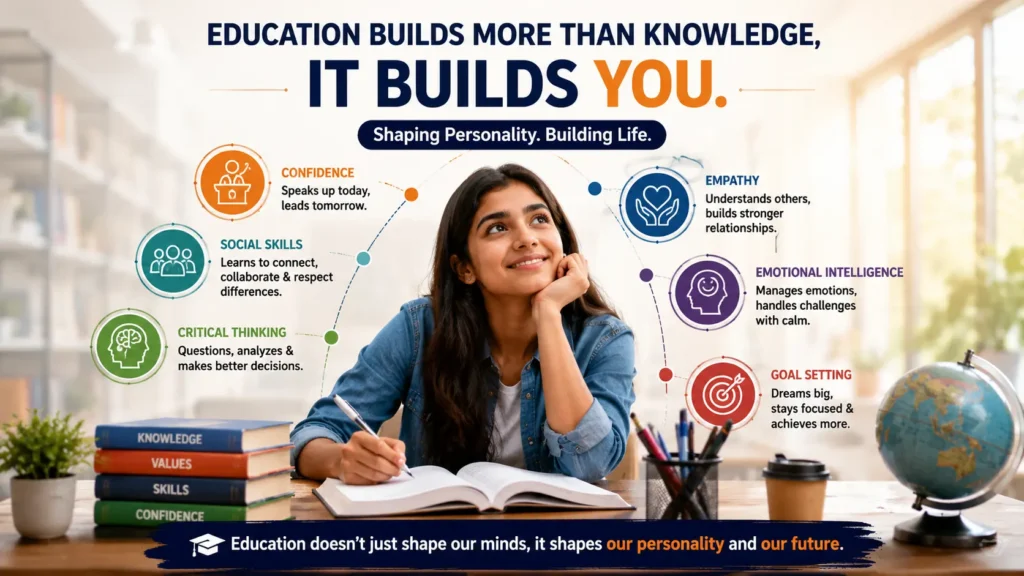
These five areas cover the core of the role of education in personality development. Each one plays out differently, but together they explain most of what changes in a person between their first day of school and their last.
Building Confidence Through Communication and Public Speaking
Every time a student answers a question in class, they practice being heard. Every presentation is a small rehearsal for adult life.
A 2025 study on self-esteem and public speaking skills among students surveyed 300 students. It found a moderately significant positive link between self-esteem and public speaking skills. In plain words, students who practiced speaking up felt better about themselves, and that confidence carried into other areas of life.
Real example: A shy student who dreads the first classroom presentation often becomes the same person who can pitch an idea in a boardroom ten years later. The skill did not appear overnight. It was built one nervous presentation at a time.
Socialization and Empathy in the Classroom
A classroom is rarely made up of people who are all alike. Different backgrounds. Different personalities. Different opinions. Learning to work with all of them is its own kind of education, and it is one of the clearest examples of the role of education in personality development in daily action.
Group projects, sports teams, and even school arguments teach empathy. A child learns to see a situation from someone else’s side, not because a textbook told them to, but because they had no choice but to sit next to that person every day for a year.
Critical Thinking and Cognitive Growth
Good education does not hand you answers. It teaches you to ask better questions. Few examples capture the role of education in personality development as clearly as this shift, from memorizing to questioning.
Subjects like science and math train the brain to break a big problem into smaller, solvable pieces. History and literature train it to see more than one side of a story. Over time, this builds a mind that questions assumptions instead of accepting them blindly, which is one of the clearest markers of a mature personality.
Moral and Ethical Development
Textbooks are full of quiet lessons in right and wrong. A story of injustice in history class. A discussion on fairness in a literature lesson. A teacher who calls out cheating without embarrassing anyone.
These moments build what psychologists call a moral compass. It is rarely taught directly. It gets absorbed, the same way a child picks up a parent’s tone of voice, and it is one of the quieter parts of the role of education in personality development that most people never notice happening.
Emotional Regulation Through Structured Learning
School comes with deadlines, exams, and disappointment. A failed test. A missed selection for the school team. These are early, low-stakes lessons in handling setbacks.
Students who learn to sit with a bad result, without falling apart, are practicing a skill they will use for the rest of their lives. This is another quiet layer of the role of education in personality development, and it connects closely with emotional intelligence, which schools build in far more subtle ways than most people realize.
Role of Teachers in Shaping Student Personality
A good teacher does more than deliver a syllabus. This is where the role of education in personality development becomes most visible, in the small daily choices a teacher makes. They notice which student is too quiet. They push the overconfident one to listen more. They decide, often without saying it out loud, who gets encouraged and who gets challenged.
This University of Michigan research on student confidence and success found something worth sitting with. Student confidence, not just motivation, was the strongest predictor of success. And confidence rarely builds itself. It usually needs one adult who believed in a student before that student believed in themselves.
A few ways teachers shape personality directly, and quietly prove the role of education in personality development every single day:
- Modeling composure. A calm teacher under pressure quietly teaches calm.
- Selective encouragement. Praise given at the right moment can change how a student sees their own ability for years.
- Setting the classroom tone. A teacher who allows mistakes without ridicule builds students who are not afraid to try.
Formal Education vs Informal Learning: What Shapes Personality More?
This is a genuine debate, and the honest answer is both matter, just differently, when it comes to the role of education in personality development.
| Factor | Formal Education | Informal Learning |
|---|---|---|
| Setting | Structured, classroom-based | Everyday life, hobbies, travel, work |
| Pace | Fixed curriculum, fixed timeline | Self-paced, driven by curiosity |
| Best at building | Discipline, structured thinking, exam resilience | Adaptability, street smarts, real-world problem solving |
| Weakness | Can reward memorization over judgment | Can lack structure and depth |
A person with only formal education can struggle outside the classroom. A person with only informal learning can struggle with structure and discipline. The strongest personalities usually draw from both.
Role of Physical Education and Extracurricular Activities
Sports and extracurriculars rarely get the credit they deserve in this conversation.
A student who plays on a school team learns to lose in front of an audience and show up again the next week. A student in the debate club learns to defend an idea even when the room disagrees. A student in music or drama learns to perform despite nerves.
These are not soft, optional extras. They build resilience, teamwork, and composure under pressure just as much as, sometimes more than, a classroom ever could. This side of the role of education in personality development rarely gets its own article, yet coaches and club mentors often shape a student as much as any teacher does. Building a habit of consistent practice here also links closely to good habits for personality development that carry into adult life.
Education and Personality Development in the Indian School System
India’s National Education Policy 2020 pushes schools to move beyond rote learning. Life skills, values, and holistic growth are now formally part of the goal, not an afterthought.
In practice, this looks like value education periods, sports as a compulsory subject, and more project-based assessment instead of pure memorization. For Indian students specifically, this shift matters. A generation raised only on marks-based competition often struggles with confidence and adaptability once they leave the exam hall behind.
Schools that combine strong academics with sports, arts, and open classroom discussion tend to produce more well-rounded adults. This is different from just adding life skills as an extra subject. It is a shift in how the entire system treats the role of education in personality development, not as a side effect of good marks, but as a goal in itself.
What Happens When Education Is Missing or Limited?
Not everyone has equal access to quality education, and that gap shows up in personality too. This is the flip side of the role of education in personality development, visible most clearly in what is missing rather than what is present.
Common effects of limited access to education, and a clear look at what the role of education in personality development leaves behind when it is missing:
- Lower self-confidence in unfamiliar social or professional settings.
- Fewer tools for critical thinking, which can make a person more vulnerable to misinformation.
- Reduced exposure to diverse perspectives, which can narrow empathy and understanding.
- Difficulty navigating formal systems, like paperwork, interviews, or workplace structures.
None of this means a person without formal education cannot build a strong personality. The role of education in personality development is real, but it is not the only path. Life experience, mentors, and self-directed learning through informal learning can fill real gaps. But it usually takes more deliberate effort without a structured system pushing that growth along.
How to Use Education Actively for Your Own Personality Development
Whether you are still studying or long done with school, you can still put the role of education in personality development to work for yourself.
- Say yes to one uncomfortable thing. A presentation, a class discussion, a new course. Growth lives in that discomfort.
- Read outside your field. It builds the same critical thinking a good classroom would.
- Join something structured. A course, a club, a sport. Structure builds discipline that casual learning rarely does.
- Reflect after setbacks. A bad grade or a failed pitch is only useful if you actually sit with what went wrong.
- Keep learning after school ends. The role of education in personality development does not have an expiry date. Continuing to build self-perception through career growth is a natural extension of this into adult life.
Conclusion
The role of education in personality development is bigger than most people give it credit for. It is not just what you learn. It is how you learn to speak up, think clearly, treat people fairly, and handle a bad day without falling apart.
Whether you are a student right now or years past graduation, that shaping never really stops. The role of education in personality development keeps working quietly in the background of every course, conversation, and challenge you take on. The next time you push yourself to speak up in a meeting, or sit with a tough loss without giving up, remember where that skill first got built.
For more on how everyday skills complement this, see our guide on life skills education for personality development.
FAQs
1. What is the role of education in personality development?
Education builds confidence, critical thinking, empathy, moral values, and emotional regulation, mainly through daily classroom interaction, structured challenges, and relationships with teachers and peers, not just through subject knowledge.
2. What are the 5 pillars of personality development in education?
Most frameworks point to confidence and communication, socialization and empathy, critical thinking, moral and ethical values, and emotional regulation as the five core pillars education contributes to.
3. What is the role of teachers in personality development?
Teachers shape personality by modeling composure, giving encouragement at the right moments, and setting a classroom tone that either builds or limits a student’s willingness to take risks and speak up.
4. What is the role of physical education in personality development?
Physical education plays a specific and often underrated role in personality development. It builds resilience, teamwork, discipline, and the ability to handle both winning and losing gracefully, skills that carry directly into adult personality and professional life.
5. How does education impact personality in the Indian school system? The
The role of education in personality development looks a little different in India. National Education Policy 2020 pushes schools toward life skills, values, and holistic development alongside academics, aiming to build more confident, adaptable students instead of only exam-focused ones.

Ayanshi is the founder of PersonaGuru.in, a blog focused on personality development, career, relationships, and mental well-being. With over 3 years of writing experience, she turns psychology and everyday experiences into practical, easy-to-understand advice for real life.