
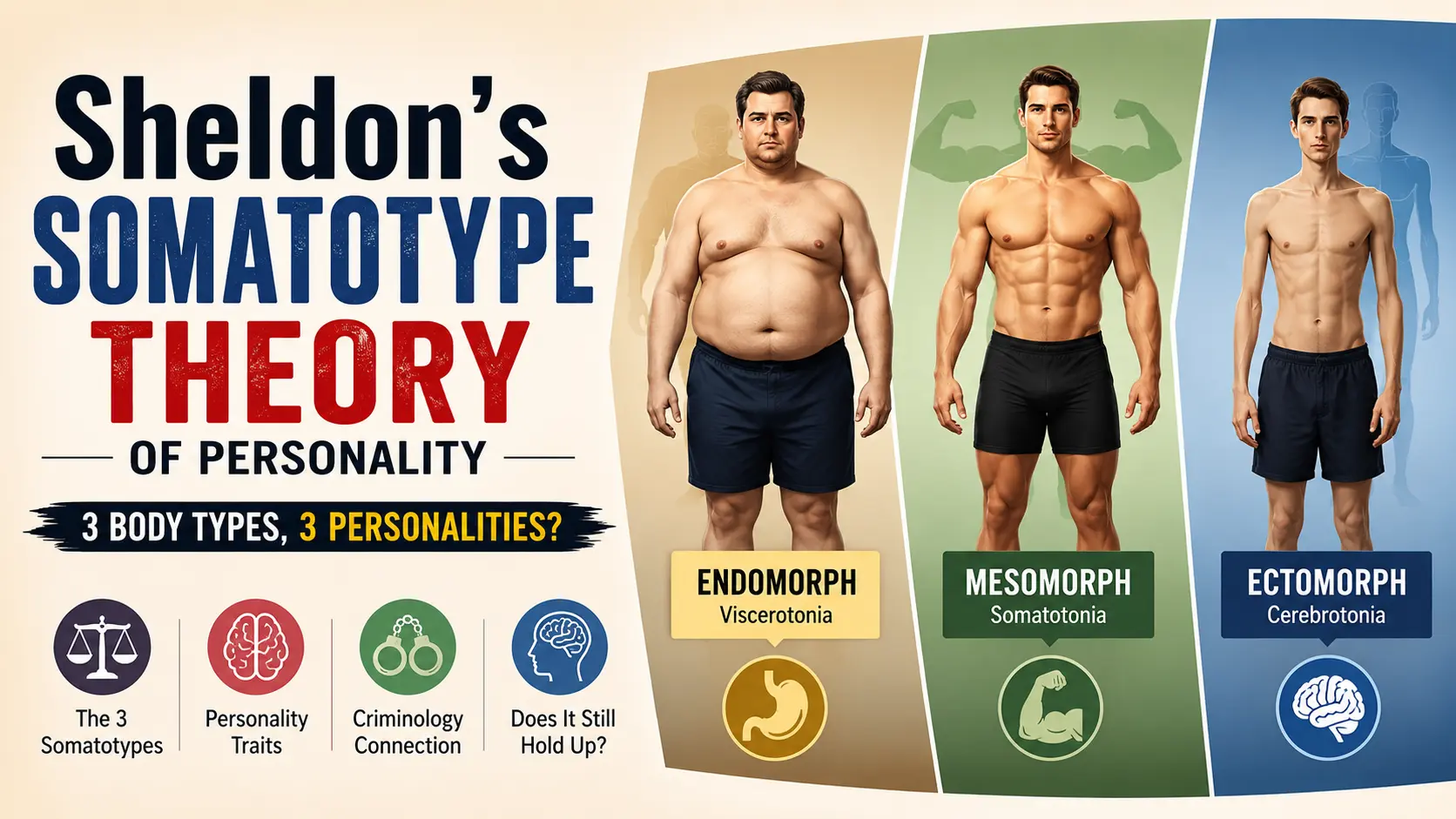
Body shape and personality. William Sheldon believed the two were connected.
He built an entire theory around it. He named it Sheldon’s Somatotype Theory of Personality.
It sorts people into three body types. Each type comes with its own set of traits. It sounds neat and simple. But is it actually true?
This guide breaks down Sheldon’s Somatotype Theory of Personality in plain words. You will learn how it was used in criminology, and why most psychologists today reject it.
Key Takeaways
- Sheldon’s Somatotype Theory of Personality sorts people into three body types: endomorph, mesomorph, and ectomorph.
- Sheldon built the theory on 4,000 photographs of male college students in the 1940s.
- He later claimed muscular body types were more likely to commit crimes, a claim that sparked major backlash.
- Most psychologists today call Sheldon’s Somatotype Theory of Personality scientifically weak. Reliability was its biggest failure.
- Genetics shape your natural build. Personality is shaped by far more than that.
What Is Sheldon’s Somatotype Theory of Personality?
William Herbert Sheldon was an American psychologist. In the 1940s, he proposed a bold idea.
He said human physique falls into three categories. He called them somatotypes. This became the foundation of Sheldon’s Somatotype Theory of Personality.
His theory came from embryology. This is the study of how a human embryo develops.
Sheldon believed the three layers of embryonic tissue shape both body and mind. Each layer, he claimed, produces a different build and a matching temperament.
In simple words, Sheldon’s Somatotype Theory of Personality says your body build hints at your personality. It was not a brand-new idea. Ancient Greek physicians linked body fluids to temperament long before Sheldon. He simply gave the concept a modern shape.
Three Somatotypes in Sheldon’s Somatotype Theory of Personality
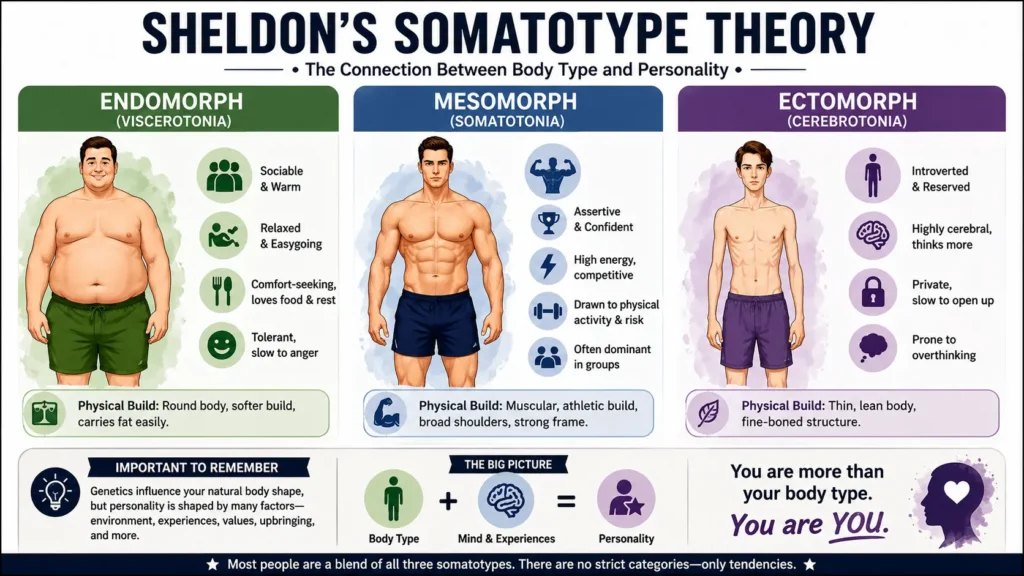
Sheldon’s theory rests on three body types. Each one has a physical build and a matching temperament.
1. Endomorph (Viscerotonia)
Endomorphs have a round, soft body build. They store fat easily and carry a wider frame.
Sheldon linked endomorphs to these traits:
- Relaxed and easygoing
- Sociable and warm
- Comfort-seeking, often enjoying food and rest
- Slow to anger, tolerant of others
2. Mesomorph (Somatotonia)
Mesomorphs have a muscular, athletic build. Broad shoulders. Solid frame.
Sheldon linked mesomorphs to these traits:
- Assertive and confident
- High energy, competitive
- Drawn to physical activity and risk
- Often dominant in group settings
If assertiveness as a trait interests you beyond body type, our guide on aggression vs assertiveness breaks down the healthy line between the two.
3. Ectomorph (Cerebrotonia)
Ectomorphs are thin and lean. Fine-boned. Often described as fragile.
Sheldon linked ectomorphs to these traits:
- Introverted and reserved
- Highly cerebral, meaning they think more than they act
- Private, slow to open up
- Prone to overthinking
Difference Between an Endomorph and a Mesomorph
The gap is easy to remember. Endomorphs carry more fat. Mesomorphs carry more muscle.
Sheldon believed this physical gap created a personality gap too. Endomorphs lean social and relaxed. Mesomorphs lean assertive and driven.
Is an Endomorph a Real Thing?
Yes, in one sense. Body types genuinely vary. Some people naturally carry more fat mass.
But here is the catch. Sheldon’s Somatotype Theory of Personality never stopped at body fat. It claimed a fixed personality comes bundled with it. That link is the part science could never confirm.
Can You Be a Mix of Somatotypes?
Almost everyone is. A pure endomorph, mesomorph, or ectomorph is rare. Most people are a blend, like an endo-mesomorph or a meso-ectomorph.
Sheldon accounted for this with his scoring system, which we cover next.
How to Identify Your Somatotype
Look at three things. Your natural fat storage tendency. Your muscle-to-frame ratio. Your bone structure.
None of this needs to be exact. Sheldon’s own scoring assumed most people are a blend, not a pure type.
Who is stronger, endomorph or mesomorph? Mesomorphs usually win on raw strength. Higher muscle mass gives them the edge. Endomorphs can be strong too, but their build favors bulk over pure power.
Is ectomorph the rarest body type? There is no solid global data to confirm this. Body type distribution depends on genetics, diet, and region. Treat any “rarest type” claim with caution.
Scoring System Behind Sheldon’s Somatotype Theory
Sheldon did not stop at three simple boxes. He built a scoring system. Every person got rated on all three dimensions, using a scale of 1 to 7.
| Component | Full Endomorph | Full Mesomorph | Full Ectomorph |
|---|---|---|---|
| Score format | 7-1-1 | 1-7-1 | 1-1-7 |
| Dominant trait | High fat storage | High muscle mass | Low fat and muscle, high linearity |
This scoring created 343 possible combinations. Sheldon studied about 4,000 photographs of college-age men to build it. He took 17 separate body measurements per subject.
Sounds scientific on paper. But there was a flaw. The scoring relied on visual judgment by a trained observer. Not on objective tools.
That single flaw became one of the biggest criticisms of Sheldon’s Somatotype Theory of Personality.
Sheldon’s Theory and Criminology
Sheldon did not stop at personality. He took the theory into criminology. This is where it turned controversial.
In his 1949 book, “Varieties of Delinquent Youth,” Sheldon compared young offenders with college students. His conclusion? Mesomorphs, the muscular type, were more likely to become delinquent.
A later, larger study by Sheldon and Eleanor Glueck went further. They studied 500 persistently delinquent boys against 500 matched non-delinquent boys. The result: 60.1% of the delinquent group was predominantly mesomorphic. Only 30.7% of the control group was.
That is a striking gap. But numbers alone do not prove causation.
Criminologist Edwin Sutherland pushed back hard. He argued Sheldon’s comparison groups were poorly matched. The data, he said, did not prove body type caused crime. It only showed a correlation.
Modern criminology has moved past body-type explanations. Today, researchers look at social environment, upbringing, and economic pressure. Not physical build.
Has Sheldon’s Somatotype Theory of Personality Been Debunked?
This is the question most people actually want answered. The honest answer? Yes, mostly. But it needs some nuance.
Is Somatotyping a Pseudoscience?
Several researchers place Sheldon’s Somatotype Theory of Personality in the same bucket as phrenology, the old idea that skull shape reveals personality. The core problem is reliability.
Different observers often rated the same person differently. According to Simply Psychology’s detailed review of Sheldon’s constitutional theory, his methods relied heavily on subjective observation rather than objective measurement, a flaw that later research could not overcome.
One academic review put it bluntly:
“The result was a system where two different observers could assign meaningfully different somatotype scores to the same individual.”
Psychologist Hans Eysenck reviewed Sheldon’s data using more controlled methods. He found no real support for the claims. That matters, since Eysenck remains one of the most respected personality researchers of the last century.
Strengths and Weaknesses of Sheldon’s Somatotype Theory of Personality
Sheldon’s work was not entirely without value. Here is a fair breakdown.
| Strengths | Weaknesses |
|---|---|
| Structured, numeric classification of physique | Relied on subjective visual judgment |
| Sparked decades of research on biology and personality | Small, non-diverse sample (only male students) |
| Heath-Carter formula still used in sports science today | Poor reliability across repeated studies |
| Opened debate on the biological roots of temperament | Used to support biased criminology claims |
Is Somatotyping Still Relevant Today?
Not as a personality model. But a modified version, the Heath-Carter method, is still used in sports science. It tracks athletes’ body composition.
So the measurement tool survived. Sheldon’s Somatotype Theory of Personality, as a personality model, mostly did not.
Can Your Somatotype Change?
People search this question constantly. The answer has two parts.
Are Somatotypes Genetic, or Can They Change With Age?
Your natural build has a genetic component. But diet, exercise, hormones, illness, and age all shape how your body actually looks over time.
Sheldon assumed somatotype was fixed at birth. Most researchers today disagree with that rigid view.
Can Endomorphs Become Ectomorphs?
Not in terms of bone structure. Your frame stays your frame.
But body composition, meaning fat and muscle levels, can shift a lot with lifestyle changes. Someone with an endomorphic tendency can build muscle and lose fat. Their appearance changes, even if their underlying frame does not.
If building that kind of consistency is what you are after, our guide on how to build willpower covers the daily habits that make lasting change possible.
Are Somatotypes Fixed?
Your skeletal frame is largely fixed. Your body composition is not. This distinction matters. It separates what genetics gave you from what lifestyle can still shape.
Is Somatotype the Same as Body Composition?
No. This is a common mix-up.
Body composition is your current ratio of fat, muscle, and bone. It changes. Somatotype, as Sheldon defined it, was meant to describe a more fixed, underlying type. Fitness culture often blends the two loosely today, but they are not the same thing.
Sheldon’s Theory vs Other Personality Theories
Sheldon was one of many psychologists trying to classify personality. Here is how his work stacks up against a few others.
| Theory | Core Idea | Scientific Standing Today |
|---|---|---|
| Sheldon’s Somatotype Theory of Personality | Body build determines temperament | Largely rejected, weak reliability |
| Jung’s Theory of Personality | Personality shaped by psychological functions and attitudes | Influential, foundation of MBTI |
| Erikson’s Stages of Development | Personality develops through 8 life-stage conflicts | Widely taught, still influential |
| Big Five (Five Factor Model) | Personality measured across five broad traits | Strongly supported by research |
For a different angle on how personality forms through life stages rather than physique, our article on Erikson’s Industry vs Inferiority stage is worth a read.
Sheldon’s Somatotype Theory of Personality for Psychology Students and Exams
Studying psychology in India? This theory shows up often. B.Ed courses, UGC-NET, and state PSC exams all cover it under “Type Theories of Personality.”
Here is what examiners usually expect:
- The three somatotypes and their matching temperaments (viscerotonia, somatotonia, cerebrotonia)
- The embryological basis (endoderm, mesoderm, ectoderm)
- The 1 to 7 scoring system and what 7-1-1, 1-7-1, and 1-1-7 mean
- The criminology angle from “Varieties of Delinquent Youth”
- The main criticism: poor reliability and a small sample size
Quick memory trick for exams: subjective, small sample, not replicated. Those three words cover most mark-scoring points for Sheldon’s Somatotype Theory of Personality.
For the deeper roots of how any personality theory takes shape, our guide on personality development from genes to Freud traces that history in detail.
Why Understanding Sheldon’s Somatotype Theory of Personality Still Matters
The personality claims did not survive scrutiny. But there is still a practical reason people care about somatotypes today.
Knowing your natural build helps you set realistic fitness goals. It helps you pick training methods that actually suit your body. It also helps you stop comparing yourself to body types that were never yours to begin with.
If body image or self-comparison is what brought you here, personality runs deeper than physique. Our article on how childhood experiences shape personality development explains what actually drives who you become.
Final Thoughts
Sheldon’s Somatotype Theory of Personality tried to answer a question people still ask today. Does your body shape your mind? His answer was a confident yes.
What survives today is mostly the vocabulary. Endomorph, mesomorph, and ectomorph. Still common terms in gyms and fitness circles. The personality claims attached to them did not hold up the same way.
Your body build may influence how you move and train. Sheldon’s Somatotype Theory of Personality does not determine who you are.
FAQs
1. What is the strongest somatotype?
Mesomorphs generally hold the physical edge. Higher natural muscle mass gives them more raw strength. This is a physical observation, not a personality claim.
2. What is the personality of an ectomorph, according to Sheldon?
Sheldon described ectomorphs as introverted, reserved, and highly cerebral. They think more than they act. This is Sheldon’s original claim, not a confirmed scientific fact.
3. What is Sheldon’s Somatotype Theory of Personality in one line?
It says human physique falls into three categories: endomorph, mesomorph, and ectomorph, each linked to a distinct personality pattern.
4. Is being a mesomorph rare?
No strong global data confirms rarity for any single type. Most people are a blend of all three, not a pure type.

Ayanshi is the founder of PersonaGuru.in, a blog dedicated to personality development, relationships, and mental health. With 3+ years of writing experience and 250+ published articles, she simplifies psychology into practical, everyday advice for real people.