
Last updated on September 13th, 2026 at 12:12 pm
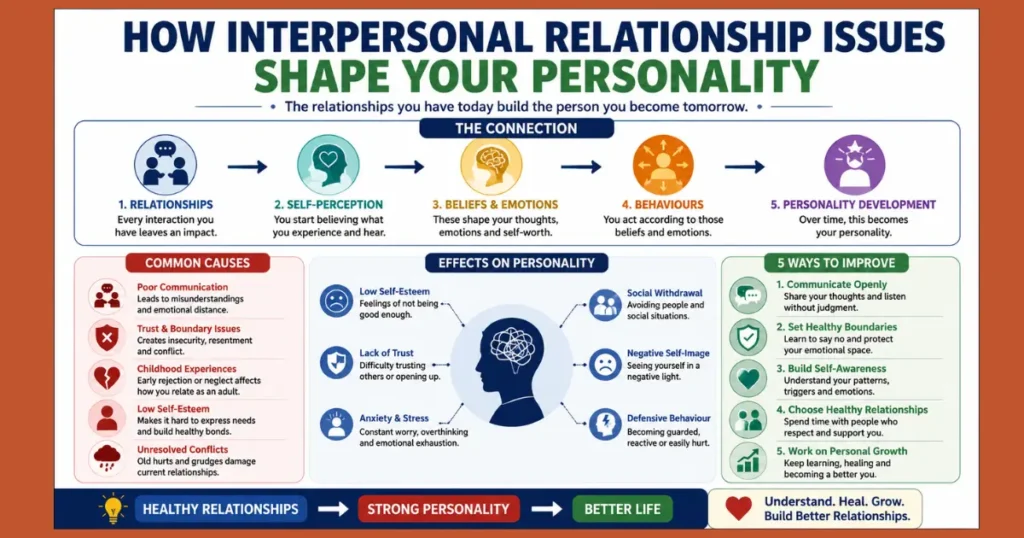
Every person who stays in your life for long enough leaves a mark on you. A close friend, a difficult sibling, a partner who never really listens, a boss who never says thank you. These bonds do not just affect your mood for one day. Over the years, they quietly shape your confidence, your habits, and even the way you see yourself.
This is exactly why interpersonal relationship issues in personality development deserve real attention. When your relationships are healthy, they build a stable, secure identity. When they stay strained for years, they can reshape your personality in ways you never chose.
In this guide, you will learn what interpersonal relationship issues in personality development actually look like, why they happen, and what they do to your self-esteem and behaviour over time. You will also get real, usable steps to fix them, starting today.
Key Takeaways
- Interpersonal relationship issues in personality development are ongoing problems in how you connect, communicate, or bond with others.
- These issues directly shape personality traits such as self-esteem, trust, and emotional openness.
- Common causes include poor communication, insecure attachment, and unresolved childhood patterns.
- Left unresolved, interpersonal relationship issues can lead to low self-worth, chronic mistrust, or social withdrawal.
- Small, consistent changes in communication and boundaries can reverse much of this damage.
What Are Interpersonal Relationship Issues in Personality Development?
Interpersonal relationship issues in personality development refer to the recurring problems people face while forming or maintaining bonds with others. This includes family, friends, romantic partners, and colleagues.
These issues matter so much because relationships are one of the biggest forces shaping who you become. Psychologist Charles Cooley described this through his idea of the “looking glass self.” In simple words, you build your sense of identity partly by imagining how others see you.
So when relationships are full of conflict or distance, that reflection gets distorted. A person may start seeing themselves as unlovable or not good enough, even when that is far from true.
Take Rohan, a 29 year old marketing executive from Pune. For years, his friends teased him for being “too serious.” He slowly started believing it, avoided social gatherings, and became quieter at work too. One relationship pattern had reshaped how he showed up everywhere.
Our detailed piece on self-concept in personality development explains this mirroring effect in more depth.
How Interpersonal Relationships Shape Your Personality
Relationships do not just reflect your personality. They actively build it. Every interaction teaches you something, whether you notice it or not.
- Secure, supportive relationships teach patience, empathy, and trust.
- Conflict-heavy relationships can teach defensiveness, anxiety, or avoidance.
- Constant rejection can quietly train a person into people-pleasing behaviour.
As one veteran relationship counsellor once told me during a client discussion, “People do not just react to each other. Over years, they slowly turn into the pattern of how they were treated.” That line has stayed with me, because it explains why interpersonal relationship issues in personality development are rarely about one single fight. They are about years of small moments adding up.
7 Types of Interpersonal Relationship Issues
Not all relationship problems look the same. Some are loud and obvious. Others stay quiet for years before anyone notices them.
| # | Type of Issue | What It Looks Like | Personality Impact |
|---|---|---|---|
| 1 | Communication breakdown | Talking past each other, avoiding hard topics | Isolation, resentment |
| 2 | Trust and boundary issues | Struggling to say no, feeling used | People-pleasing, burnout |
| 3 | Rejection sensitivity | Overreacting to small signs of distance | Anxiety, clinginess |
| 4 | Emotional withdrawal | Shutting down during conflict | Detachment, coldness |
| 5 | Unresolved conflict | Same fight repeating without real resolution | Chronic frustration, cynicism |
| 6 | Unrealistic expectations | Expecting a partner or friend to meet every need | Constant disappointment |
| 7 | Lack of emotional validation | Feelings dismissed or minimised regularly | Low self-worth, self-doubt |
1. Communication Breakdown
This happens when one or both people stop expressing their real thoughts and feelings. Small misunderstandings pile up over months.
Example: Ananya’s partner asked if she was upset. She said “I am fine,” when she was clearly not. He had no idea anything was wrong. Repeated for a year, this single habit taught both of them that honesty was not safe in their relationship.
2. Trust and Boundary Issues
Trust is not built once. It gets rebuilt every single day through small, consistent actions. When trust breaks, or when a person never learns healthy boundaries, resentment builds quietly in the background.
Many people who struggle here were never taught boundaries growing up. Our article on how childhood experiences shape personality development covers this connection closely.
3. Rejection Sensitivity
Some people read too much into small signals, like a delayed reply or a short reply. This often starts from earlier experiences of real rejection and becomes a lens through which every new relationship is filtered.
4. Emotional Withdrawal
This happens when a person shuts down completely during conflict instead of engaging. Over time, the other person feels shut out, and the relationship loses its emotional closeness.
5. Unresolved Conflict
Some couples or friends have the exact same argument for years, never actually resolving the root issue. Vikram and his brother have fought about the same family property issue for over a decade. Nothing changes because neither addresses the real hurt underneath it.
6. Unrealistic Expectations
When one person expects a partner or friend to fulfil every emotional need, disappointment becomes constant. No single relationship can carry that weight alone.
7. Lack of Emotional Validation
When feelings are repeatedly dismissed (“you are overreacting,” “it is not a big deal”), a person slowly stops trusting their own emotional responses. This directly damages self-esteem over time.
What Causes Poor Interpersonal Relationships?
There is rarely one single cause behind interpersonal relationship issues in personality development. Most struggles come from a mix of early experiences, personality traits, and present day stress.
Childhood Attachment Patterns
British psychiatrist John Bowlby’s attachment theory explains that our earliest bond with a caregiver builds a template for every future relationship. According to Simply Psychology’s overview of attachment theory, children who face inconsistent caregiving often grow into adults with anxious or avoidant attachment styles.
This pattern is not permanent. It simply needs conscious, steady effort to change.
Interpersonal Relationships and Personality Disorders
For some individuals, deeper patterns like certain personality disorders can make forming stable relationships far more difficult. This can include intense fear of abandonment, difficulty trusting others, or extreme sensitivity to perceived criticism.
If relationship struggles feel severe, persistent, and are affecting daily functioning, speaking with a licensed mental health professional is the safest next step.
Current Life Stress
Recent data adds real weight to this picture. According to the American Psychological Association’s 2025 Stress in America report, a large share of American adults say their closest relationships do not give them enough emotional support, and high stress levels are strongly tied to social disconnection. Stress does not just come from relationships. It also makes existing interpersonal relationship issues worse.
Negative Effects on Personality Development
Unresolved relationship issues rarely stay contained to one area of life. They tend to spill into how a person sees themselves entirely.
Low Self-Esteem and Identity Confusion
Constant friction or criticism, especially from people close to you, chips away at confidence. Over time, this can create a shaky sense of identity, where a person is unsure of their own worth outside of others’ approval.
Defensive Traits: Withdrawal, Anger, Mistrust
When conflict goes unresolved again and again, the mind starts protecting itself. This often shows up as:
- Withdrawing from social situations
- Quick anger or irritability
- Chronic suspicion of others’ intentions
These are not character flaws. They are learned defence mechanisms. Recognising them is the first step to unlearning them.
Interpersonal Relationship Issues in Adults
While these patterns often begin in childhood, interpersonal relationship issues in adults can show up clearly across every type of relationship, including romantic partnerships, family relationships, friendships, and the workplace.
Real-Life Examples
- Romantic relationships: A partner avoids all conflict, leading to years of buried resentment.
- Workplace relationships: A colleague struggles to say no, ends up overloaded, and grows quietly bitter.
- Family relationships: An adult child still seeks approval from a critical parent, shaping every major life decision.
Communication patterns learned early often repeat in adult partnerships. Our guide on how to communicate with an avoidant partner walks through one of the most common versions of this.
Why Do I Struggle With Interpersonal Relationships?
This is one of the most searched questions on this topic, and for good reason. Usually, the struggle comes down to one or more of these:
- A fear of vulnerability, often from past hurt
- Never learning healthy communication growing up
- Low self-esteem making closeness feel unsafe
- Unrealistic expectations of what relationships should look like
How Interpersonal Relationships Contribute to Personal Development
It is easy to focus only on the damage relationships can cause. But the same bonds that can hurt personality development are also the ones that heal it.
Building Self-Concept Through Social Feedback
Positive, honest feedback from people you trust helps build a stable, accurate self-image. A friend who tells you the truth kindly, a partner who celebrates your wins, a mentor who genuinely believes in your growth. These interactions slowly rebuild what damaged relationships once tore down.
How Healthy Relationships Build Emotional Maturity
Working through conflict, rather than avoiding it, is one of the fastest ways to grow emotionally. Every resolved disagreement teaches patience, empathy, and self-control.
This links closely to emotional regulation as a whole. Our article on emotional intelligence explains how these same skills apply across every relationship in your life.
5 Ways to Develop Good Interpersonal Relationships
If you want to learn how to develop good interpersonal relationships, start with a few consistent habits rather than trying to change your entire personality.
- Improve communication skills. Say what you mean, calmly and clearly, instead of hinting or staying silent.
- Set healthy boundaries. Learn to say no without guilt. A boundary protects the relationship; it does not damage it.
- Practise active listening. Put away distractions. Repeat back what you heard before responding.
- Work on your attachment wounds. Notice your patterns. Anxious? Avoidant? Naming it is the first step to changing it.
- Know when to seek professional support. A therapist can help untangle patterns that feel too deep to solve alone.
A small daily habit, like asking one honest question (“How are we doing, really?”), can prevent months of quiet resentment.
Conclusion
Interpersonal relationship issues in personality development are not a sign of a broken character. They are learned patterns, built over years, and every learned pattern can be reshaped with the right awareness and effort.
If you recognised your own story somewhere in Rohan’s, Ananya’s, or Kabir’s, take that as a starting point, not a verdict. Start with one honest conversation this week. Set one small boundary. That is how real change in interpersonal relationship issues in personality development actually begins.
Explore more practical guides on personaguru.in to keep building a stronger, more self-aware personality, one relationship at a time.
FAQs
1. What is the most important relationship in personality formation?
The earliest caregiver relationship, usually with a parent, is considered the most influential. It forms the attachment style that shapes every relationship that follows.
2. What factors strengthen interpersonal relationships?
Honest communication, consistency, mutual respect, and the willingness to repair conflict quickly all strengthen relationships over time.
3. Why are interpersonal relationships important in personality development?
They provide the social feedback that shapes self-esteem, emotional regulation, and identity. Personality never develops in isolation.
4. What are examples of interpersonal relationships?
Common examples include parent-child bonds, friendships, romantic partnerships, sibling relationships, and workplace relationships.

Ayanshi is the founder of PersonaGuru.in, a blog dedicated to personality development, relationships, and mental health. With 3+ years of writing experience and 250+ published articles, she simplifies psychology into practical, everyday advice for real people.