
Priya was the topper of her class every single year. On paper, she had every reason to feel proud of herself. Yet she often told me she felt like a fraud, waiting for someone to finally notice she was not as good as her grades suggested.
Her marks were high. Her self-esteem was not. That gap is more common than most people realize, and it points to something important. Self-esteem rarely comes from achievement alone.
Understanding the real factors affecting self-esteem in personality development helps explain why two equally capable people can see themselves so differently. This guide breaks down exactly what shapes self-esteem, using real research and simple, human examples.
Key Takeaways
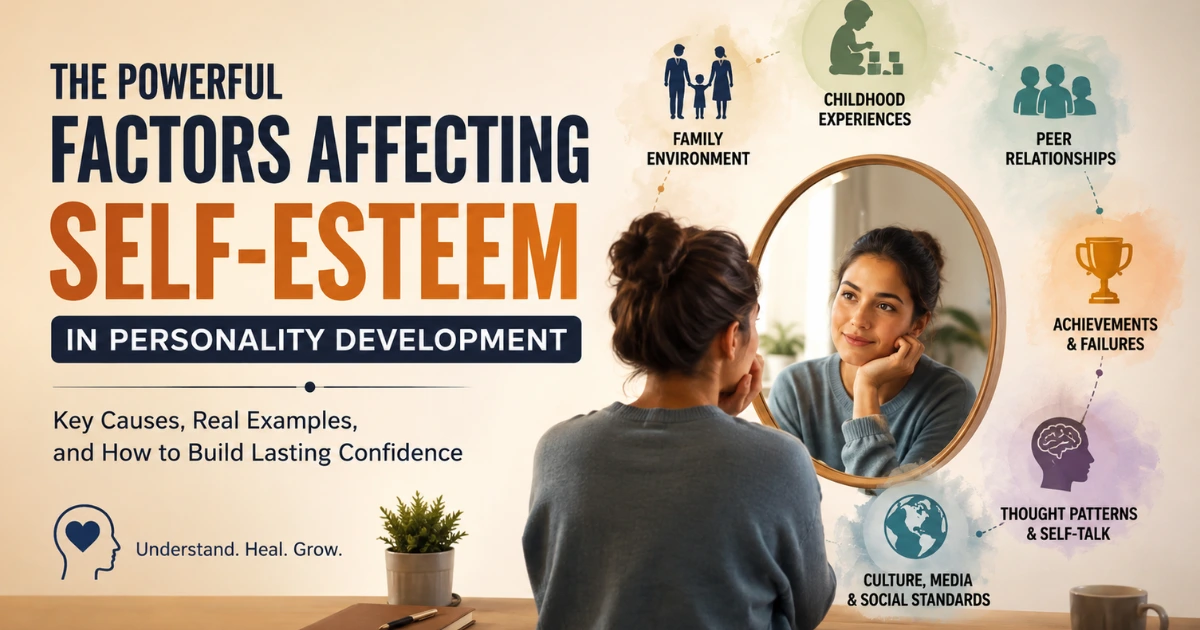
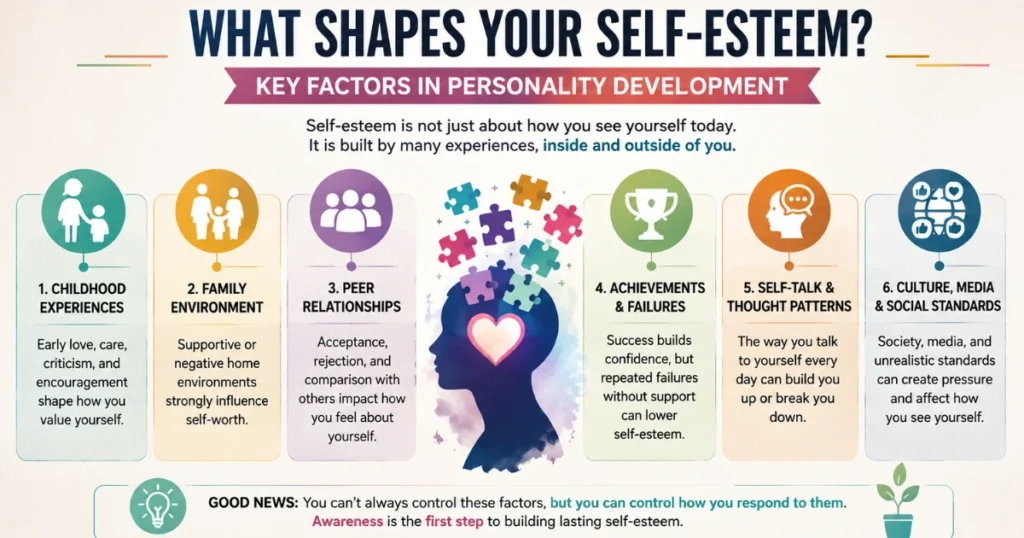
- The main factors affecting self-esteem in personality development include childhood experiences, family environment, peer relationships, personal achievements, thought patterns, and culture.
- Childhood and self-esteem are closely linked, since early caregiving experiences often set the pattern adults carry for decades.
- Self-esteem is not fixed. It shifts across your life as your environment and experiences change.
- A 2025 Pew Research Center survey found that 48% of teens now say social media has a mostly negative effect on people their age, up sharply from 32% in 2022.
- Girls report more damage to their confidence from social media than boys do, according to the same survey.
- You cannot control every factor that shaped your self-esteem growing up, but you can control how you respond to those factors today.
What Is Self-Esteem in Personality Development?
Self-esteem is how much value and worth a person believes they hold, independent of what others think. It is one of the quiet, invisible pillars that personality is built on. The factors affecting self-esteem in personality development shape that pillar from a very young age.
High self-esteem usually shows up as calm confidence, the ability to accept feedback without falling apart, and comfort with who you are. Low self-esteem often looks like constant self-doubt, difficulty accepting compliments, or a harsh inner critic that never seems satisfied.
If you are looking for practical steps to strengthen your own self-esteem, our guide on how to build self-esteem walks through the exact process. Here, the focus stays on understanding where self-esteem actually comes from.
What Are the Factors That Affect Self-Esteem?
The factors affecting self-esteem in personality development fall into two broad groups. Internal factors include your thought patterns, achievements, and temperament. External factors include your family, peers, culture, and life events. Together, these explain most of the differences you see between confident and self-doubting adults.
Neither group works alone. A supportive family can soften the blow of a harsh internal critic, while a critical thought pattern can undo even the most loving upbringing if it goes unchecked.
6 Key Factors Affecting Self-Esteem in Personality Development
1. Childhood Experiences and Upbringing
Childhood and self-esteem are closely linked, more than most other factors on this list. Self-esteem starts forming earlier than most people expect, often before a child can even speak. The way caregivers respond to a child’s early efforts, whether with encouragement or criticism, quietly sets a template for how that child will judge themselves for years to come.
A child who hears “you can try again” after a mistake tends to grow up believing failure is survivable. A child who hears only criticism tends to grow up believing failure defines them.
We cover this in far greater depth in our guide on how childhood experiences shape personality development.
2. Family Environment and Parenting Style
Beyond individual moments, the everyday feel of a home stays with you for years. Warm, structured parenting tends to build secure self-esteem. Harsh, unpredictable, or overly controlling parenting often leads to anxiety and a shaky sense of self-worth.
Household stability matters here too. A chaotic or unstable home can quietly erode a child’s sense of safety long before it affects their grades or friendships.
Our detailed guide on the role of family in personality development explores specific parenting patterns and their long-term effects on children.
3. Peer Relationships and Social Comparison
Once children reach school age, peers become almost as influential as parents. Being accepted, teased, or excluded by classmates leaves a real mark on self-worth.
Social comparison plays a huge role here, and it does not stop in childhood. Adults compare careers, relationships, and lifestyles constantly, often without realizing how much it chips away at self-esteem.
Rohan, a reader who once wrote to me after a workshop, said he spent his twenties comparing his slow career growth to friends who seemed to be racing ahead. It was only when he stopped scrolling through everyone else’s highlight reel that his own sense of self-worth started to stabilize.
4. Achievements, Failures, and Sense of Competence
Reaching personal goals genuinely builds self-esteem, but only when the goals feel authentic rather than imposed. Repeated, unmanaged setbacks, especially without support, can create a feeling of helplessness that outlasts the actual failure.
This is exactly what happened with Priya from the opening of this guide. Her achievements were real, but because she never felt they were truly her own, they failed to translate into genuine self-esteem.
5. Cognitive Thought Patterns and Self-Talk
How you talk to yourself matters as much as what happens to you. Habitual negative self-talk, like assuming the worst about your own abilities, reinforces low self-esteem even when the outside evidence does not support it.
This factor is unique because, unlike childhood or family background, it is one you can actively work on and reshape at any age.
6. Culture, Media, and Social Standards
Culture quietly decides what worth is supposed to look like, whether that is academic success, physical appearance, or social status. Media, and social media in particular, has intensified this pressure enormously in recent years.
According to a 2025 Pew Research Center survey, 48 percent of teens now say social media has a mostly negative effect on people their age, a sharp rise from 32 percent in 2022. The same research found girls are twice as likely as boys to say social media has hurt their confidence.
What Are the Factors That Affect Self-Esteem Negatively?
Some of these factors do not just fail to build self-esteem. They actively damage it over time, and understanding the causes of low self-esteem is often the fastest way to stop that damage.
| Negative Factor | How It Affects Self-Esteem |
|---|---|
| Childhood criticism or neglect | Creates deep, lasting self-doubt |
| Bullying or peer rejection | Directly harms sense of belonging and worth |
| Negative self-talk | Reinforces core beliefs of inferiority |
| Unrealistic social media comparison | Skews body image and success standards |
| Controlling relationships | Damages an already established sense of self-worth |
| Chronic unmanaged failure | Builds a pattern of learned helplessness |
Seeing which of these show up in your own story is often the first real step toward change.
How Do These Factors Shape Personality Development?
Self-esteem does not stay contained to how you feel about yourself. It spills into nearly every visible part of your personality.
People with healthy self-esteem tend to communicate more openly, take on new challenges without excessive fear, and recover from setbacks faster. People with low self-esteem often avoid risks, struggle with assertiveness, and read neutral situations as personal criticism.
Psychologist Nathaniel Branden, one of the most cited voices in self-esteem research, once described self-esteem as the reputation you have with yourself. That reputation, built from every factor covered above, becomes the lens your entire personality gets viewed through.
If low self-esteem shows up specifically as difficulty speaking up or setting boundaries, our guide on factors affecting assertiveness in personality development explores that connection in more detail.
Self-Esteem vs Self-Confidence: Are the Factors the Same?
When people compare self-esteem vs self-confidence factors, they often assume the two are identical. They are not quite the same thing.
Self-esteem is your overall sense of worth as a person. Self-confidence is your belief in your ability to succeed at specific tasks or skills. You can be confident at your job while still struggling with low self-esteem in your personal life.
The factors overlap heavily; family, achievements, and social comparison shape both, but self-confidence responds more directly to skill building and practice, while self-esteem tends to require deeper emotional work.
How to Protect and Strengthen Your Self-Esteem
Once you know the factors that affect you most, you can start working against the ones that hurt you.
- Separate your worth from your achievements. Remind yourself that failing at a task does not make you a failure as a person.
- Limit comparison triggers. Reduce time spent on social media accounts or situations that consistently leave you feeling smaller.
- Practice honest self-talk. Notice when your inner voice turns harsh, and consciously replace it with something you would actually say to a friend.
- Surround yourself with supportive people. The relationships you keep as an adult can slowly reshape patterns set in childhood.
- Celebrate effort, not just outcomes. This single shift helps rebuild a healthier relationship with failure over time.
Want to track this yourself? Download our free Self-Esteem Factors Worksheet — a 2-page printable that helps you rate which factors affect you most, reframe harsh self-talk, and track your progress over 7 days.
For a full, step-by-step approach to building lasting self-esteem, our complete guide on how to build self-esteem is worth reading next.
Conclusion
The factors affecting self-esteem in personality development are rarely just one thing. Childhood, family, peers, achievements, self-talk, and culture all combine to shape how you see yourself.
You cannot rewrite the factors that already shaped your past. But understanding them clearly, the way Priya eventually did, is often the first step toward building a self-esteem that finally feels like your own.
Explore our complete personality development guide to see how self-esteem fits into the bigger picture of who you are becoming.
Which of these factors do you think has shaped your own self-esteem the most? It is worth sitting with that question for a moment before you move on with your day.
FAQs
1. What are the factors that affect self-esteem?
The main factors affecting self-esteem in personality development are childhood experiences, family environment, peer relationships, personal achievements and failures, thought patterns, and cultural or social standards, including media influence.
2. What are 7 factors that affect self-esteem negatively?
Common negative factors include childhood criticism, neglect, bullying, negative self-talk, unrealistic social comparison, controlling relationships, and repeated unmanaged failure.
3. Is self-esteem a personality factor?
Self-esteem is closely tied to personality but is considered a psychological trait shaped by both internal thought patterns and external experiences, rather than a fixed personality type.
4. What factors influence self-esteem in children?
In children, parenting style, early caregiving warmth, school experiences, and peer acceptance are some of the strongest influences on developing self-esteem.
5. How does self-esteem affect personality development?
Self-esteem shapes how openly a person communicates, how they handle failure, and how assertive or withdrawn they become, making it one of the most influential factors in overall personality development.

Ayanshi is the founder of PersonaGuru.in, a blog dedicated to personality development, relationships, and mental health. With 3+ years of writing experience and 250+ published articles, she simplifies psychology into practical, everyday advice for real people.