
Last updated on September 18th, 2026 at 07:40 am
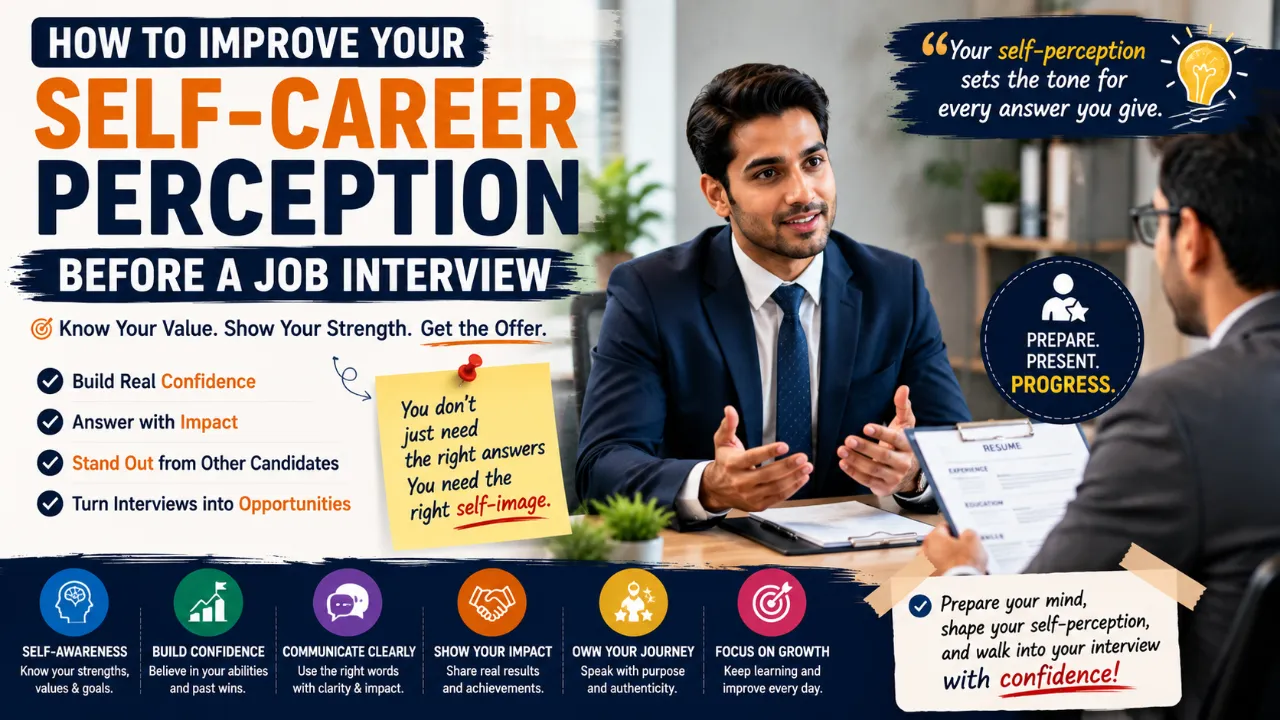
How to improve self-career perception in interview settings comes down to four things: build a story bank of real wins, drop weak or apologetic words, treat the interview as a two-way conversation, and rehearse your answers out loud until they sound natural. Interviewers notice your self-image in the first minute, long before your first real answer.
Have you ever left an interview thinking, “I knew the answers, so why did I sound so unsure?” That gap isn’t a skills problem. It’s about how you see yourself, before you even walk into the room.
Most people prep answers. Very few prep how they see themselves. But interviewers pick up on your self-image within the first minute.
This guide builds on our main guide on self-career perception in personality development, applied directly to interview day.
Key Takeaways
- Self-career perception has three parts: self-awareness, self-efficacy, and career identity.
- Interviewers notice your self-perception through word choice and body language.
- A story bank of 4 to 5 real wins is the fastest way to sound confident.
- Treat the interview as a two-way fit check, not a test you might fail.
- Small daily practice works better than a last-minute pep talk.
What Is Self-Career Perception
Self-career perception is simply how you see your own worth at work. It has three parts.
Self-awareness means knowing your real strengths and weaknesses. Self-efficacy means believing you can hit your goals. Career identity means how much your job feels like part of who you are.
All three show up in an interview. “Tell me about a failure” tests self-awareness. “Why should we hire you?” tests self-efficacy. “Where do you see yourself in five years?” tests career identity.
Two candidates with the same experience can get very different results. It is rarely about who knew more. It is about who believed more and showed it.
Why Interviewers Sense Your Confidence First
Recruiters read self-awareness signals through the whole interview, not just one question. Indeed’s guide to personality interview questions explains that even a simple weakness question tests whether you can talk about yourself honestly, without sounding defeated or arrogant.
This links to what psychologists call occupational self-concept. It is how your general self-image shapes your behavior at work. Career research suggests that self-concept is not fixed. It shifts with each role, each feedback cycle, and each interview outcome, which is why practicing it before a high-stakes interview actually works. Interviews are one of the sharpest moments where it gets tested.
In short: your posture, pauses, and word choice are all being read as data.
What Interviewers Actually Look For
Most interviewers are not testing your knowledge alone. They are checking one thing underneath every question: will this person represent themselves accurately once they are inside the team?
Hiring managers commonly flag two patterns as risk signals. One is over-claiming, where every answer sounds too polished with no real detail. The other is under-claiming, where a strong candidate downplays real work out of habit. Both break trust in different ways.
A calm, specific answer beats a perfect one. Interviewers remember the candidate who paused, thought, and answered honestly far more than the one who recited a rehearsed line.
How to Improve Self-Career Perception in an Interview
This is the part that actually changes your results. Below are eight simple steps for how to improve self-career perception in interview settings, starting today.
1. Build a Story Bank First
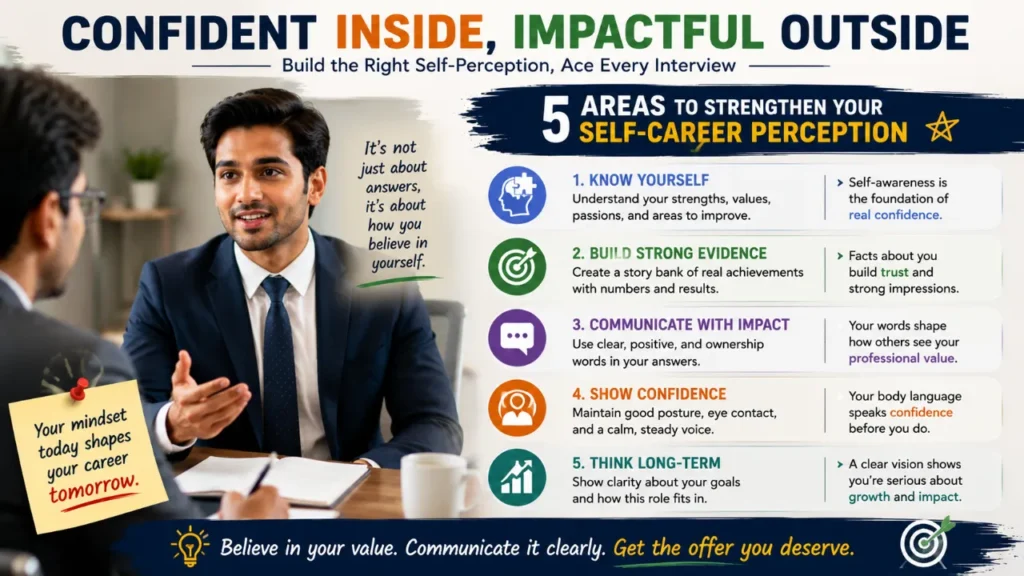
Write down 4 to 5 real wins before the interview. Add a number or result where you can.
- A time you increased something (sales, speed, retention)
- A time you fixed a real problem
- A time you led something, even without a title
- A time you learned fast under pressure
This way, you recall facts under stress. You do not invent confidence on the spot.
2. Use a Simple Formula for Failure Questions
“Tell me about a failure” is not a trap. It checks self-awareness. Use three parts: what happened, what you did, what you learned. Skip the apology.
Example: Rohit, a supply chain lead from Pune, used to freeze on this question. He rewrote his answer with this formula: a shipment delay he missed, the fix he built after, and the habit he still uses. His interviewer called it the most memorable answer of the day.
3. Treat It as a Two-Way Conversation
You are not there to be judged. You are checking if the role fits your goals, just as much as they are checking you. This shift moves your tone from pleading to calm.
Write down two real questions you want to ask them. Asking these later proves the shift is real, not just a pep talk.
4. Drop Weak Words, Use Ownership Words
Small word choices quietly hurt how confident you sound.
| Weak Phrasing | Ownership Phrasing |
|---|---|
| “I kind of managed the project” | “I managed the project” |
| “I just helped with the launch” | “I worked directly on the launch” |
| “I’m not really a numbers person, but…” | “My focus is strategy, and I work closely with the numbers team” |
| “Sorry, can I clarify?” | “Just to confirm I understand…” |
Say your answers out loud once. Listen for “just,” “kind of,” and “I guess.” Cut them.
5. Practice Out Loud, Not in Your Head
Silent reading feels useful but does not train your voice or pace. Record yourself on your phone answering three common questions. Play it back. It feels odd the first time. That is exactly why it works.
6. Body Language Is Part of Self-Perception Too
Open posture, steady eye contact, and slower speech are not just for show. They send calm signals back to your own brain. Confidence is not only projected outward. It is also built by how your body signals to you.
7. Do a Five-Minute Check the Night Before
Do not cram facts the night before. Instead, answer three questions:
- What are my top three strengths right now?
- What is one example that proves each one?
- What do I genuinely want from this role?
This is the same checklist from our self-awareness guide. It works well the night before, because your last thoughts turn into evidence, not anxiety.
8. Handle Salary and Weakness Questions Without Losing Self-Perception
These two questions break self-perception faster than any other. Most people either go silent or over-apologise.
For weakness questions, name one real weakness, then show the fix in progress. Do not soften it into a hidden strength (“I work too hard”). Interviewers hear that pattern constantly, and it lowers trust, not raises it.
For salary questions, give a number range based on real research, not a guess. State it once, calmly, without a follow-up apology. A pause after your number is not a mistake. Let it sit.
Example: Priya, a UX designer, used to add “but I am flexible” right after every number. She dropped that line and kept her number flat. Her next two offers came in higher than her previous role, not lower.
A Real Example of Self-Career Perception in Interview Settings
Ananya, a marketing coordinator, was rejected twice for the same type of role. Her answers were correct but sounded unsure, full of “I think” and “maybe.”
Before her third interview, she built a story bank, dropped weak words, and treated the interview as a fit check. She got the offer. Her own words after: “The facts about me did not change. Only how I said them did.”
This pattern shows up often in career coaching work: structured practice with real feedback tends to beat a generic pep talk.
Common Mistakes to Avoid
- Memorizing word for word. This makes you sound robotic if a question is phrased differently.
- Comparing yourself to other candidates. You have no real data on them. It only hurts your calm.
- Fearing silence. Interviewers pause to think too. Silence is not always bad.
- Skipping “why this role.” A vague answer signals low career identity, even with strong skills.
- Apologizing before you answer. “Sorry, this might not be great” plants doubt before you even speak.
Conclusion
Your resume gets you the interview. Knowing how to improve self-career perception in interview moments is what decides if you get the offer. The good news: unlike years of experience, this is something you can shift in one week of focused practice.
Build your story bank today. Say it out loud twice before your next interview. Walk in as an equal, not a guest.
For the full framework behind this, read our guide on self-career perception in personality development. You can also check our guides on interview skills in personality development and improving your personality for job interviews. This ties into the broader career and workplace growth framework — planning, mindset, resilience, and daily habits together.
FAQs
1. What are some ways to improve my self-perception?
Start with self-reflection. Write down your real strengths and recent wins. Ask a mentor for honest feedback. Set small, real goals so you build proof, not just positive thoughts.
2. How to improve myself in an interview?
Build a story bank, practice answers out loud, research the role deeply enough to ask real questions, and use ownership words instead of weak ones.
3. How can I build self-confidence in a job interview?
Confidence comes from preparation you can point to, not just positive thinking. Specific examples, steady body language, and treating the interview as a two-way talk all build real, repeatable confidence.
4. What are my top 3 areas of improvement in interview questions?
Pick honest but manageable areas, like public speaking, delegating, or time estimates. For each, briefly say what you are doing about it. This shows self-awareness plus action, which is exactly what interviewers want.
5. Why do I sound nervous even when I know the answer?
This usually happens when your voice has never practiced the answer out loud; only your mind has. Nerves fill that gap. Recording yourself and speaking answers aloud a few times before the interview trains your voice, not just your memory, which is why it calms nerves faster than re-reading notes.

Ayanshi is the founder of PersonaGuru.in, a blog focused on personality development, career, relationships, and mental well-being. With over 3 years of writing experience, she turns psychology and everyday experiences into practical, easy-to-understand advice for real life.