

A coworker taking credit for my work can be frustrating, especially when your contribution gets overlooked in front of your manager or team. There is a clear way to handle it. Pause before you react. Decide if it happened once or if it is a pattern. If it is small, let it go. If it matters, talk to the person in private. Name what you did in one calm sentence. Ask a question instead of making an accusation. If it keeps happening, share your work directly with your manager and keep a written record.
You spend two late nights on a proposal. In the client meeting, your teammate walks through your slides and says “I” instead of “we.” Your manager nods along. You sit there, smiling, while your stomach turns.
If you have searched for coworker taking credit for my work right after a moment like this, you are looking for two things. You want to know what to say. You want to know if you are overreacting.
You are probably not overreacting. Staying quiet feels safer in the moment. Over time, it can cost you visibility and trust in your own work.
If a coworker taking credit for my work keeps happening to you, this guide gives you calm, exact words. You will get scripts for meetings, one-on-ones, and email. You will also learn how to stop it from happening again.
I write about workplace communication and personality development on PersonaGuru.in. My background is in HR, and I look closely at how small, everyday conversations shape how people are seen at work. Sometimes the hardest part is not knowing what happened. It is knowing what to say without turning the situation into a conflict.
Key Takeaways
- Pause first. A reaction said in anger rarely helps your case.
- Ask a question instead of making an accusation. It opens a conversation instead of a fight.
- Keep a simple record of your ideas and contributions.
- Share your progress with your manager directly, not only through a teammate.
- A repeated pattern needs a different response than a one-time mistake.
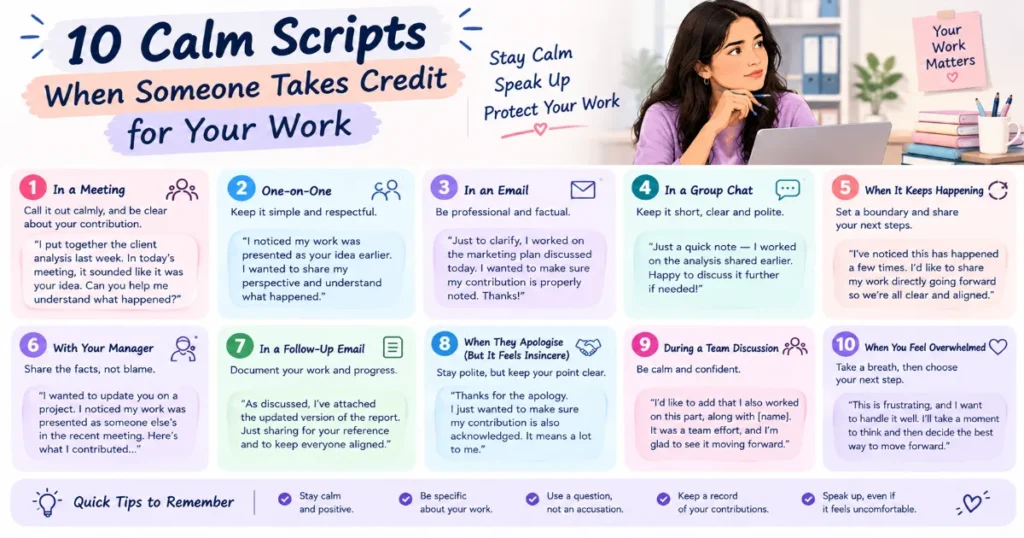
What Should You Do When a Coworker Takes Credit for Your Work?
Follow four steps. Pause, decide if it is worth raising, talk to the person privately, and involve your manager only if it continues. Each step matters on its own.
Step 1: Pause before you react
Your first feeling will likely be anger or shock. That is normal. Do not respond in that state.
Harvard Business Review contributing editor Amy Gallo has written about this exact moment, and her advice holds up well years later. She notes that reacting to a colleague right when it happens, while emotions are high, can be a mistake. A pause gives you room to think clearly.
Give yourself a few hours, or a full day if you can. Take a short walk. Write down exactly what happened while it is fresh.
Step 2: Decide if it is worth raising
A coworker taking credit for my work does not always call for a big conversation. Not every case needs one.
Ask yourself one question. Does this affect how people see my work, my growth, or my next review? If the answer is small, it may be easier to let it go this one time. If the answer is a clear yes, move to the next step.
Step 3: Talk to them privately and ask a question
Do not raise it in front of the group. A private, calm conversation works better. These tips for effective conflict resolution apply directly to this kind of talk.
Open with a fact, not a fight. Say what you did in one clear sentence. Then ask a question instead of an accusation.
Try this: “I put together the client analysis last week. In today’s meeting, it sounded like it was your idea. Can you help me understand what happened?”
This line does two things. It states your contribution clearly. It also gives the other person a chance to explain, apologise, or correct the record.
Step 4: If it continues, loop in your manager
When a coworker taking credit for my work is a one-off, a clear private conversation may resolve the misunderstanding. If it continues, you need a more structured approach. Share your work directly with your manager going forward. You do not need to frame it as a complaint. Simply keep them updated on what you are doing, in writing.
Assertive, not aggressive, is the goal here. This guide on the difference between aggression and assertiveness explains where that line sits.
What Is It Called When Someone Takes Credit for Someone Else’s Work?
There is no single formal term, but people commonly call it credit stealing, idea theft, or overclaiming. In academic writing on workplace behaviour, researchers sometimes use the term “credit taking.” It describes an employee claiming outsized credit for a shared or team effort.
You do not need the exact label to fix a coworker taking credit for your work. Knowing that this is a recognised, common workplace pattern can help you feel less alone in it.
Why Do People Take Credit for Other People’s Work?
The reason may be simple oversight, self-promotion, or a misunderstanding. Understanding the likely reason does not excuse the behaviour, but it does help you choose your response. Working on your own self-awareness also makes it easier to read the situation calmly instead of reacting on instinct.
- They want to look good. In competitive workplaces, some people highlight their own name whenever they can.
- It was a genuine oversight. Meetings move fast. A person juggling ten updates may simply forget who suggested what.
- They lack self-awareness. Some people genuinely believe a shared idea became theirs once they refined or presented it.
Karen Dillon, former editor of Harvard Business Review, has written about how many people who take credit are simply focused on making themselves look good in the moment.
You can learn more from the person’s response than from guessing their motive. Watch whether the behaviour repeats. That tells you more than any single incident can.
What Should You Say? 10 Scripts for Every Situation
Here are ready lines for the most common versions of a coworker taking credit for my work. Adjust the names and details to fit your workplace.
When a colleague does it in a meeting
- In the moment, gently: “Thanks for building on that. I worked on the testing part of this yesterday, so happy to add detail if useful.”
- Re-anchor your role: “Right, and to add to what I shared last week, here is the next part I worked on.”
When Your Boss Is Taking Credit for Your Work
- Private, respectful: “I wanted to flag that the vendor analysis in yesterday’s meeting was something I put together. Could we make sure that comes through clearly next time?”
- Future-focused: “Going forward, I would like to present my own updates directly in these meetings.”
When it happens in a group chat
- Light correction, in writing: “Adding a bit of context, I drafted the first version of this on Tuesday. Happy to share the file if useful.”
The one-on-one conversation opener
- Fact plus question: “I put together the client analysis last week. In today’s meeting, it sounded like it was your idea. Can you help me understand what happened?”
- Direct but calm: “I noticed my name was left off the proposal. Was that intentional, or can we correct it in the follow-up email?”
When you are not sure it was intentional
- Give the benefit of the doubt: “I know these meetings move fast. I wanted to mention that I led this piece, in case it got missed.”
- Ask for a fix, not an apology: “Would you be able to send a short follow-up crediting the team, so the record is clear?”
Short version for small moments
- One line, low stakes: “Quick note, that part was mine, thanks for sharing it though.”
Example: One Meeting, Two Approaches
Let us look at how this plays out. Jaya is a product manager in Bengaluru. This is a fictional example, built to show a common pattern.
Jaya spent a week building a pricing model. In a leadership review, her teammate Rohan presented it as his own analysis. Their director praised Rohan directly.
| Approach | What happens |
|---|---|
| Stay silent | Jaya says nothing. Her contribution remains unclear, and the pattern repeats the next month. |
| Calm response | Jaya waits a day, then messages Rohan privately and clearly states her contribution. |
With the calm response, Rohan apologises and credits her by name in the next meeting. Jaya also starts sending her director a short weekly update on her own work, so her contributions stay visible either way.
How Do You Say It by Email or Message?
Keep it short, factual, and free of blame. A written note also creates a helpful record if the issue comes up again.
Follow-up email after a meeting
Subject: Quick follow-up on the pricing model
Hi Rohan,
Thanks for presenting the pricing model today. Since I put together the analysis last week, I wanted to share the working file directly with the team as well, in case anyone has questions on the details.
Best, Jaya
Short message to your manager
“Hi, sharing my update from this week. I completed the full pricing model and the client cost comparison. Let me know if you would like a walkthrough.”
This message does not mention the other person at all. It simply makes your work visible, on your own terms. Strong communication skills for career growth make updates like this feel routine instead of awkward.
How Can You Stop This From Happening Again?
Fixing one case of a coworker taking credit for my work is useful. Building habits that prevent it from happening again is better.
Document your work
Keep a simple running note of your ideas, drafts, and finished tasks, with dates. This does not need to be formal. A notes app or a shared document works fine. If a dispute ever comes up, you will have your own timeline.
Share progress directly with your manager
Do not rely on a teammate to relay your work upward. A short weekly update, even three lines long, keeps your manager aware of what you are doing.
Speak up in meetings before others can
Speaking up early can make it easier for others to connect an idea with you. Good time management also helps here. It gives you space to prepare your points before the meeting starts, instead of reacting after someone else has spoken.
What If a Coworker Keeps Taking Credit for Your Work?
A repeat pattern needs a firmer, documented approach, not a bigger reaction in the moment.
If a coworker taking credit for my work has happened more than twice with the same person, here is what to do.
- Write down each incident, with dates and what was said.
- Have one direct conversation, naming the pattern rather than just the latest event. “This is the third time this has come up, and I want to understand why.”
- Copy your manager on relevant updates going forward, so your work is visible without needing anyone else to mention it.
- If nothing changes, raise it with HR or your manager formally, using your written record as evidence.
This is not about punishing anyone. It is about protecting your own visibility at work. These ways to improve your negotiation skills also apply here. Asking for your name to be added correctly is, in a small way, a negotiation.
Conclusion
Dealing with a coworker taking credit for your work is uncomfortable. It does not have to turn into conflict.
Pause first. Ask a calm question instead of making an accusation. Keep a simple record of your own contributions. Share your progress directly with your manager every week if you can.
Pick one script from this guide and keep it ready. The next time it happens, you will already know exactly what to say. Explore more guides in our career and workplace growth section to keep building these skills.
Read next: our guide on how to say no to extra work covers another common workplace boundary. It protects your time the same way this guide protects your credit.
Frequently Asked Questions
Is taking credit for someone else’s work illegal?
Taking workplace credit is not automatically a legal violation. The legal position can change depending on the work involved, intellectual property rights, employment agreements, and local law. Company policy may separately treat repeated misrepresentation as a workplace conduct issue. This is general information, not legal advice.
What if my boss is the one taking credit?
Use a calmer, more indirect approach than you would with a peer. Try a private, respectful conversation, and focus on future meetings rather than the past one. If it continues, keep your own written record of your contributions.
Should I confront them right in the meeting?
Usually not. A quick, light addition like “adding to that” is fine in the moment. Save the direct conversation for privately, after you have had time to think it through calmly.
How do I prove an idea was mine?
Keep dated notes, drafts, emails, or messages that show your original contribution. A simple timestamped document or email thread is often enough. Indeed’s career advice team recommends keeping this record even for small contributions, since it protects you if the same person repeats the pattern with someone else.
What if I am wrong and it was a misunderstanding?
Start the conversation with a question, not an accusation, so you leave room for that possibility. Many credit issues come from genuine oversight, not a deliberate plan against you.

Ayanshi is the founder of PersonaGuru.in, a blog focused on personality development, career, relationships, and mental well-being. With over 3 years of writing experience, she turns psychology and everyday experiences into practical, easy-to-understand advice for real life.