
Rohan used to lose his temper every time his cricket team lost a match. He would blame his teammates. He would sulk for hours. His coach noticed this and gave him one simple task. After every match, win or lose, Rohan had to shake hands with the opposite team and say one good thing about their game.
It felt awkward at first. Within three months, something changed. Rohan stopped blaming others. He started analysing his own mistakes instead. His coach did not teach him a life lesson that day. Sports did.
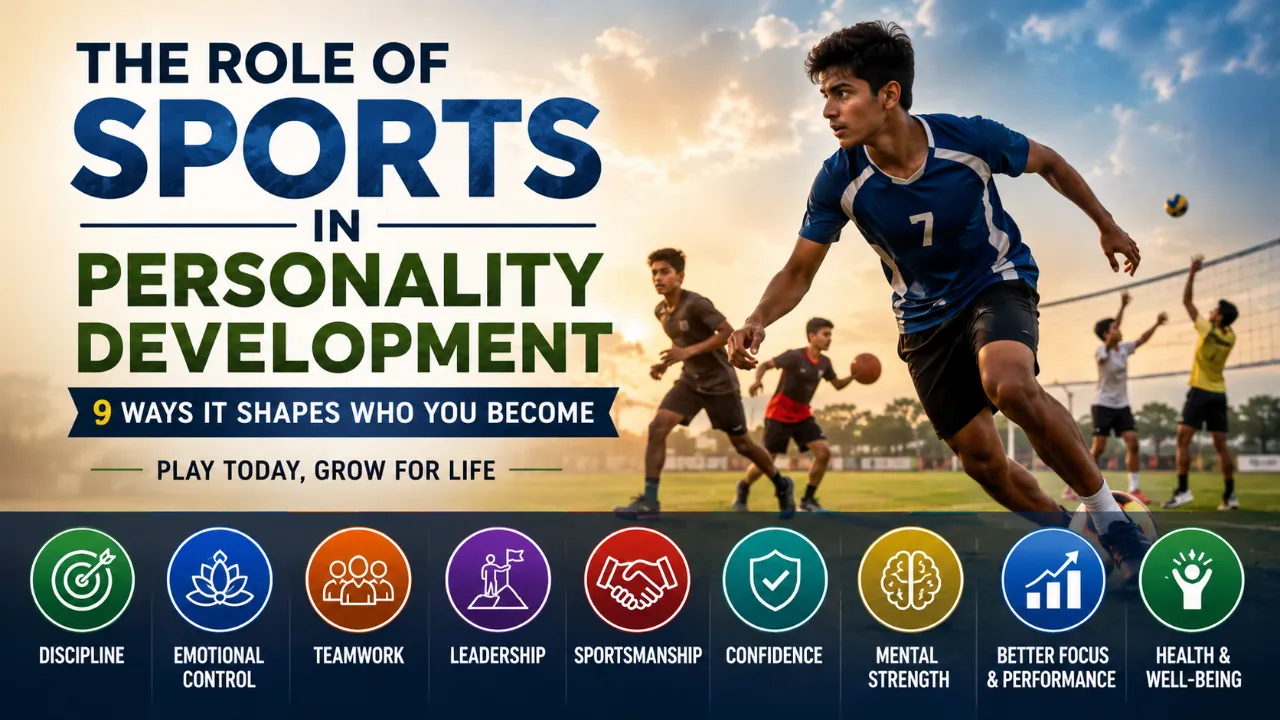
The role of sports in personality development lies in repeated real-world practice. Sports train discipline through fixed schedules, build emotional control through wins and losses, and boost confidence through visible progress. Unlike theory, this learning happens under real pressure, which makes it last.
Key Takeaways
- Sports build discipline, emotional control, and resilience through repeated real-life practice, not theory.
- The 5Cs framework, Commitment, Communication, Concentration, Control, and Confidence, explains why sports change personality at a psychological level.
- Team sports and individual sports shape personality in different ways.
- Regular physical activity also reduces anxiety and depression, according to WHO data.
- Sports give students a practical, exam-ready way to understand personality theory, not just a textbook definition.
What Is the Role of Sports in Personality Development?
The role of sports in personality development shows up in how sports force a person to face pressure, failure, teamwork, and competition again and again. Each situation trains a specific part of personality. Discipline comes from practice schedules. Emotional control comes from handling defeat. Confidence comes from small wins that add up over time.
Sports are not a shortcut. They are repetition with consequences, and that is exactly what shapes personality. This overlaps closely with how self-discipline gets built through daily consistency, one of the strongest personality traits sports reinforce.
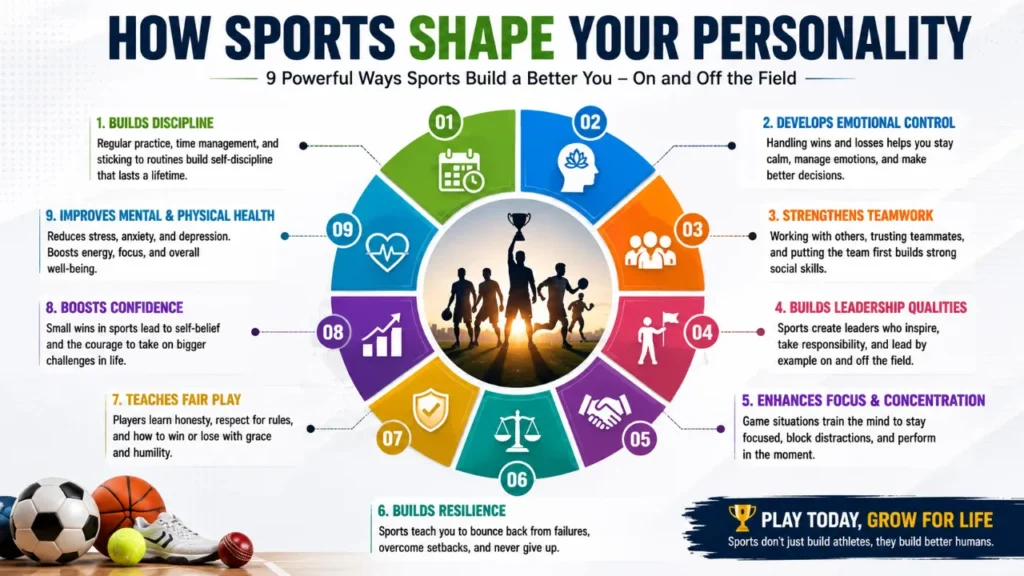
9 Ways Sports Shape Your Personality
Understanding the role of sports in personality development becomes easier once you break it into specific, everyday changes.
1. Builds Discipline and Time Management
A player who wants to improve cannot skip practice whenever they feel lazy. Fixed practice timings, fixed diet, fixed sleep schedule, all of it trains the brain to follow structure. Learning how time management shapes personality off the field works the same way sports build it on the field, through fixed routines, not motivation alone.
2. Develops Emotional Control Under Pressure
Every athlete faces a moment where the score is close and the pressure is high. Staying calm in that moment is a skill, not a personality trait people are born with. This single skill shows the role of sports in personality development at its clearest.
3. Strengthens Teamwork and Social Skills
Team sports like football, kabaddi, or basketball do not work if one player tries to be a hero. Players learn to pass the ball, trust a teammate’s position, and adjust their own game for the team’s benefit. Even quieter, more reserved players benefit here, since practical ways to build social skills often overlap directly with what a team sport naturally teaches.
4. Builds Leadership Qualities
Someone always leads on the field, a captain, a senior player, or simply the player who takes responsibility during a crisis. Leadership in sports is tested in real time. There is no time to overthink. This matches closely with the core leadership qualities every good leader needs, most of which are first practiced on a field, not in a boardroom.
5. Teaches Fair Play and Sportsmanship
Losing gracefully is harder than winning gracefully. Sports teach both. A player learns to respect the opponent, accept the referee’s decision, and avoid blaming others for a loss. This becomes a lifelong habit of fairness and honesty in personal dealings too.
6. Sharpens Strategic and Analytical Thinking
Every sport involves reading the opponent, predicting their next move, and adjusting strategy mid-game. A chess player, a badminton player, and a football midfielder all do this constantly. This kind of quick thinking is the same skill covered in building problem-solving skills for personality development, just applied under a scoreboard instead of a deadline.
7. Boosts Self-Confidence
Small victories build big confidence. Scoring one goal, winning one race, or simply improving personal timing gives visible proof of growth. This is the same principle behind practical ways to boost self-confidence, visible progress beats motivational talk every time.
8. Relieves Stress Through Physical Activity
According to the World Health Organization’s physical activity guidelines, regular physical activity reduces symptoms of anxiety and depression and improves overall mental well-being. Sports give this benefit naturally, without a person even realizing they are managing stress while they play.
9. Builds Resilience After Failure
No athlete wins every match. Every serious player faces injuries, losses, and bad days. Learning to get back on the field after a loss builds the exact kind of resilience covered in strategies for developing resilience in personal growth, the resilience to fail and try again anyway.
What Are the 5 C’s of Sports Psychology?
Most articles on this topic list benefits without explaining why sports actually work on personality. This is where the role of sports in personality development moves from opinion to psychology.
The 5Cs framework, developed through research at Loughborough University, identifies five psychological and social skills that sports build in young athletes.
| C | What It Means | Personality Trait It Builds |
|---|---|---|
| Commitment | Sticking to practice and goals | Discipline, consistency |
| Communication | Talking to teammates and coaches | Confidence in expression |
| Concentration | Staying focused during play | Attention control |
| Control | Managing emotions under pressure | Emotional regulation |
| Confidence | Trusting one’s own ability | Self-esteem |
“Discipline is the bridge between goals and accomplishment.” This old sports saying, often attributed to basketball coach Jim Rohn, captures exactly what the 5Cs framework proves scientifically.
Want to track your own progress on these five traits? Download the free 5Cs self-check worksheet and rate yourself honestly across all five areas.
Role of Sports in Building Character
Meera, a school badminton player, once told her coach she wanted to quit after losing three matches in a row. Her coach did not console her. He simply said, “Losing shows you where you are. Quitting decides where you stay.”
Meera stayed. A year later, she was captain of her school team. This is what building character through sports actually looks like, not a single dramatic moment, but small decisions repeated until they become identity. Building real willpower works the same way. Small daily choices, repeated consistently, are what actually build willpower, whether on a badminton court or anywhere else in life.
Individual Sports vs Team Sports: Different Personality Impact
Not all sports shape personality the same way. This distinction rarely gets covered, but it matters.
- Individual sports like athletics, swimming, and badminton build self-reliance, personal accountability, and internal motivation, since there is no teammate to share the blame or the credit.
- Team sports like cricket, football, and kabaddi build cooperation, trust, and social adaptability, since success depends on other people as much as personal skill.
A person choosing between the two should think about which trait they want to strengthen more, independence or collaboration.
Role of Sports in Personality Development: Class 12 Exam Answer Format
Students often search for a structured answer for board exams or essays. Here is a simple three-part format to use.
Introduction: Sports play a significant role in shaping a well-rounded personality by building discipline, resilience, and social skills alongside physical fitness.
Body: Explain any three to four points from the list above, discipline, emotional control, teamwork, and leadership work well for a class 12 answer, with one real-life example for each.
Conclusion: Sports do not just build a healthy body. They build a stable, confident, and socially capable personality, making them an essential part of holistic student development.
This structure also works for essays and speeches on the same topic.
Conclusion
Rohan still plays cricket. He still loses matches sometimes. The difference is in how he handles it now, calmly, without blame, and with a plan to do better next time.
That is what the role of sports in personality development really means. It is not about becoming a professional athlete. It is about becoming someone who can handle pressure, work with others, and keep showing up even after a loss. For a wider look at how every part of your character connects, read the complete personality development guide.
Want a ready reference for this? Download the free Role of Sports in Personality Development self-check worksheet below and track your own growth across the 5Cs.
FAQs
1. What is the role of sports in personality development?
Sports build personality by training discipline, emotional control, teamwork, and confidence through repeated real-world practice under pressure, not through theory alone.
2. What are the 5 C’s of sports psychology?
The 5Cs are Commitment, Communication, Concentration, Control, and Confidence, a framework developed through sports psychology research at Loughborough University to explain how young athletes develop mental and social skills.
3. What are the 10 importances of sports?
Sports build discipline, emotional control, teamwork, leadership, sportsmanship, strategic thinking, confidence, stress relief, resilience, and physical health, together shaping a complete personality.
4. How do sports help build character?
Sports build character by placing a person in repeated situations involving failure, pressure, and competition, forcing honest self-reflection and consistent effort, which shapes lasting personal values.
5. Do individual sports and team sports affect personality differently?
Yes. Individual sports strengthen self-reliance and personal accountability, while team sports build cooperation, trust, and social adaptability.
6. Can adults benefit from sports the same way students do?
Yes. Adults gain the same discipline, stress relief, and confidence benefits from sports, and the WHO recommends 150 to 300 minutes of moderate activity weekly for adults specifically for these mental health gains.

Ayanshi is the founder of PersonaGuru.in, a blog dedicated to personality development, relationships, and mental health. With 3+ years of writing experience and 250+ published articles, she simplifies psychology into practical, everyday advice for real people.