
How to improve self awareness is a question Rhea did not think she needed to ask, until her manager sat her down after a client call and asked why she had interrupted the client three times. Rhea had no idea she had done it even once. She thought the call had gone well. That gap between how she saw herself and how the room actually experienced her is the exact problem this article helps you fix.
Key Takeaways
- Self-awareness has two parts: knowing yourself from the inside, and knowing how others actually see you from the outside. Most people are strong in one and weak in the other.
- Research from organizational psychologist Tasha Eurich found that 95% of people believe they are self-aware, but only 10 to 15% actually meet the criteria.
- Journaling, mindfulness, and feedback all help, but the Johari Window is one of the most useful tools for spotting blind spots specifically.
- Asking “what” instead of “why” during self-reflection leads to clearer insight and less defensiveness.
- Self-awareness is not fixed. It is a learnable skill that improves with deliberate practice.
Direct Answer: How to improve self awareness comes down to two habits done consistently: reflecting honestly on your own reactions, and actively seeking feedback from people who will tell you the truth. Journaling, mindfulness, and tools like the Johari Window sharpen the first habit. Asking trusted colleagues or friends what they actually notice about you sharpens the second. Both matter, because looking inward alone rarely reveals your blind spots.
What Is Self-Awareness? (Quick Answer)
Self-awareness is your ability to accurately notice your own emotions, behavior, and impact on the people around you. It sounds simple, but most people overestimate how self-aware they actually are.
Self-awareness is the ability to see your own thoughts, emotions, and behavior clearly, and to understand how they affect the people around you.
Internal vs External Self-Awareness (Why Both Matter)
Organizational psychologist Tasha Eurich led a research program spanning nearly 5,000 people. She published the findings in Harvard Business Review in 2018. About 95% of participants believed they were self-aware. But by her team’s own research criteria, only 10 to 15% actually were.
The reason for that gap is that self-awareness is not one skill. It is two.
- Internal self-awareness is how clearly you see your own values, reactions, strengths, and weaknesses.
- External self-awareness is how accurately you understand how other people actually experience you.
Eurich’s research found almost no relationship between the two, which is the whole point of looking at internal vs external self awareness separately instead of treating them as the same thing. You can be excellent at understanding your own emotions and still have serious blind spots in how others see you, which is exactly what happened to Rhea on that client call. If you want to read Eurich’s original research in full, her Harvard Business Review piece on self-awareness is worth the fifteen minutes.
Signs You Might Lack Self-Awareness
A few patterns show up consistently in people with low self-awareness.
- You are regularly surprised by feedback, positive or negative.
- You interrupt conversations without noticing until someone points it out.
- Conflicts feel like they always happen “to” you, never partly caused by you.
- You struggle to name what you are feeling in the moment, only after the fact.
- Close friends or colleagues hesitate before giving you honest opinions.
If two or three of these signs of lack of self awareness sound familiar, that is not a character flaw. It usually just means feedback has not been reaching you clearly, which is fixable.
How to Improve Self Awareness: Practical Techniques That Work
1. Practice Daily Reflection Through Journaling
Spend five minutes at the end of each day writing down one moment that triggered a strong reaction, good or bad. With consistent practice, you will start noticing recurring patterns over time. Those patterns are far more useful than any single incident.
2. Use the Johari Window to Spot Blind Spots
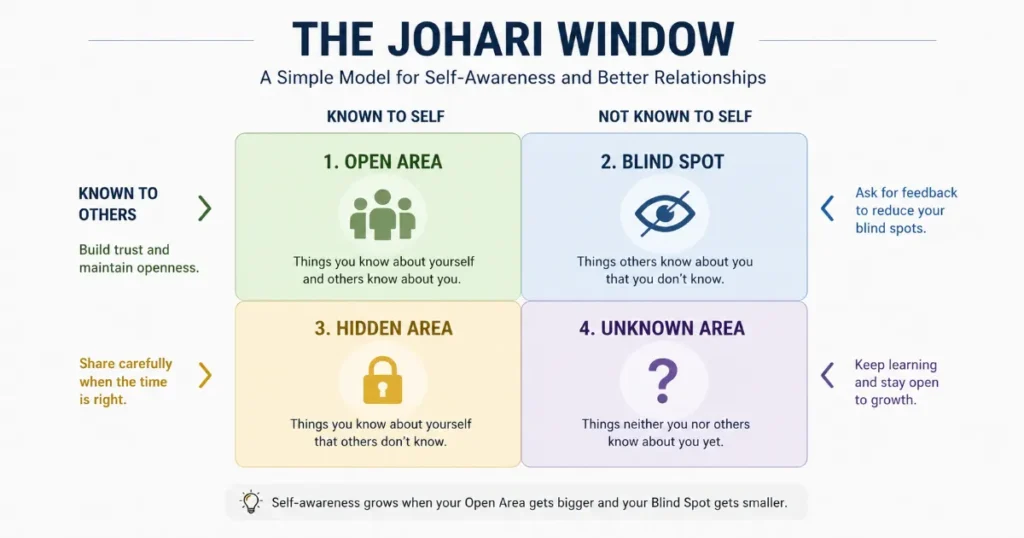
The Johari Window is a simple framework built in 1955 by psychologists Joseph Luft and Harrington Ingham. It splits what is known about you into four areas: what you know and others know, what only you know, what only others know, and what nobody knows yet.
The second area, what others know about you but you do not, is where most blind spots live. The only way to shrink that area is to actively ask for feedback rather than wait for it. MindTools’ breakdown of the Johari Window is a good next read if you want to try building your own.
3. Ask for Honest Feedback, and Actually Use It
Example: Karan, a product manager in Hyderabad, asked three colleagues for one thing he could improve, every quarter, without fail. The first few rounds stung. By the third round, his team started volunteering feedback before he even asked, because they trusted he would not get defensive. Hearing hard feedback without it wrecking your self-confidence is its own skill, and it gets easier every time you practice it.
4. Practice Mindfulness
A few minutes of sitting quietly and noticing your thoughts without judging them builds the muscle of watching yourself in real time, which is the core skill self-awareness actually depends on.
5. Notice Your Body Before You React
A tight chest, clenched jaw, or shallow breathing usually shows up before you say something you regret. Learning to notice these physical cues gives you a few seconds of warning most people never use.
6. Ask “What” Instead of “Why”
Eurich’s research found that asking yourself “why did I react that way” often traps people in unproductive loops. Asking “what caused this reaction, and what can I do differently” moves you toward action instead of rumination.
Example: Simran kept asking herself why she dreaded Monday meetings, and kept coming up empty. Once she switched to asking what specifically made those meetings draining, she realized it was always the same colleague interrupting her updates. That was something she could actually address.
How to Improve Self Awareness in the Workplace
Self-awareness at work shows up in specific, noticeable ways.
| Situation | Low Self-Awareness Looks Like | High Self-Awareness Looks Like |
|---|---|---|
| Receiving feedback | Getting defensive immediately | Pausing before responding |
| Team disagreement | Assuming you are right by default | Asking what you might be missing |
| Public speaking | Not noticing you are rushing | Noticing nerves and slowing down |
| Leading a meeting | Dominating the conversation | Checking who has not spoken yet |
Example: Aditya ran engineering standups that regularly ran twenty minutes over. He genuinely believed the team valued the extra discussion time. When he finally asked for anonymous feedback, half the team said they dreaded standups because of how long they ran. He had no idea, because nobody had told him directly. Stories like this are exactly why so many teams start asking how to improve self awareness in the workplace before things like this get pointed out to them, instead of after.
How to Improve Self Awareness as a Leader
Leaders face a particular trap here. The more senior someone becomes, the less honest feedback they tend to receive, because people are naturally cautious about criticizing someone with authority over them.
This is not a minor issue. Our detailed guide on leadership fundamentals covers this pattern in more depth, but the short version is that leaders who want to know how to improve self awareness as a leader actively build channels for honest feedback instead of assuming an open door is enough. An anonymous suggestion box, a trusted peer outside your reporting line, or a habit of directly asking “what should I stop doing” all work better than hoping people will speak up on their own.
Is Self-Awareness a High IQ Trait?
Not exactly. Self-awareness sits closer to emotional intelligence than to raw intellectual ability. A person can have a very high IQ and still struggle to notice their own blind spots, while someone with an average IQ can be remarkably self-aware because they have practiced it deliberately. If you want to see how these two abilities actually compare, our breakdown of EQ vs IQ which is more important goes into this in detail.
How Self-Awareness Connects to Emotional Intelligence
Psychologist Daniel Goleman, whose work popularized emotional intelligence, lists self-awareness as the first and foundational pillar of the entire model. Without it, the other pillars, like self-regulation and empathy, do not have much to build on, since you cannot manage or read emotions you cannot first notice.
Our full guide on how to build EQ walks through the other pillars if you want the complete picture, and our career and workplace growth guide connects this skill to the broader professional picture.
Conclusion
How to improve self awareness is less about one big breakthrough and more about small, repeated habits. Reflect honestly, ask for feedback you might not want to hear, and notice the gap between how you see yourself and how others actually experience you. That gap is where the real growth happens, and closing it, even partially, changes how you lead, work, and connect with people. It is also one of the most foundational skills in our complete guide to personality development, since almost everything else builds on knowing yourself accurately first.
Frequently Asked Questions
What are the 7 pillars of self-awareness?
There is no single, universally accepted list of seven pillars. Different frameworks name them differently. Common themes across most versions include values, passions, aspirations, fit with your environment, patterns in your thoughts and behavior, emotional reactions, and your impact on others.
What are 5 ways to develop self-awareness?
Journaling, mindfulness practice, actively seeking feedback, using a tool like the Johari Window, and noticing physical signals before reacting are five of the most practical starting points.
Can self-awareness be learned, or are some people just born with it?
It can be learned. Self-awareness is a skill, not a fixed trait. Regular reflection and honest feedback help you build it over time, no matter where you start.
What is the Johari Window?
It is a framework created in 1955 by psychologists Joseph Luft and Harrington Ingham that maps what is known and unknown about you, to yourself and to others, into four quadrants. It is especially useful for identifying blind spots and for spotting the early signs of lack of self awareness before they cause real damage.
How long does it take to become more self-aware?
There is no fixed timeline, but people who journal and ask for feedback consistently often notice real shifts within a few months, since patterns tend to surface faster than most people expect.

Ayanshi is the founder of PersonaGuru.in, a blog dedicated to personality development, relationships, and mental health. With 3+ years of writing experience and 250+ published articles, she simplifies psychology into practical, everyday advice for real people.