
Last updated on September 15th, 2026 at 06:54 am
Two people grow up in the same house, eat the same food, and go to the same school. One turns out confident and outgoing. The other is quiet and keeps to himself. Same environment, completely different personalities. This is not random. There is a reason behind it.
Personality development is a lifelong process. It starts the moment you are born and keeps evolving through every experience, relationship, and choice you make. Understanding what shapes your personality gives you real power over how you grow as a person.
In this article, we will walk through the core building blocks of personality development, including personality traits, the role of genetic factors, and the lasting influence of Sigmund Freud’s personality theory. We will also look at how personality connects to mental health and what you can practically do to grow.
 |
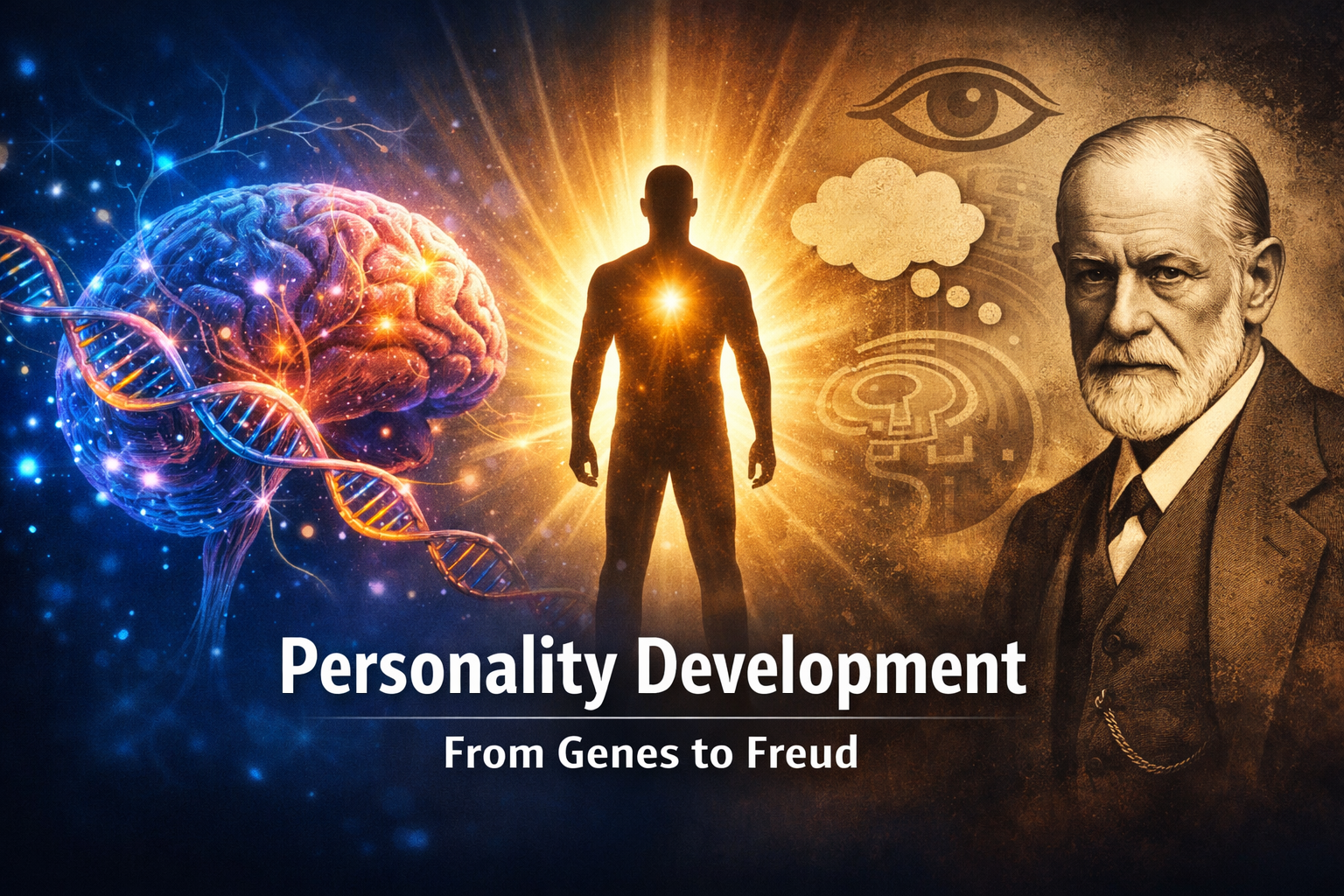
| Personality Development: A Journey from Genes to Freud |
What Is Personality Development?
Personality development is the gradual process through which a person develops consistent patterns of thinking, feeling, and behaving. These patterns define who you are and how you interact with the world around you.
It is shaped by multiple forces working together: your genes, your upbringing, your relationships, your culture, and your personal experiences. No single factor decides everything. Every factor plays its own role.
The important thing to know is that personality development never fully stops. You are always changing, even when you do not notice it.
The Building Blocks: Personality Traits
At the core of personality development are personality traits. These are the stable, recurring patterns in how you think, feel, and behave. They are the raw material your personality is built from.
Psychologists use a model called the Big Five, also known as OCEAN, to map out the five core personality traits:
Openness refers to how curious and creative you are. People high in openness enjoy new experiences and ideas.
Conscientiousness is about discipline and reliability. Highly conscientious people meet deadlines, stay organized, and follow through on commitments.
Extraversion determines whether you get your energy from being around people or from spending time alone. Extroverts thrive in social settings while introverts recharge in solitude.
Agreeableness reflects how empathetic and cooperative you are with others. Highly agreeable people avoid conflict and genuinely care about others’ feelings.
Neuroticism shows how emotionally stable or sensitive you are. People high in neuroticism tend to experience anxiety and mood swings more often.
These five traits combine in different ways to create a unique personality profile for every person. No profile is better or worse than another. Each has its own strengths.
Every personality trait you develop also affects how you handle stress and conflict. Read more: Aggression Management in Personality Development
Want to find out where you stand on these five traits? Take a free test at 16Personalities and discover your own personality profile.
Genetic Factors in Personality Development
While every human shares the same basic DNA structure, the small variations in our genes contribute to the uniqueness of our personalities. Genetic factors in personality development lay the foundation for our natural tendencies and predispositions.
Some people are born with a natural leaning toward creativity. Others are genetically more prone to anxiety. Some have an inborn tendency toward optimism. These are not learned behaviors. They come from biology.
Twin studies have consistently shown that around 40 to 60% of personality traits can be linked to genetic factors. That is a significant portion.
But here is what matters most. Genes are not your destiny. A person genetically prone to anxiety can build strong emotional resilience through a supportive environment and the right experiences. Think of your genes as the first sketch on a canvas. Your life experiences are what fill in the rest of the painting.\
Your genes are just one piece of the puzzle. To understand all the forces shaping your personality, read: Key Factors Affecting Developing Your Personality
Freud’s Personality Theory and Its Influence
No discussion of personality development is complete without Sigmund Freud. He was one of the most influential thinkers in the history of psychology, and his ideas still shape how we understand personality today.
Freud’s psychoanalytic theory introduced the idea that personality is made up of three distinct parts working together: the id, the ego, and the superego.
The Id, Ego, and Superego Explained
The id is the most primitive part of the mind. It runs on instinct and desire. It wants what it wants, right now, without thinking about consequences or social rules.
The ego is the rational middle layer. It takes the demands of the id and tries to meet them in ways that are realistic and socially acceptable.
The superego is your internal moral compass. It is shaped by the values and rules you absorbed from your parents, culture, and society. It is the voice that tells you what is right and what is wrong.
Here is a simple example. Suppose you are exhausted and want to skip work. Your id says stay in bed. Your ego reminds you of your responsibilities and the practical consequences. Your superego adds a layer of guilt. Most of the time, you end up going to work. That is all three parts running simultaneously in the background.
Why Freud Still Matters Today
Some of Freud’s specific ideas have been updated or challenged by modern science. But his core insight holds true. Early childhood experiences leave a deep mark on adult personality. This is now strongly supported by attachment theory and modern developmental psychology. The quality of your earliest relationships directly shapes how you handle emotions, trust, and connections as an adult.
You can read a deeper breakdown of Freud’s psychoanalytic theory on Simply Psychology.
Personality Development and Mental Health
Personality development and mental health are deeply connected. The traits you carry, the experiences you have had, and the internal conflicts you carry all directly affect your emotional well-being.
Research shows that people high in neuroticism face a significantly greater risk of anxiety and depression. On the other hand, people who score high in conscientiousness and agreeableness tend to report better mental health outcomes overall.
Understanding your own personality traits is not about putting yourself in a box. It is about knowing yourself well enough to make better decisions, build healthier relationships, and spot the patterns that are holding you back.
Self-awareness is the starting point. When you understand why you react a certain way, you gain the ability to choose a different response. That is where real growth begins.
If you want to understand how personality development can improve your life beyond mental health, check this out: How Personality Development Can Transform Your Life
Practical Steps to Support Your Personality Development
Write in a journal regularly. Do not just record what happened. Write down how you reacted and why. Over time, patterns will become visible that you would otherwise miss.
Consider therapy. Cognitive Behavioral Therapy and psychodynamic therapy have strong scientific backing for reshaping unhealthy personality patterns. Talking to a professional is not a sign of weakness. It is one of the most effective tools available.
Work on a growth mindset. Research by psychologist Carol Dweck shows that people who believe they can change actually do change more. The belief itself creates the conditions for growth.
Invest in quality relationships. The people around you shape you more than you realize. Healthy, honest relationships naturally bring out better versions of your personality over time.
Building self-awareness also means understanding your emotional responses better. Read: 4 Types of Emotional Intelligence and How to Improve Them
Conclusion
Understanding your personality is not a one-time thing. Your genetic factors give you a starting point. Freud’s theory reveals the hidden forces behind your behavior. Your traits show you the patterns that keep showing up in your life, in your relationships, at work, and even in how you talk to yourself.
None of this is set in stone. You are always changing, whether you notice it or not. Every experience, every honest reflection, every small effort you make is quietly shaping who you are becoming.
Celebrate what you are good at. Be honest about what needs work. That balance is where real growth happens.
If this article got you thinking, start small today. Pick one thing about yourself you want to understand better. Pay attention to it this week. That is enough to begin.
Explore more articles on PersonaGuru and keep learning about yourself and the people around you.

Ayanshi is the founder of PersonaGuru.in, a blog focused on personality development, career, relationships, and mental well-being. With over 3 years of writing experience, she turns psychology and everyday experiences into practical, easy-to-understand advice for real life.
1 thought on “Personality Development: A Journey from Genes to Freud”