

Here is a fact that surprises most people. Your personality does not just shape your choices. Your choices circle back and reshape your personality.
Psychologists call this the corresponsive principle in personality development. It explains why an outgoing person often becomes even more outgoing with age, while a quiet person often becomes even more reserved.
This guide covers what the corresponsive principle in personality development actually means, how it works step by step, what real research says, and how you can use it on purpose to build a trait you want.
New to this topic? Read our Personality Development Guide for a complete overview.
Key Takeaways
- Your existing traits pull you toward environments that match them.
- Those environments then strengthen the same traits over time.
- Four everyday processes drive this: attraction, selection, manipulation, and attrition.
- A 2003 Dunedin study found traits at 18 predicted work conditions at 26.
- A 2024 twin study found this pattern may shift after age 50.
- You can use this principle on purpose to build a trait you actually want.
What Is the Corresponsive Principle in Personality Development?
The corresponsive principle in personality development is the idea that your existing traits lead you into specific life situations. Those situations then reinforce and magnify the same traits over time.
Psychologists Avshalom Caspi, Brent Roberts, and Terrie Moffitt first proposed this idea. Their research, summarised in the Noba Project’s personality stability module, describes it as a form of positive matching. Your personality and your environment work together instead of against each other.
Think of it as an echo. You send a signal into the world through your behaviour. The world sends back a stronger version of that same signal.
How the Corresponsive Principle Works
The Core Cycle
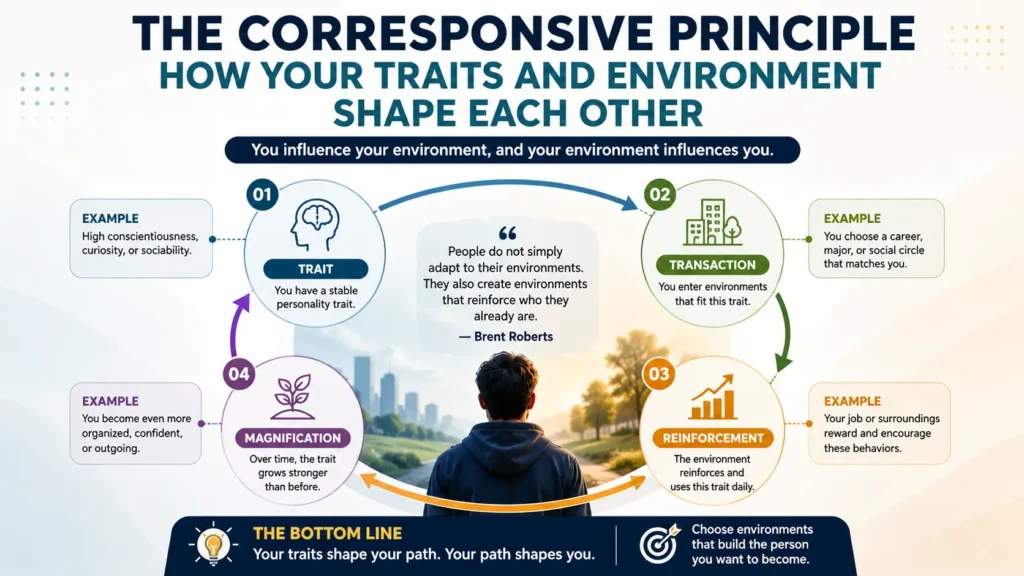
The corresponsive principle in personality development follows four simple steps:
- Trait. You already have a stable trait. High conscientiousness, for example.
- Transaction. You land in an environment that fits this trait, such as a structured career.
- Reinforcement. The environment asks you to practise this trait daily.
- Magnification. Over months and years, the trait grows stronger than where it started.
Two Mechanisms
Two forces work together here:
- Social selection. You gravitate toward people and situations that already match who you are.
- Social influence. Once inside that environment, its daily demands quietly train you to become more of what you already were.
Person-Environment Transactions
Personality does not just react to the world. It actively creates conditions for its own growth, and this is part of why the corresponsive principle in personality development holds up across so many life stages. There are three types of transactions:
- Active transactions. You deliberately pick or build an environment. A curious student choosing a research-heavy college course is one example.
- Reactive transactions. Two people face the same situation but respond differently because of personality. One employee sees a tight deadline as exciting. Another sees it as a threat.
- Evocative transactions. Your personality pulls specific reactions out of other people. A warm, easygoing person often receives warmth back, which then confirms and strengthens their easygoing nature.
If you want to understand how daily habits and intentional actions shape who you become, read our guide on How to Groom Your Personality.
“People do not simply adapt to their environments. They also create environments that reinforce who they already are.”
— Brent Roberts
Four Processes Behind the Cycle
Four everyday processes explain how this cycle plays out.
| Process | What It Means | Everyday Example |
|---|---|---|
| Attraction | You are drawn to environments that fit your personality | An organised person is drawn to project management |
| Selection | Institutions pick people whose traits match their needs | A sales team hires outgoing candidates over quiet ones |
| Manipulation | You reshape your environment to suit your traits | A tidy person rearranges a shared workspace |
| Attrition | You leave environments that clash with your personality | An introvert quits a job built on constant networking |
What Research Shows About the Corresponsive Principle in Personality Development
The Dunedin Study
One of the strongest pieces of evidence comes from a birth cohort study in Dunedin, New Zealand. Researchers Brent Roberts, Avshalom Caspi, and Terrie Moffitt tracked young people from age 18 to age 26.
- Traits measured at 18 predicted the type of work conditions people ended up in at 26.
- Those same work conditions then shaped further personality change between the two ages.
A separate workplace study by Le, Donnellan, and Conger found a similar pattern. Traits that predicted a person’s job conditions were often the exact traits that grew stronger because of those conditions.
A 2024 Update
Here is a fresh finding most articles on the corresponsive principle in personality development miss entirely. A 2024 study by Christopher Beam and Emily Schoenhofen Sharp, published in Innovation in Aging, tested this principle differently.
- Sample: 1,700 twins from the Swedish Adoption and Twin Study of Aging.
- Age range: 51 to 91 years.
- Test-retest stability of personality traits reached around 0.70 after age 50.
- Result: a competing idea called the niche-picking principle explained the data better than the corresponding principle in this age group.
Instead of traits getting magnified with age, twins mostly maintained existing differences or grew slightly more alike. This does not cancel the corresponding principle. It suggests the intensifying effect may be strongest earlier in adulthood, shifting toward simple maintenance later in life.
Example of the Corresponsive Principle in Personality Development
Ananya, a college student from Pune, was naturally talkative. This trait pulled her toward event management, a field that rewards exactly this energy. Five years into the job, she was noticeably more outgoing than at nineteen. Her job did not create her extraversion. It picked up a trait that already existed and pushed it further.
This is also why career choices matter so much in long-term personality growth. Our guide on Self-Career Perception in Personality Development explains how the work you choose can reinforce the traits you already possess.
Her younger brother showed the opposite pattern. Naturally quiet and detail-focused, he chose data analysis, a role built on long, solitary focus. Over time, he grew even more reserved and precise.
“People often ask me why I got even more introverted after starting this job,” he once said. “I think the job did not change me. It just gave my old habits somewhere to grow.”
Same family. Same upbringing. Two completely different corresponsive cycles.
Corresponsive Principle vs Other Principles
| Principle | Core Idea |
|---|---|
| Corresponsive Principle | Environments intensify the traits that led you there |
| Maturity Principle | People generally grow more conscientious and stable with adult responsibilities |
| Cumulative Continuity Principle | Traits become more stable and predictable the longer a person lives |
How to Use This Principle to Change Yourself
You can use this principle on purpose. Follow these steps:
- Name the trait you want to build. Confidence, patience, or discipline, for example.
- Identify your current environment and what it currently reinforces in you.
- Choose a new, unfamiliar environment on purpose. One that demands the trait you want.
- Stay long enough for reinforcement to work. A week rarely works. Months usually do.
- Track small changes. Note one example each week of the new trait showing up.
Simply wanting to change rarely works alone. This principle suggests real change needs a new environment doing some of the work for you.
Want to apply the corresponsive principle to your own life?
📥 Download the Free Trait Cycle Breaker Worksheet (PDF)
Final Thought
Your personality and your life are never separate stories. They write each other. Your traits open certain doors. Walking through those doors makes those same traits grow. Once you see this pattern, changing a trait stops feeling like willpower alone. It starts feeling like a choice about which doors you walk through next.
Want to understand how much control you feel over these choices? Read our guide on Locus of Control in Personality Development. You can also explore your own blind spots using the Johari Window in Personality Development.
FAQs
What Is the Corresponsive Principle of Personality Development?
It is the idea that a person’s existing traits draw them toward specific environments, and those environments then reinforce and strengthen the original traits, creating a self-sustaining cycle.
Corresponsive Principle vs Correspondence Principle
The corresponsive principle belongs to personality psychology and describes trait-environment reinforcement. The correspondence principle is an unrelated physics term describing how classical and quantum theories align at large scales.
What Are the 5 Principles of Personality Development?
- Corresponsive principle
- Maturity principle
- Cumulative continuity principle
- Role continuity principle
- Identity development principle
Does This Apply in Old Age?
Partly. A 2024 study suggests that after age 50, traits are mostly maintained rather than magnified, meaning the niche-picking principle may explain late-life stability better than the corresponsive principle.

Ayanshi is the founder of PersonaGuru.in, a blog dedicated to personality development, relationships, and mental health. With 3+ years of writing experience and 250+ published articles, she simplifies psychology into practical, everyday advice for real people.