
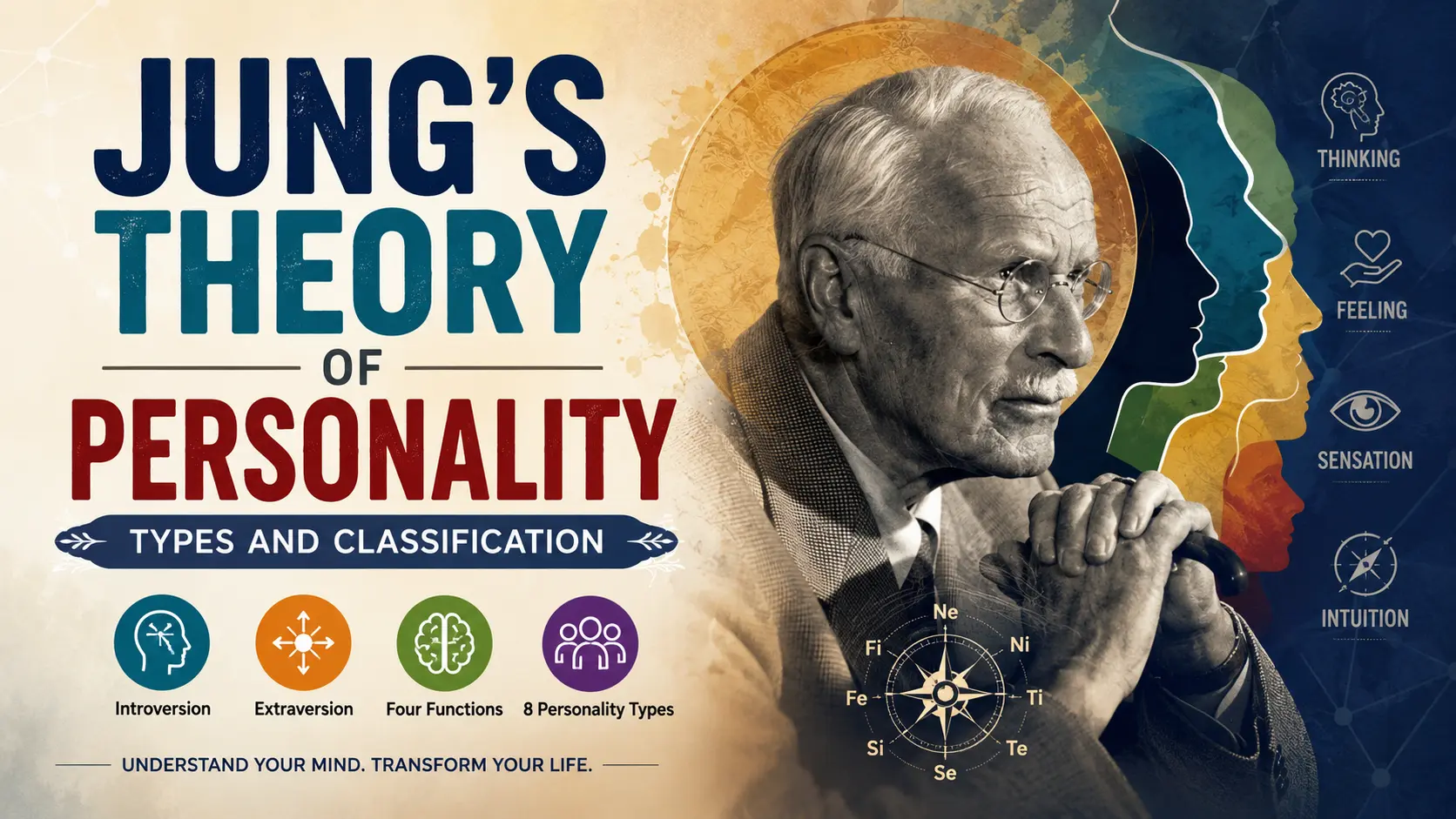
Have you taken one of those sixteen-personality quizzes online and wondered where the idea came from? It did not start with a website. It started with a Swiss psychiatrist named Carl Jung.
Jung’s theory of personality remains one of the most influential classification systems in psychology, over a century after he first wrote it down. This guide breaks it down in plain language, with real examples, so you understand it instead of just memorizing it. For the full roadmap of how personality forms over time, our personality development hub guide is a good starting point before you dive in here.
Key Takeaways
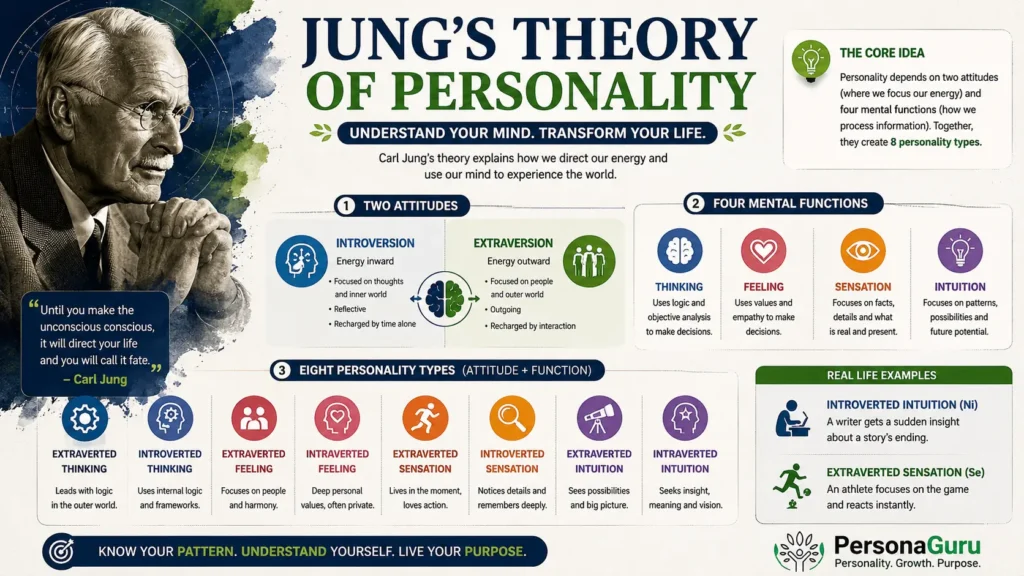
- Jung’s theory of personality uses two attitudes, introversion and extraversion, combined with four mental functions.
- The four functions are thinking, feeling, sensation, and intuition.
- Combining the attitudes with the functions gives eight personality types.
- Jung’s theory of personality became the direct foundation for the Myers-Briggs Type Indicator.
- Modern psychology values Jung’s ideas but treats his fixed categories with more caution than he intended.
Who Was Carl Jung and What Did He Discover?
Carl Jung was a Swiss psychiatrist who worked closely with Sigmund Freud before building his own school of thought, called analytical psychology. In 1921, he published Psychological Types, where he laid out his full theory of personality classification. Simply Psychology’s guide to Carl Jung covers his complete body of work if you want to go deeper into his broader theories beyond typology.
Jung wanted to understand why intelligent, well-meaning people could look at the same situation and reach opposite conclusions. He believed the answer lay in how a person’s mind naturally directs its energy. That idea became the backbone of Jung’s theory of personality, and it connects closely to the genetic and historical roots of personality development, which trace how Jung’s ideas fit into the wider timeline of personality psychology.
What Is the Difference Between Introvert and Extravert in Jung’s Theory?
Jung’s theory of personality starts with two basic attitudes. Every person leans toward one more than the other.
Introverts direct their mental energy inward. Jung described them as more focused on their own thoughts and internal reactions than on the outside world. Common traits include:
- Feeling recharged after time alone, not drained by it
- Thinking things through before speaking
- Preferring deep one-on-one conversations over large groups
Extraverts direct their mental energy outward. Jung described them as finding meaning from people, activities, and events around them. Common traits include:
- Feeling energized by social interaction
- Thinking out loud rather than internally
- Adapting quickly to new people and environments
Kabir, a marketing executive in Bengaluru, saw this play out clearly on his team. One colleague stayed quiet in every brainstorm, only to send a fully formed idea by email that night. Another jumped in immediately, building on ideas out loud. Neither approach was wrong. They were simply pulling energy from different directions, exactly the split Jung described a century ago. This attitude leaning is not purely learned behavior either. Our guide on the nature versus nurture debate in personality development explains how much of a trait like this comes from biology versus upbringing.
What Are Jung’s Four Personality Functions?
Attitude alone does not complete Jung’s theory of personality. He also identified four functions that describe how a person processes information.
Thinking vs Feeling are the judging functions. A thinking-oriented person leans on logic and objective analysis. A feeling-oriented person leans on personal values and how a choice affects people. Neither is more emotional than the other. Jung used “feeling” to mean a values-based judgment, not simply having emotions.
Sensing vs Intuition are the perceiving functions. A sensing-oriented person trusts concrete, present, verifiable details. An intuition-oriented person trusts patterns, hunches, and future possibilities over isolated facts.
What Are Jung’s 8 Personality Types?
Combine the two attitudes with the four functions, and Jung’s theory of personality produces eight types.
| Type | Core Focus |
|---|---|
| Extraverted Thinking | Objective logic applied outward |
| Introverted Thinking | Internal logical frameworks |
| Extraverted Feeling | Social harmony and shared values |
| Introverted Feeling | Deep personal values, often private |
| Extraverted Sensation | Real-time concrete experience |
| Introverted Sensation | Detailed internal sensory impressions |
| Extraverted Intuition | Spotting outward trends and possibilities |
| Introverted Intuition | Internal insight and abstract vision |
Jung believed most people lean on one dominant function, with the rest playing supporting roles. His original 1921 text, documented in full on Wikipedia’s Psychological Types entry, goes into far more depth on how these eight types interact than most modern summaries cover.
Download the Jung Personality Self-Check Worksheet (PDF) to find your own attitude and function leaning in five minutes.
Is MBTI Based on Jung’s Theory?
If you have ever heard someone call themselves an INFJ or an ESTP, you have already met Jung’s influence.
In the 1940s, Katharine Briggs and her daughter Isabel Briggs Myers built directly on Jung’s theory of personality to create the Myers-Briggs Type Indicator. They added one more dimension, judging versus perceiving, which Jung himself never included. This produced the sixteen personality types now used in workplaces and career counseling worldwide.
Worth remembering: the MBTI is not identical to Jung’s original theory. It is an adaptation, built by two researchers who were not trained psychologists. Jung’s own writing was more nuanced than the simplified four-letter labels many people use today.
How Is Jung’s Theory Different From the Big Five?
Jung sorts people into fixed types. Modern psychology largely favors a different model, the Five Factor Theory, which measures personality on continuous scales instead.
| Feature | Jung’s Theory | Five Factor Theory |
|---|---|---|
| Structure | Fixed types | Continuous scales |
| Origin | Clinical observation, 1921 | Statistical trait research |
| Categories | 8 types (16 with MBTI) | 5 broad traits |
| Scientific standing | Popular but debated | Widely accepted academically |
Neither theory is simply right or wrong. Jung’s theory gives an intuitive language for self-reflection. The Five Factor Theory has stronger predictive research behind it, and our guide on the key aspects of personality development covers it alongside the other major traits psychologists study today.
What Are the Limitations of Jung’s Theory?
Most articles skip this part, so here it is straight.
The biggest criticism is rigidity. Real people rarely fit one fixed box. A widely cited 2005 review of MBTI research by psychologist David Pittenger found that a large share of test-takers received a different four-letter type when retested just weeks later. That instability raises real questions about how fixed these categories are in daily life.
A few more limits worth knowing:
- Jung built his framework from clinical observation, not large-scale statistical research
- The categories work better as a language for self-reflection than as a precise diagnostic tool
- Briggs and Myers later expanded and reinterpreted Jung’s original ideas, so what most people know today is not exactly what Jung wrote in 1921
None of this erases the value of the work. It simply means the smartest use of Jung’s theory of personality is as a lens for tendencies, not a permanent label.
How Can You Apply Jung’s Theory in Daily Life?
- Notice where your energy goes after a long day. Quiet time alone or a call to a friend? That reveals your attitude leaning.
- Watch how you decide under pressure. Logic first, or impact on people first? That reveals your dominant function.
- Use it to understand conflict, not win arguments. A colleague who decides differently is not flawed. A different function is simply in action.
- Avoid over-labeling yourself. Treat your type as a tendency, not a fixed identity, and pair it with a clearer sense of self-concept for a fuller picture of who you are.
Naina, a college student preparing for her personality development exam, realized why her study group kept clashing. Two members wanted every session planned to the minute. Two others wanted to explore freely and figure out structure later. Once she saw it through Jung’s lens, the friction made sense instead of feeling personal.
Final Thoughts
Jung’s theory of personality gave the world a vocabulary for why people think and decide so differently. You do not need to memorize all eight types to benefit from it. Simply noticing whether your energy points inward or outward, and whether you judge through logic or values, gives you a genuinely useful lens for understanding yourself and the people around you.
FAQs
1. What are Jung’s 4 personality types?
Jung’s core framework rests on four functions: thinking, feeling, sensation, and intuition. Combined with introversion and extraversion, these expand into eight distinct types.
2. What is Jung’s theory of personality called?
It is known as Jung’s theory of psychological types, first detailed in his 1921 book Psychological Types.
3. Is MBTI based on Jung’s theory?
Yes. Katharine Briggs and Isabel Briggs Myers built the Myers-Briggs Type Indicator directly on Jung’s theory of personality, adding a judging versus perceiving dimension that Jung never included.
4. Is Jung’s theory scientifically proven?
It is influential but debated. It offers a useful language for self-reflection, though the Five Factor Theory has stronger statistical support for predicting real-world behavior.

Ayanshi is the founder of PersonaGuru.in, a blog dedicated to personality development, relationships, and mental health. With 3+ years of writing experience and 250+ published articles, she simplifies psychology into practical, everyday advice for real people.