
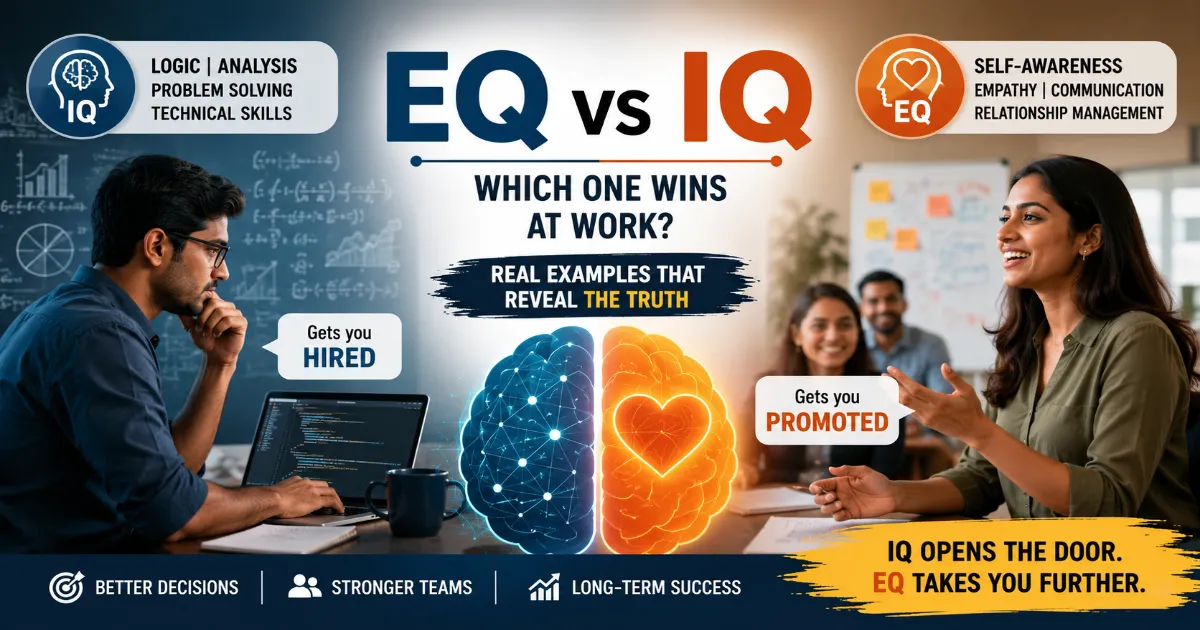
Eq vs iq which is more important is one of the oldest debates in psychology and career advice, and Devansh and Ananya’s story shows exactly why it still matters. Devansh topped every exam in his engineering batch. He could solve a broken algorithm faster than anyone on his team. But two years into his first job, he was still an individual contributor, while Ananya, who had graduated with an average CGPA, was already leading a twelve-person team. She was not smarter on paper. She was better at reading people, staying calm under pressure, and getting a room to agree on a plan. Her manager once told her that talent gets you hired, but people skills get you promoted.
That gap between Devansh and Ananya is exactly what the EQ vs IQ debate is really about. Below, you will find clear definitions, real workplace comparisons, and an honest look at where each one actually matters.
Key Takeaways
- Eq vs iq which is more important comes down to context: IQ measures reasoning, memory, and problem-solving ability, while EQ measures self-awareness, empathy, and how well you manage emotions, your own and other people’s.
- IQ tends to open the first door. EQ tends to decide how far you go after that.
- A 2022 meta-analysis in Frontiers in Psychology found emotional intelligence positively linked to job performance, job satisfaction, and organizational commitment, and negatively linked to job stress.
- Neither score works alone. High IQ without EQ often stalls in leadership roles. High EQ without any technical grounding struggles too.
- SQ (social quotient) and AQ (adversity quotient) are two lesser-known but useful additions to this picture.
Direct Answer: Between EQ and IQ, EQ tends to matter more for long-term career growth and leadership, while IQ tends to matter more for technical and analytical tasks. Technical competence can help you get through the door. EQ becomes increasingly important for promotion once your role involves collaboration, communication, and leading other people.
What Is IQ? (Quick Answer)
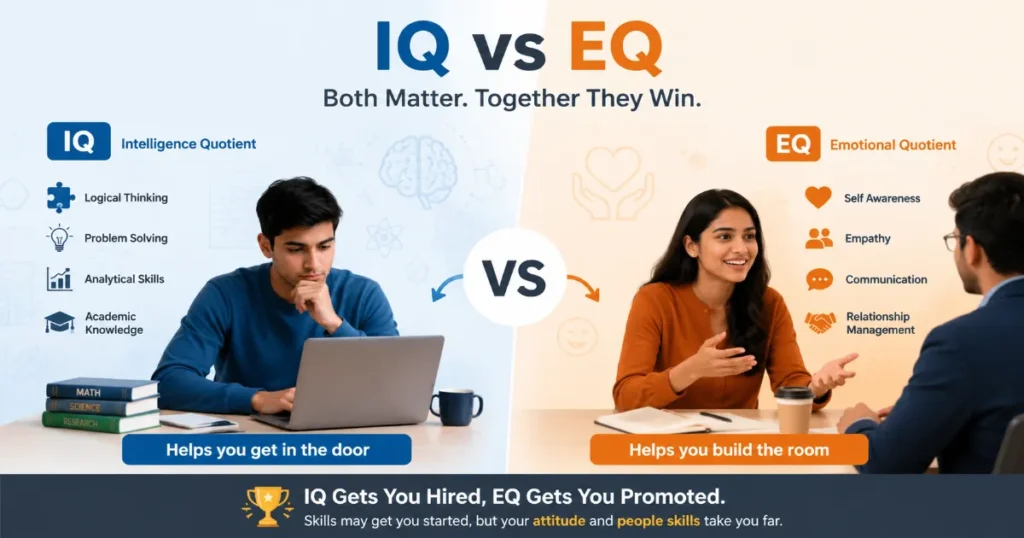
IQ, or intelligence quotient, measures your reasoning ability, memory, logic, and problem-solving skill. It is what standardised tests were originally built to capture, and it stays fairly stable across your life.
IQ is a standardized score that measures cognitive abilities such as logical reasoning, memory, and problem-solving, and it strongly predicts performance in academic and technical settings.
What Is EQ? (Quick Answer)
EQ, or emotional quotient, measures how well you recognise and manage your own emotions and how well you read and respond to the emotions of people around you. Unlike IQ, EQ can be built and strengthened over time.
EQ, also called emotional intelligence, is your ability to identify, understand, and manage emotions, both your own and other people’s, and it strongly predicts success in leadership, teamwork, and communication.
If you want a deeper walkthrough of how to actually build this skill, our full guide on how to build EQ breaks it down step by step.
EQ vs IQ Which Is More Important?
Neither score wins outright. They measure different things and matter in different moments.
| Factor | IQ | EQ |
|---|---|---|
| What it measures | Reasoning, memory, problem-solving | Self-awareness, empathy, emotional control |
| Can it improve? | Relatively stable across adulthood | Can be developed through practice and feedback |
| Best predictor for | Academic and technical performance | Leadership, teamwork, long-term career growth |
| Common weak spot | Struggles with people management | Struggles with pure technical depth |
| Typical role fit | Research, engineering, data-heavy work | Management, sales, client-facing roles |
If you are asking whether emotional intelligence is more important than IQ, the honest answer is that it depends on the task in front of you, not on which one sounds more impressive.
EQ vs IQ Which Is More Important in the Workplace
This is where the debate stops being academic and starts affecting paychecks.
Example: A software company in Bengaluru had two candidates for a team lead role. One had the highest technical assessment score the company had seen that year. The other scored lower on the technical test but had led three cross-team projects without a single escalation to HR. The company chose the second candidate. Six months later, their team had the lowest attrition in the department.
Research backs this pattern up. A 2011 meta-analysis published in the Journal of Organizational Behavior found that emotional intelligence adds real predictive value for job performance even after accounting for cognitive ability and personality, meaning EQ is not just a nice-to-have layered on top of IQ, it measurably contributes on its own. Technical skill gets you shortlisted. How you handle a disagreement, a missed deadline, or a frustrated client often decides who gets promoted after that.
If you are wondering whether EQ is more important than IQ in the workplace specifically, most current research says yes for people-facing work, once a baseline level of technical competence is already in place.
Here is how that plays out across common work situations.
| Situation | IQ Helps With | EQ Helps With |
|---|---|---|
| Difficult client | Finding the technical solution | Managing the conversation |
| Team conflict | Understanding the underlying problem | De-escalating emotions |
| Presentation | Organising complex information | Reading the audience |
| Leadership | Strategic analysis | Building trust and motivation |
| Crisis | Finding options quickly | Keeping people calm |
EQ vs IQ: What Matters More for a Leader?
Eq vs iq which is more important becomes hardest to ignore in leadership. A brilliant strategist who cannot read a room will struggle to keep a team motivated. A leader with strong EQ, even with average technical depth, tends to build trust faster and hold onto good people longer.
Example: Arjun managed a support team going through a rough product launch. Tickets were piling up and the team was exhausted. He did not lecture them about numbers. He acknowledged that the week had been brutal, adjusted the workload, and asked what would actually help. Complaints dropped, and two team members later said that week was when they decided to stay long term.
This is not just a nice story. A meta-analysis of 92 independent studies found a moderate positive relationship between a leader’s emotional intelligence and how effective their team judged them to be, which helps explain why technical expertise alone rarely produces great leadership.
Our broader guide to leadership fundamentals is worth reading if you are building these skills from the ground up.
Difference Between IQ and EQ, With Examples
Eq vs iq which is more important is easier to answer once you see it in action. Here is what the difference actually looks like.
- IQ in action: solving a complex spreadsheet formula nobody else on the team could figure out.
- EQ in action: noticing a teammate has gone quiet in meetings for two weeks and checking in before it becomes a resignation letter.
- IQ in action: spotting the flaw in a financial model within minutes.
- EQ in action: delivering that same bad news to a client without the conversation turning defensive.
Both skills solve real problems. They just solve different kinds of problems.
Beyond IQ and EQ, Where SQ and AQ Fit In
IQ and EQ are not even the full picture. Two other quotients come up often enough to be worth knowing, though it is worth saying upfront that neither one is as scientifically standardized as IQ or EQ.
- SQ (Social Quotient): your ability to build and navigate relationships and social networks effectively. Where EQ is about managing emotions, SQ is more about reading social dynamics and group behaviour.
- AQ (Adversity Quotient): your ability to keep functioning and adapting when things go wrong. This one shows up constantly in fast-changing startups, where plans fail weekly and resilience matters as much as raw intelligence.
Keyword research for this article actually showed more monthly search volume for “IQ vs EQ vs SQ” than for the exact EQ vs IQ phrase itself, which suggests people increasingly want the fuller picture, not just a two-way comparison.
Can Someone Have High IQ but Low EQ?
Yes, and it is more common than people assume, which is part of why eq vs iq which is more important stays such a persistent question. A person can solve difficult technical problems with ease and still struggle to notice when a colleague feels dismissed in a meeting. The two abilities develop somewhat independently, since one is largely about processing information and the other is about processing people.
The reverse is also true. Someone can be excellent at managing relationships and reading a room without being especially strong at abstract problem-solving. In real workplaces, people rarely rely on only one ability. Technical competence and interpersonal skills usually work together, even when one is clearly stronger than the other.
How to Tell If You Have High EQ
A few honest signs tend to show up consistently in people with strong emotional intelligence.
- You notice your own mood shifting before it affects how you speak to someone.
- You can sit with someone else’s bad mood without needing to fix it immediately.
- Feedback rarely surprises you, because you were already sensing the gap.
- You recover from conflict without holding a grudge for days.
- People tend to open up to you without being asked to.
If most of these sound familiar, your EQ is probably stronger than you give yourself credit for.
Is “EQ Matters More Than IQ” Overstated?
Here is a correction worth making. Daniel Goleman, whose 1995 book made emotional intelligence a household term, later pushed back on how far the idea had been stretched. He publicly clarified that the widely repeated claim that EQ accounts for 80 percent of success was never something his research actually said. That number came from a misreading of separate data showing IQ accounts for roughly 20 percent of career success, not a direct measurement of EQ’s share.
This does not mean EQ is unimportant. It means the popular version of the claim got exaggerated along the way. The core point stands on its own without needing an inflated number: the popular “EQ accounts for 80 percent of success” claim should not be presented as a direct finding from Goleman’s own research. If you want the fuller account of how this claim spread and where it broke down, this detailed breakdown of the EQ research is worth reading.
A Few Practical Tips to Build Both
Eq vs iq which is more important matters less in the abstract than how you actually build both. Here is how.
- Do not neglect either one. Building your EQ does not mean ignoring technical growth, and vice versa.
- Ask for feedback on your blind spots. Most people overestimate their own EQ. A trusted colleague’s honest input is more accurate than your own guess.
- Practice noticing before reacting. A three-second pause before responding in a tense conversation is a simple, learnable EQ habit.
- Track your reactions for a week. Write down moments you felt triggered at work. Patterns show up fast once you look for them.
Reading these patterns in yourself takes a level of self-confidence that not everyone starts with, and building that alongside your EQ tends to compound the results. If you manage people day to day, pairing this with how you adjust your leadership style to the person in front of you makes both skills far more useful in practice. And if your team includes people who lean more autocratic or more collaborative by nature, understanding autocratic vs democratic leadership helps you read which approach actually needs more EQ from you in the moment. If you are working on your professional growth more broadly, our guide to career and workplace growth brings together communication, leadership, and confidence skills that all feed into this same picture.
Conclusion
EQ vs IQ which is more important? There is no single winner, and pretending otherwise oversimplifies both. IQ still matters for solving hard technical problems. EQ still matters more for building the kind of trust that gets you promoted and keeps a team together. The realistic goal is not picking a side. It is knowing which one the moment in front of you actually needs. This balance is really just one piece of the bigger picture covered in our complete guide to personality development.
Frequently Asked Questions
1. Is emotional intelligence more important than IQ?
This is the heart of the eq vs iq which is more important question. For leadership, teamwork, and long-term career growth, most current research leans toward EQ mattering more. For purely technical or analytical work, IQ still carries more weight.
2. Are Gen Z more emotionally intelligent?
There is no strong consensus on this yet. Some workplace surveys suggest younger employees are more comfortable discussing emotions openly, but comfort discussing emotions is not the same as having measurably higher EQ, and the research here is still developing.
3. Why is EQ so important?
EQ shapes how well you handle conflict, read a room, build trust, and lead people, all of which affect long-term career outcomes more consistently than raw problem-solving speed does.
4. What is IQ vs EQ vs SQ?
IQ measures reasoning and problem-solving. EQ measures how well you manage emotions. SQ measures how well you navigate social relationships and group dynamics. All three contribute to overall success in different ways.
5. Can you improve your EQ over time?
Yes. Unlike IQ, which stays relatively fixed, EQ can be actively built through self-reflection, honest feedback, and consistent practice noticing your own emotional reactions before acting on them.

Ayanshi is the founder of PersonaGuru.in, a blog dedicated to personality development, relationships, and mental health. With 3+ years of writing experience and 250+ published articles, she simplifies psychology into practical, everyday advice for real people.