
Last updated on September 15th, 2026 at 06:54 am
Leadership and management are not the same skill. Leadership means setting direction and inspiring people toward a shared goal. Management means organizing resources and executing that goal efficiently. Every strong organization needs both, often from the same person at different moments. For the full picture of what leadership means and the traits every effective leader builds, see our complete leadership guide.
Leadership and management often get used as the same word. They are not. Both matter. Both build successful teams. But they solve different problems, and mixing them up creates real confusion at work.
This guide breaks the difference down simply, with real examples, so you can spot which one a moment actually calls for.
Key Takeaways
- Leadership sets direction. Management executes it.
- Peter Drucker’s famous line still holds: management is doing things right, leadership is doing the right things.
- The best professionals build both skills, not just one.
- Great organizations fail without either. Vision without execution stalls. Execution without vision drifts.
- Knowing which mode a situation needs is a skill in itself.
.webp "Leadership and Management: Two Sides of the Success Coin") |
| Leadership and Management: Two Sides of the Success Coin |
Understanding the Difference Between Leadership and Management
Leadership: Guiding the Way
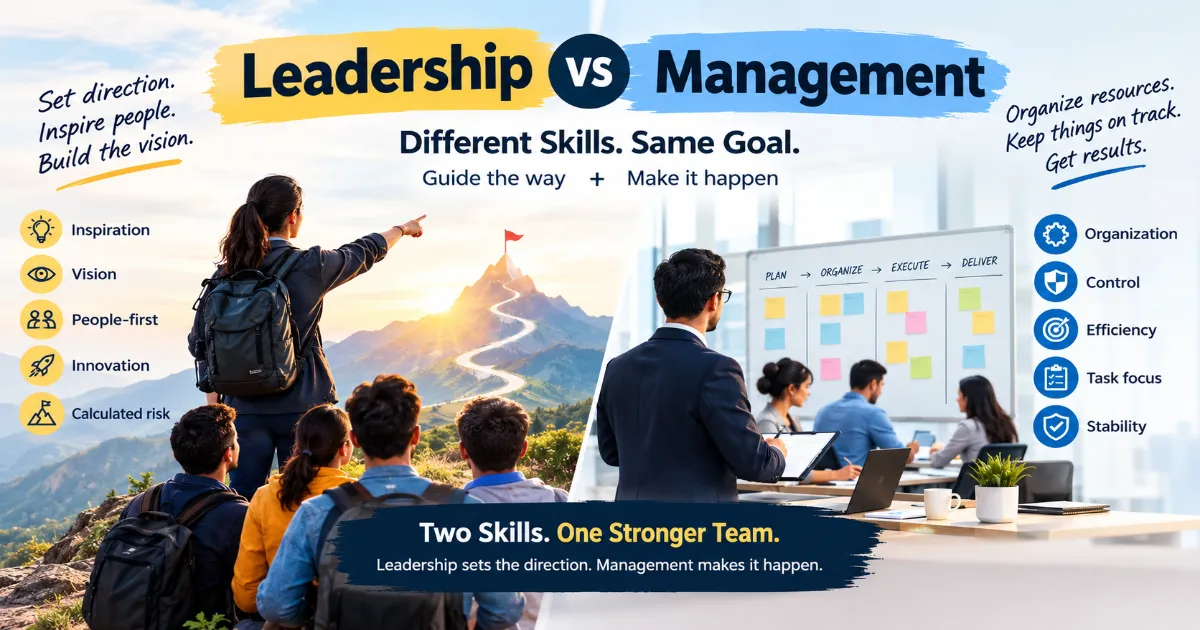
Leadership is like being the captain of a ship. You set the course. You inspire the crew. You guide everyone toward a shared destination, even when the route is unclear.
A few things define leadership in practice:
- Inspiration. Leaders spark real enthusiasm. People follow because they want to, not because they were told to.
- Vision. Leaders can describe what success looks like years before it exists.
- Innovation. Leaders question the current approach and look for a better one.
- People-first. Leaders invest in relationships. They mentor. They notice when someone is struggling.
- Calculated risk. Leaders accept uncertainty when the upside is worth it.
Steve Jobs is the textbook example. He rarely ran Apple’s day-to-day operations himself. His strength was vision, insisting the company build things nobody had asked for yet.
Management: Organizing and Achieving
A few things define management in practice:
- Organization. Managers arrange people, budgets, and time to hit a specific goal.
- Control. Managers build systems to track progress and catch problems early.
- Efficiency. Managers protect deadlines and budgets without losing quality.
- Task focus. Managers keep daily operations running without drama.
- Stability. Managers favor proven methods over untested ones, on purpose.
Tim Cook is the clearest modern example. After taking over from Jobs, Cook did not try to out-inspire him. He built Apple into one of the most operationally disciplined companies in the world, which is exactly what the company needed at that stage.
Leadership and Management: The Key Difference
In simple terms: leadership is doing the right things. Management is doing things right.
That distinction comes from management thinker Peter Drucker, and it has held up for decades because it is genuinely useful. Leadership decides where to go. Management makes sure you actually get there.
Leadership scholar Warren Bennis put it even more directly: leaders do the right thing, managers do things right. Neither one works alone for long.
Why This Distinction Actually Matters
Confusing the two causes real damage. A team led only by management gets efficient at the wrong goals. A team led only by leadership gets inspired and then stalls, because nobody built the systems to execute the vision.
This shows up constantly in small businesses and startups. A founder with huge vision but no operational discipline burns out their team chasing ideas that never ship. The fix is rarely “be a better leader.” It is usually learning to motivate a team while also building the structure to follow through.
The reverse problem is just as common. A manager who runs a tight, efficient operation but never asks whether the team is even solving the right problem, can watch a competitor with a clearer vision pull ahead. This is one of the clearest leadership trends shaping how companies operate this year: the gap is closing, and both skills are increasingly expected from the same person.
Can One Person Be Both?
Yes, and the strongest professionals usually are. N.R. Narayana Murthy built Infosys on a genuinely bold vision for what an Indian technology company could become globally, while also building some of the most disciplined operational and governance systems in the industry. That combination, not just the vision, is what made the company last.
Building both takes deliberate self-development as a leader, not just experience. Vision does not automatically produce discipline, and discipline does not automatically produce vision. Each has to be built on purpose.
Women leading across industries today show this balance clearly too. It is worth looking at examples of women in leadership who combine both strengths, since so many of the most cited case studies still skew toward men.
Which One Does Your Team Need Right Now?
Ask a simple question: is the problem direction, or execution?
If the team is confused about why the work matters, that is a leadership gap. If the team knows the goal but keeps missing deadlines, that is a management gap. Most workplace friction traces back to one of these two, misdiagnosed as the other.
Founders and small business owners often benefit from studying leadership lessons from successful entrepreneurs who had to build both skills from scratch, usually the hard way.
Conclusion
Leadership and management are two sides of the same coin, not competitors. Leadership provides direction and belief. Management turns that belief into results people can actually see.
You do not have to pick one permanently. Most careers ask you to shift between the two, sometimes in the same afternoon. The goal is not choosing a side. It is knowing which one the moment in front of you actually needs, and if career growth is part of that question for you right now, our career and workplace growth guide is a good next read.
Frequently Asked Questions
Q1. What is the main difference between leadership and management?
Leadership is about setting direction and inspiring people toward it. Management is about organizing resources and executing that direction efficiently. One decides where to go, the other makes sure you get there.
Q2. Can a manager also be a leader?
Yes. Many of the most effective professionals build both skill sets over time. Being a manager does not stop someone from also inspiring a team with a clear vision.
Q3. Which is more important for a business, leadership or management?
Neither works well alone. A business with only vision and no execution stalls quickly. A business with only execution and no direction eventually falls behind. Most successful companies need both, often at different moments.
Q4. Who said “management is doing things right, leadership is doing the right things”?
The line is widely credited to management thinker Peter Drucker, drawn from his writing on efficiency versus effectiveness in the 1960s. Leadership scholar Warren Bennis later phrased a similar distinction his own way.
Q5. How do I know if a situation needs leadership or management?
Ask whether the problem is about direction or execution. If people are unclear on why the work matters, that calls for leadership. If people understand the goal but keep missing it, that calls for management.

Ayanshi is the founder of PersonaGuru.in, a blog dedicated to personality development, relationships, and mental health. With 3+ years of writing experience and 250+ published articles, she simplifies psychology into practical, everyday advice for real people.