
Last updated on August 5th, 2026 at 01:05 pm
Have you ever said something you thought was harmless and watched someone’s face fall? Or found out, years later, that your close friends all noticed a habit you never knew you had?
That gap, between how you see yourself and how the world sees you, is exactly what the Johari Window in personality development was built to close.
It started as a tool for corporate training rooms. Today, it is one of the simplest and most practical models for personal growth. Understanding the Johari Window in personality development can help you spot blind spots, build self-trust, and form deeper, more honest relationships.
Key Takeaways
- The Johari Window maps your personality into four areas, based on what you know about yourself and what others know about you.
- The four areas are the Open Area, Blind Spot, Hidden Area, and Unknown Area.
- Research shows that 95% of people believe they are self-aware, but only 10 to 15% actually are, according to organizational psychologist Tasha Eurich’s self-awareness research.
- Growing your Open Area, by asking for feedback and sharing more of yourself, is the fastest way to build real self-awareness.
- You do not need therapy or a course to try this. A pen, a printed adjective list, and one honest friend are enough to start.
- The Johari Window in Personality Development works best when paired with honest peer feedback, not self-reflection alone.
As the philosopher Lao Tzu once put it: “He who knows others is wise; he who knows himself is enlightened.”
What Is the Johari Window in Personality Development?
The Johari Window is a simple psychological model that maps your personality onto a two-by-two grid. One side of the grid is what you know about yourself. The other side is what others know about you. In short, the Johari Window in Personality Development is about closing the gap between self-image and how others see you.
Think of it as a mirror with four panels. Some panels show a clear reflection. Others are fogged up, either to you or to the people around you.
In personality development, this model gives you something most self-help advice does not: a visual way to track the gap between self-perception and how others actually experience you.
Who Created the Johari Window?
Psychologists Joseph Luft and Harrington Ingham created the model in 1955 at the University of California, Los Angeles. The name “Johari” comes from combining their first names, Joe and Harry.
It was originally built to study group dynamics in workshops. It has since become a standard tool for the Johari Window in personality development work across psychology, coaching, HR training, and personal development.
What Is the Main Objective of the Johari Window?
The main objective is simple: grow your Open Area. Every exercise, every feedback request, and every honest conversation is aimed at one goal. You want more of your personality to be known to both you and the people around you, because that is where trust, clarity, and confidence live.
Is the Johari Window Used in Psychology?
Yes. Therapists and counselors use it to help clients notice patterns they cannot see on their own, process feelings they have been hiding, and build healthier communication habits. It is also common in leadership coaching and team-building sessions. This is exactly why the Johari Window in Personality Development sessions is common in therapy intake and leadership coaching.
4 Quadrants of the Johari Window Explained
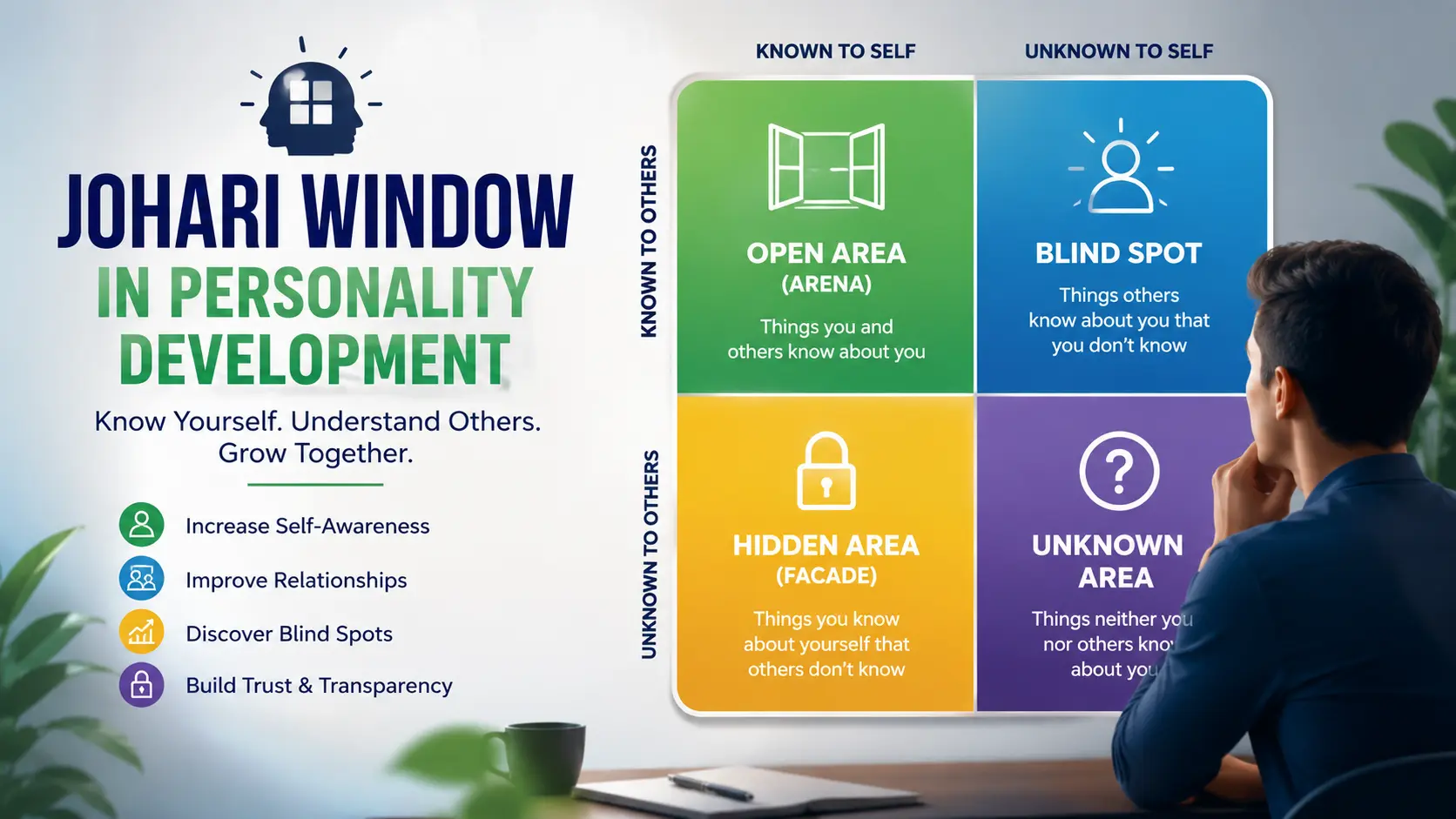
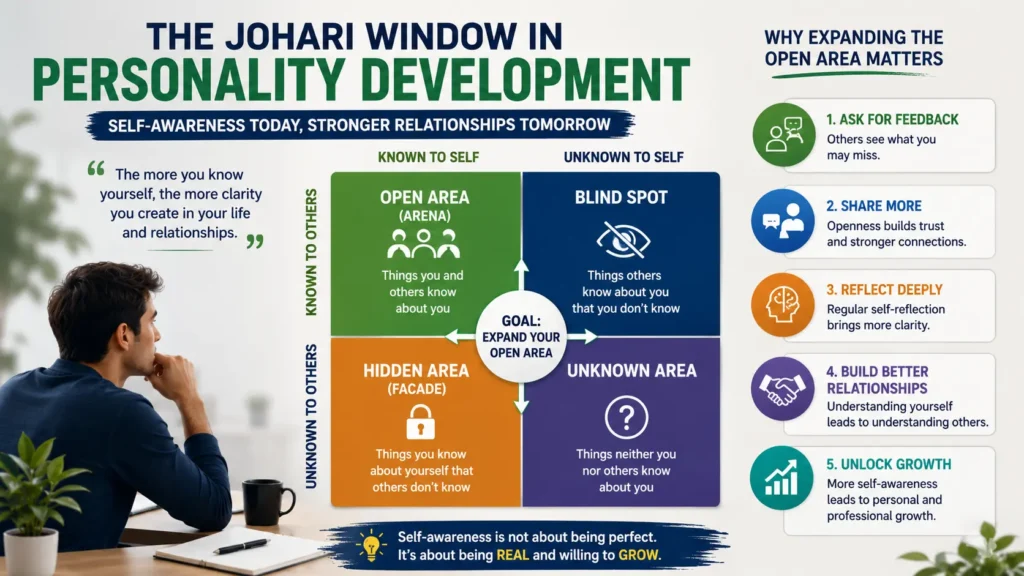
The model divides your personality into four quadrants. Each one depends on who has access to that piece of information: you, others, both, or neither.
| Quadrant | Known to You | Unknown to You |
|---|---|---|
| Known to Others | Open Area (Arena) | Blind Spot |
| Unknown to Others | Hidden Area (Facade) | Unknown Area |
Open Area (Arena)
This is everything that both you and others know about you: your visible habits, your public opinions, your obvious strengths. A large Open Area usually means fewer misunderstandings and easier conversations.
What is a key feature of the open self? Transparency. There is no guessing game here. What people see is genuinely what you are, which is what makes someone feel approachable and trustworthy.
Blind Spot
This is the part others notice about you that you have missed completely. Maybe you think you are a great listener, but your friends have quietly noticed you interrupt them often.
Shrinking this quadrant by actively asking for feedback is one of the fastest ways to grow in personality development.
Sometimes what sits in your Blind Spot is not just a small habit like interrupting someone. It can be a deeper pattern, such as manipulation, constant criticism, or refusal to take responsibility. If you want to check whether any of your own patterns match these, our guide on Toxic Personality Traits: Meaning, Examples, Psychology, and How to Spot Them Early breaks down the warning signs in detail.
Hidden Area (Facade)
This is your private space. Fears, past mistakes, insecurities, things you know about yourself but choose not to share. Some privacy is healthy. Too much of it, though, can leave you feeling isolated even when people surround you. Managing your Hidden Area with care is a core part of the Johari Window in Personality Development.
Unknown Area
This quadrant holds talents, reactions, and patterns that neither you nor anyone else has discovered yet. It usually only shows up when life throws something new at you, a crisis, a new job, or an unfamiliar challenge that forces a new side of you to appear.
How Does the Johari Window Help in Personality Development?
Real growth happens when you deliberately expand your Open Area while shrinking the other three. Here is how that plays out in practice.
Building Self-Awareness
Most people rely only on their own reflection to understand who they are. The problem is that self-reflection alone is biased. You cannot see your own blind spots by definition.
The Johari Window forces you to combine internal reflection with outside feedback. That combination is what actually builds accurate self-awareness, not just confidence in your own opinion of yourself.
If you want to go deeper into the reflection side of this process, our guide on how meditation improves personality development covers practical ways to build that inner clarity.
Improving Interpersonal Trust
When you open up first, even a little, you permit other people to do the same. This is the simplest way to build interpersonal trust. Vulnerability, shared carefully, works better than any icebreaker game.
How the Johari Window Relates to Communication
Most miscommunication happens because two people are speaking from different quadrants. If you say something from your Hidden Area without context, or if you accidentally touch someone’s Blind Spot, confusion follows.
Feedback is the fix here, and it works. Research from Gallup found that employees who get daily feedback from their manager are 3.6 times more likely to stay motivated than those who only get an annual review. The same principle applies outside the office. Regular, honest feedback keeps your self-image accurate— and building factors that affect assertiveness in how you communicate makes that feedback easier to give and receive.
Johari Window in Relationships
How does Johari apply to relationships? Every close relationship, romantic, family, or friendship, grows stronger when both people shrink their Hidden Area and Blind Spot together.
Sharing a fear you normally keep private. Asking your partner what habit of yours actually bothers them. These small, uncomfortable moments are what build real intimacy over time.
How to Complete a Johari Window (Step by Step)
This exercise takes about 15 minutes and needs nothing more than a pen and a willing friend.
Step 1: Self-Assessment. Look at a list of 56 personality adjectives (calm, confident, witty, nervous, independent, and so on). Pick 5 to 6 words that describe you best.
Step 2: Get Peer Feedback. Give the same list to 2 or 3 people who know you well. Ask them to independently pick 5 to 6 words for you, and ask them to be genuinely honest, not polite.
Step 3: Plot and Compare. Sort every chosen word into the grid.
- Open: Words picked by both you and your peers.
- Blind: Words picked only by your peers.
- Hidden: Words picked only by you.
- Unknown: Words nobody picked. These point to growth areas worth exploring.
Johari Window Examples
Two quick, real-world scenarios show how this plays out.
Personal Life Example
Rahul thinks of himself as calm and easygoing. He picks “calm” on his own list. During a family dinner, his sister mentions that he actually gets visibly anxious whenever plans change at the last minute.
That anxiety was sitting in Rahul’s Blind Spot the whole time. Now that he knows, he can work on it directly instead of being caught off guard by it.
Workplace Example
Priya manages a team of eight. She is efficient and reliable, but she never talks about her life outside work. Her team respects her, but a few describe her as distant.
Her Hidden Area- everything she keeps private- has quietly grown into a wall. When she starts sharing small, honest details about her own challenges, her team opens up too. This kind of balanced openness matters just as much at work as it does at home, and it connects closely to your broader self-career perception in personality development.
Benefits of Using the Johari Window
| Benefit | What It Actually Does |
|---|---|
| Reduces social anxiety | Bringing hidden fears into the open removes the stress of guarding a secret |
| Reveals hidden talents | Trying new things moves qualities out of the Unknown Area |
| Builds emotional intelligence | You learn to hear feedback without getting defensive |
| Strengthens leadership | Leaders who share openly build more engaged, honest teams |
| Deepens relationships | Mutual disclosure builds trust faster than small talk |
These benefits show exactly why the Johari Window in personality development remains a relevant, low-effort tool for growth even outside the workplace.
Is the Johari Window Still Relevant Today?
Yes, and arguably more than ever. Social media has made curated, filtered versions of ourselves the norm. Most people now spend more energy managing how they appear than understanding who they actually are.
The Johari Window pushes in the opposite direction. It is one of the few tools built entirely around honesty over image, which is exactly what makes it useful in a world of highlight reels.
Is the Johari Window Effective?
For self-awareness specifically, yes. It will not fix every personal problem, but as a starting point for noticing blind spots and encouraging honest feedback, few tools are this simple and this direct.
Criticisms and Limitations
No model is perfect. A few fair criticisms are worth knowing before you start.
- Shared vulnerabilities can occasionally be used against the person who disclosed them, so choose your feedback circle carefully.
- Harsh or careless feedback can hurt more than it helps if it is not delivered with care.
- The model simplifies human personality into four boxes, which cannot fully capture how complex and situational people actually are. Even with these limits, the Johari Window in personality development remains one of the simplest and most practical self-awareness tools available today.
Modern Alternatives to the Johari Window
If you want to explore other self-awareness frameworks alongside this one, a few worth knowing are:
- The Big Five Personality Test (OCEAN): Measures Openness, Conscientiousness, Extraversion, Agreeableness, and Neuroticism.
- The 360 Degree Feedback Loop: A structured review process common in workplaces.
- Myers-Briggs Type Indicator (MBTI): Categorizes how people prefer to perceive and process the world.
A Fun Fact About the Johari Window
The name has nothing to do with psychology jargon. It is simply “Jo” and “Hari,” the first names of its two creators, mashed together. Joseph Luft and Harrington Ingham never expected their name combination to still be taught in psychology classes seventy years later.
Fresh Tips to Expand Your Open Area This Week
- Try micro disclosure. Share one small, low-stakes personal story with a friend or coworker. Comfort builds gradually, not all at once.
- Ask sharper questions. Instead of “How am I doing?” try “What is one habit of mine that gets in the way?” Specific questions get specific, useful answers.
- Say yes to something new. A new hobby, a new group, an unfamiliar situation. These are the fastest ways to discover what is sitting in your Unknown Area.
Psychologist Carl Rogers made a similar point: real change only becomes possible once you fully accept yourself as you are.
Free Johari Window Worksheet PDF
Reading about this model is one thing. Actually, mapping your own personality is what makes it useful.
We built a free, printable Johari Window Self-Awareness Worksheet. It includes the full 56-word adjective checklist, a ready-to-fill 2×2 grid, and guided reflection questions to help you turn your results into an actual action plan.
Download your free worksheet here and try it with one honest friend this week.
Conclusion
Johari Window in Personality Development is not a one-time test. It is a habit. Every honest conversation, every piece of feedback you ask for, moves you one step closer to knowing yourself the way others already do.
Start small. Pick one word from your Hidden Area and share it with someone this week. Ask one friend what habit of yours actually gets in the way. That single step is where real self-awareness begins.
Ready to see your own Johari Window? Download the free worksheet below and try it with one honest friend today.
Want to build a stronger personality overall? Check out our complete guide to personality development for the full roadmap.
Frequently Asked Questions
Is the Johari Window used in therapy?
Yes. Therapists use it to help clients safely explore hidden emotions, spot long-standing blind spots, and build healthier communication patterns in their relationships.
What are the 4 types of the Johari Window?
The four quadrants are the Open Area (Arena), the Blind Spot, the Hidden Area (Facade), and the Unknown Area.
What happens to our Johari Window as we choose to disclose?
Every time you disclose something you were keeping private, your Hidden Area shrinks, and your Open Area grows. Over time, this builds deeper trust with the people around you.
Is the Johari Window good or bad?
It is neither. It is a neutral, diagnostic tool. Used with honesty and care, it is genuinely useful for self-awareness and personal growth.
What are the three main goals of using the Johari Window?
The three goals are to expand the Open Area, shrink the Blind Spot through feedback, and shrink the Hidden Area through honest disclosure.
To build on what you learn here, our guide on understanding emotional intelligence is a natural next read.

Ayanshi is the founder of PersonaGuru.in, a blog dedicated to personality development, relationships, and mental health. With 3+ years of writing experience and 250+ published articles, she simplifies psychology into practical, everyday advice for real people.