
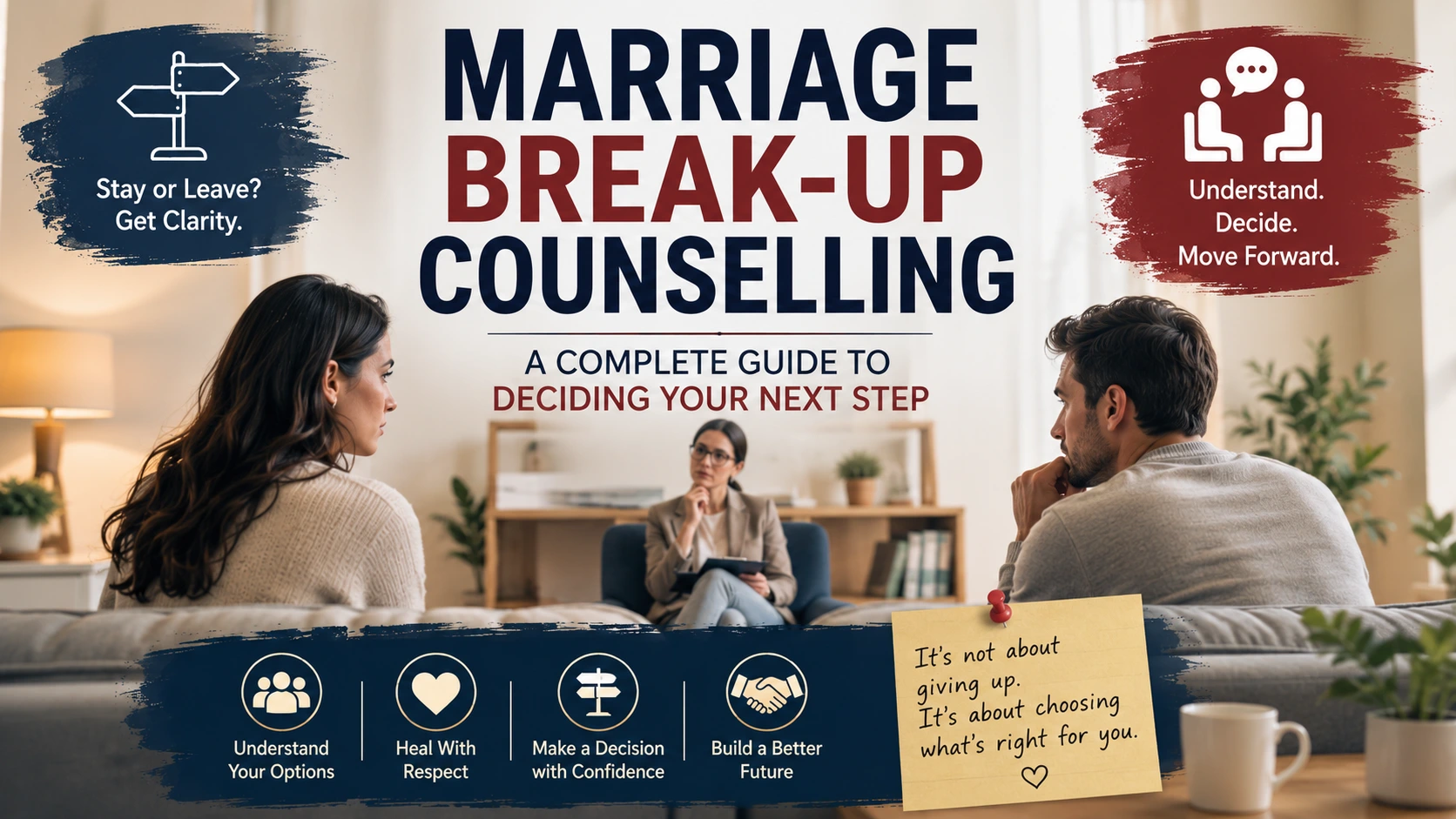
Marriage break-up counselling might be exactly what you need if you are lying awake at midnight, wondering if your marriage is actually over.
Part of you wants to fight for it. Part of you wants to walk away. And part of you just wants someone to tell you what to do.
That limbo feeling is exactly where marriage break-up counselling comes in. A regular marriage counselor assumes you want to save the relationship. But what if you genuinely do not know what you want yet? This kind of counselling is built for exactly that. It does not try to fix your marriage. It helps you figure out if your marriage is worth fixing.
Key Takeaways
- Marriage break-up counselling helps you decide whether to stay or separate, with no pressure either way.
- It differs from regular counselling because it never assumes both partners want to stay.
- The process usually takes 3 to 5 sessions, not months.
- This approach is also called discernment counseling, developed by Dr. William Doherty.
- The real goal is not saving your marriage. It is making a decision you can live with.
What Is Marriage Break-Up Counselling
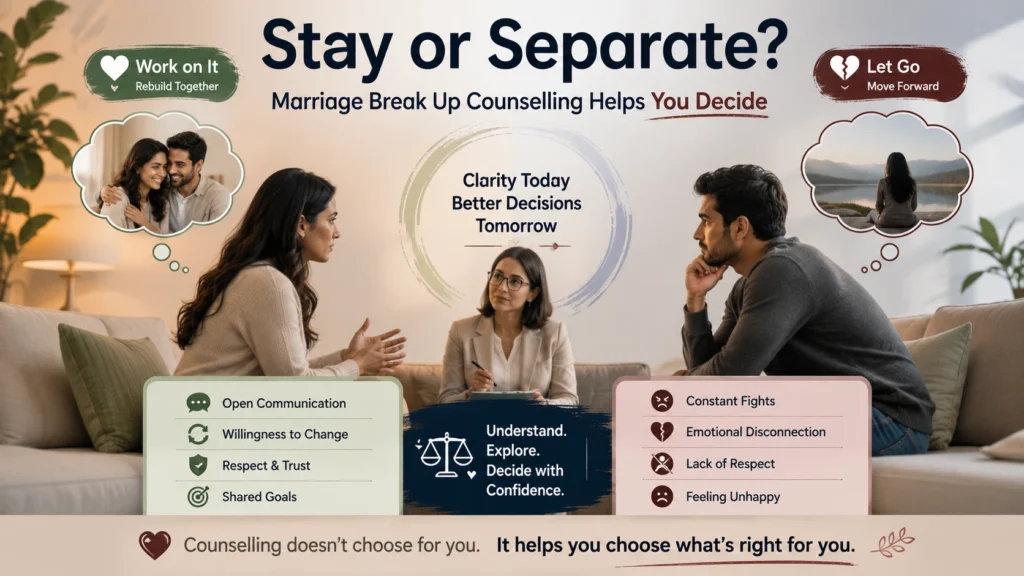
Marriage break-up counselling is therapy for couples who are genuinely unsure if their relationship should continue.
Regular marriage counselling assumes both partners want to stay. This one does not. The therapist stays neutral. They do not push you toward staying or leaving. Instead, they help you understand what is really happening and what you actually want.
This approach also goes by another name: discernment counseling, or separation therapy. It was developed by Dr. William Doherty, a professor at the University of Minnesota, through the Doherty Relationship Institute, specifically for couples where one partner is “leaning in” to save the marriage while the other is “leaning out” toward divorce.
Doherty’s research tracked certified discernment counselors. Roughly half the couples chose structured couples therapy afterward. About 30% chose separation. The rest chose to continue as they were, at least for now, while they gained more clarity. A follow-up study found that 40 percent of couples were still married two years later.
All three outcomes count as a success here. The goal was never forced reconciliation. It was confidence, instead of confusion.
How Is This Different From Regular Marriage Counselling
This distinction matters. It changes what actually happens in the therapy room.
Regular marriage counselling starts from a shared assumption. Both of you want to stay together. The counselor helps you get there through better communication and conflict resolution.
Marriage break-up counselling starts from a different place. You are not sure. One or both of you might be done. The counselor helps you find out what is true, without judgment either way.
| Aspect | Regular Marriage Counselling | Marriage Break-Up Counselling |
|---|---|---|
| Assumption | Both want to stay together | Unclear if staying is right |
| Goal | Improve the relationship | Gain clarity about the future |
| Therapist role | Coach toward reconciliation | Neutral facilitator |
| Key question | How do we fix this? | Should we stay or leave? |
| Typical timeline | Often 6 to 12 months | Usually 3 to 5 sessions |
| Outcome | Ideally, a stronger marriage | Staying, leaving, or more time |
If you are both genuinely committed but struggling, regular counselling works well. If you are honestly unsure whether you want to stay, break-up counselling is the more honest starting point.
Do Marriage Counselors Ever Suggest a Break-up
Yes. It happens more often than most people expect.
A good marriage counselor will name separation as the healthiest option when certain patterns show up clearly.
- When safety is at risk. If there is abuse, physical, emotional, or financial, a counselor will recommend leaving. This is not a gray area.
- When one person has already emotionally left. If a partner has checked out completely, pushing for reconciliation often just prolongs the pain.
- When the relationship is actively harming both people. This looks different for everyone. For some, it is years of criticism. For others, it is a betrayal that never truly healed.
- When both people are exhausted. Sometimes couples have tried everything. Therapy. Books. Real effort. And nothing has shifted. At that point, a counselor may gently name that staying is not serving either of you.
A good counselor will never simply tell you to leave. But they will help you see clearly. Is staying actually serving you? Or is it just serving your fear of being alone?
Signs It Might Be Time to Consider Separation
Not every struggling marriage should end. But some genuinely should.
- Repeated cycles with no real change. You fight about the same things. You apologize. Things improve for a week. Then you fall back into the same pattern. This has been going on for over a year.
- One partner has already emotionally checked out. You can feel it. They do not ask about your day anymore. They do not seem to care whether you stay or leave.
- Safety or respect is consistently missing. This includes obvious abuse. It also includes subtler things, like constant contempt or feeling small.
- You are staying out of fear, not love. Fear of being alone. Fear of judgment. Fear of starting over. These are real fears. But they are not good reasons to stay.
- You cannot remember why you loved them. Can you still find that feeling? Or has it been buried too deep under resentment?
- Your mental or physical health is deteriorating. A relationship should add to your life. It should not slowly take from it.
What Happens in a Marriage Break-Up Counselling Session
If you have never done this before, here is what the process usually looks like.
Session 1: the assessment. The counselor asks both of you to describe the relationship. How did you meet? What was good? When did things start to shift? They will also meet with you individually, without your partner in the room.
Sessions 2 and 3, the deep dive. This is where the real patterns surface. What needs are not being met? Is there still respect underneath the hurt?
Sessions 4 and 5, the decision. By now, clarity usually starts to form. You might realize you want to fight for the marriage. Or that it is time to let go. Or that you need individual therapy first.
The discernment period. Some couples need time to sit with what they learned. A counselor may suggest two to four weeks with no major decisions. You simply live in the clarity you gained and see how it feels.
What Is the 3-3-3 Rule and Does It Apply to Breakups
The 3-3-3 rule is most commonly a dating framework, not a breakup recovery rule. It suggests checking in with yourself at three points in a new relationship: after 3 dates, after 3 weeks, and after 3 months.
Some breakup recovery communities have adapted a separate version for healing after a split. It goes like this: 3 days for the initial emotional release, 3 weeks for active reflection, and 3 months for rebuilding your routine.
Neither version is a strict clinical rule. Both are simply reminders. Healing takes real time. Structured checkpoints can help you avoid big decisions made in raw emotion.
What Type of Therapy Works Best During a Breakup
If you have decided to separate, therapy usually does not stop. It just changes shape.
Discernment counseling, if you have not tried it yet, is worth doing first. Couples who go through this before separating often report less regret. The decision felt thoughtful, not impulsive.
Individual therapy alongside couples sessions tends to work best during an active separation. Individual therapy gives you space to grieve. Couples sessions give you structure for the practical work, co-parenting, finances, and logistics.
Solo individual therapy after separation becomes especially important once the split is final. This is where you rebuild your sense of identity, so you do not carry old patterns into your next relationship.
How Long Does This Process Usually Take
There is no single standard timeline. But here is what most people experience.
- Deciding to seek help: 1 to 2 weeks, if you are being proactive
- Finding the right counselor: 1 to 3 weeks, depending on availability
- The discernment counselling itself: 3 to 5 sessions, over roughly 4 to 8 weeks
- Adjustment after a decision: 2 to 4 weeks if separating, or ongoing if working on the marriage
- Full emotional processing: often 6 to 12 months after separation
If children, shared finances, or years of hurt are involved, this usually takes longer. That is completely normal.
How to Find the Right Counselor for This
Not every marriage counselor is trained specifically in discernment work. Here is what to look for.
- Proper credentials. A master’s degree or higher in counseling, psychology, or social work, with proper licensure.
- Relevant experience. If infidelity is involved, look for someone who specializes in that. If abuse is present, find someone trauma-informed.
- Genuine neutrality. A good counselor will not push you toward staying or leaving.
- Willingness to meet individually. The best discernment counselors offer both individual and joint sessions.
- A realistic approach. Be cautious of anyone who promises to “save your marriage” outright. Real therapy offers clarity, not guaranteed outcomes.
If your marriage has been struggling with trust after a betrayal, it may also help to read about common mistakes couples make when reconciling after infidelity, since the same clarity that helps with separation also helps with rebuilding.
Final Thoughts
Marriage break-up counselling is not about saving your marriage. It is about saving yourself from confusion, regret, and decisions made purely out of fear.
If constant self-doubt feels familiar in this relationship, it is worth understanding how patterns from emotionally immature parents quietly shape how much dysfunction we learn to accept as adults.
Whether you stay or leave, the goal stays the same: clarity. You deserve a relationship that adds to your life, not one that slowly subtracts from it.
FAQs
1. What are the 7 stages of a breakup?
Most people move through something like shock and denial, anger, bargaining, depression, acceptance, rebuilding, and finally integration. These stages rarely happen in a strict order. It is common to cycle through some of them more than once.
2. What is the hardest phase after a breakup?
Most people find the first 2 to 3 months hardest. The reality still feels raw. For others, a harder phase shows up closer to the 6-month mark, once the initial adrenaline fades.
3. Can counselling save a marriage that is already breaking down?
Sometimes, but not always. Counselling can help a marriage that still has a foundation of respect and willingness. It generally cannot fix a marriage where one person has already given up, or where abuse is present. What it can always do is help you see clearly which category your marriage falls into.

Ayanshi is the founder of PersonaGuru.in, a blog focused on personality development, career, relationships, and mental well-being. With over 3 years of writing experience, she turns psychology and everyday experiences into practical, easy-to-understand advice for real life.