

Last updated on September 13th, 2026 at 12:32 pm
Can a narcissist change? This is the question you keep asking yourself at 2 AM, replaying every broken promise.
You have been waiting for the apology. The real one. The kind where they actually understand what they did wrong and commit to being different.
Maybe they promised to change after you threatened to leave. Maybe they said they would go to therapy. Maybe they swore this time would be different.
But weeks pass. Months pass. You are back to square one, wondering if anything will ever truly change.
If you are asking whether a narcissist can change, you are not alone, and whether a narcissist can change is one of the most searched questions in relationship psychology today.
Key Takeaways
- Narcissists can change, but it is rare and requires genuine motivation, not just pressure.
- Most narcissists lack the self-awareness needed to recognize they have a problem.
- There is a real difference between narcissistic traits and full Narcissistic Personality Disorder. One is far more changeable than the other.
- Real change looks different from a temporary performance. Watch for consistency, not promises.
- Age, therapy, and hitting a personal low point can all influence whether change happens.
- Waiting for a narcissist to change while you stay in the relationship often costs your own mental health.
Can a Narcissist Actually Change
Yes, a narcissist can change. But the chances are low, and the process is slow. The question “Can a narcissist change?” gets asked thousands of times daily by people in painful relationships. The answer is yes—but understanding what that change actually looks like is crucial, because most people mistake performance for transformation.
Here is why it is so hard. Narcissism runs on low self-awareness. A narcissist rarely sees their own behavior as the problem. They see themselves as justified, and if something goes wrong, it is usually someone else’s fault in their eyes.
That is the real barrier standing between a narcissist and change. You cannot fix something you do not believe is broken.
For change to begin, a narcissist first has to accept that how they treat people is causing harm. That belief does not come naturally. It usually gets forced on them through consequences, such as losing someone they value.
The American Psychiatric Association notes that people with Narcissistic Personality Disorder rarely seek treatment unless they are pushed into it, whether by a court order, an ultimatum, or a personal crisis. Even then, many leave therapy early because they do not believe they need it.
Still, change is not impossible. Some narcissists do the work. Some develop real empathy over time. Some become better partners and parents.
But it is the exception. Not the rule.
Narcissistic Traits vs Narcissistic Personality Disorder
This distinction changes the whole answer to whether change is possible.
Narcissistic traits are behaviors that most people show sometimes. Being self-focused, craving attention, or struggling with empathy in certain moments does not mean someone has NPD. Many successful, functional people carry narcissistic traits without it becoming pathological.
Narcissistic Personality Disorder is a clinical diagnosis. It describes a lasting pattern of grandiosity, low empathy, and a constant need for admiration that shows up across nearly every part of a person’s life.
The key difference is this. Someone with narcissistic traits can grow and soften over time. Someone with full NPD faces a much steeper climb.
| Aspect | Narcissistic Traits | Narcissistic Personality Disorder |
|---|---|---|
| Self awareness | Can develop with effort | Rarely develops naturally |
| Empathy | Can be practiced and learned | Genuinely difficult to access |
| Response to criticism | Defensive, but can absorb feedback | Usually dismisses feedback entirely |
| Motivation to change | Present if the consequences are clear | Rarely felt at all |
| Overall likelihood of change | Moderate to good | Low |
Most people dealing with a narcissist in their life are dealing with someone closer to full NPD, not just occasional narcissistic traits. That distinction matters when you are deciding how much hope to place in change.
What Would Make a Narcissist Want to Change
Narcissists rarely change because they want to become better people. They change when the cost of staying the same finally becomes too high.
1. Hitting a Personal Low Point
This is the most common trigger. When a narcissist loses something they truly value, a job, a marriage, custody of their children, or their public reputation, the pain sometimes becomes impossible to ignore.
Even then, many will simply blame everyone else and move on. But occasionally, the loss is big enough that they cannot spin a story where they are the victim. In that rare moment, some narcissists experience real clarity.
For example, a man with strong narcissistic traits goes through a painful divorce. He loses time with his children. For the first time, he faces consequences he cannot talk his way out of. Some men in this position genuinely start therapy and do the work. Others simply move on to a new relationship and repeat the pattern.
2. Fear of Losing Someone Important
If a partner says clearly, “I am leaving if this does not change,” some narcissists will try.
The important word here is try. They might start therapy. They might make a real effort for a few weeks or months. But sustaining that effort is hard because it demands ongoing self-reflection, something that does not come naturally to them.
3. Genuine Self-Awareness
This is rare, but it happens, usually later in life. Some narcissists watch their adult child develop the same patterns they had, and it shakes something loose. Others go through a health scare that makes them think seriously about their legacy. Sometimes, it is simply years of accumulated life experience finally breaking through.
When genuine self-awareness shows up, real change becomes possible.
Signs a Narcissist Is Truly Changing vs Just Performing
This is the part most people get wrong. Many narcissists are excellent at performing change. They apologize beautifully, promise the world, and seem genuinely sorry, for a while.
Real change looks very different from a performance.
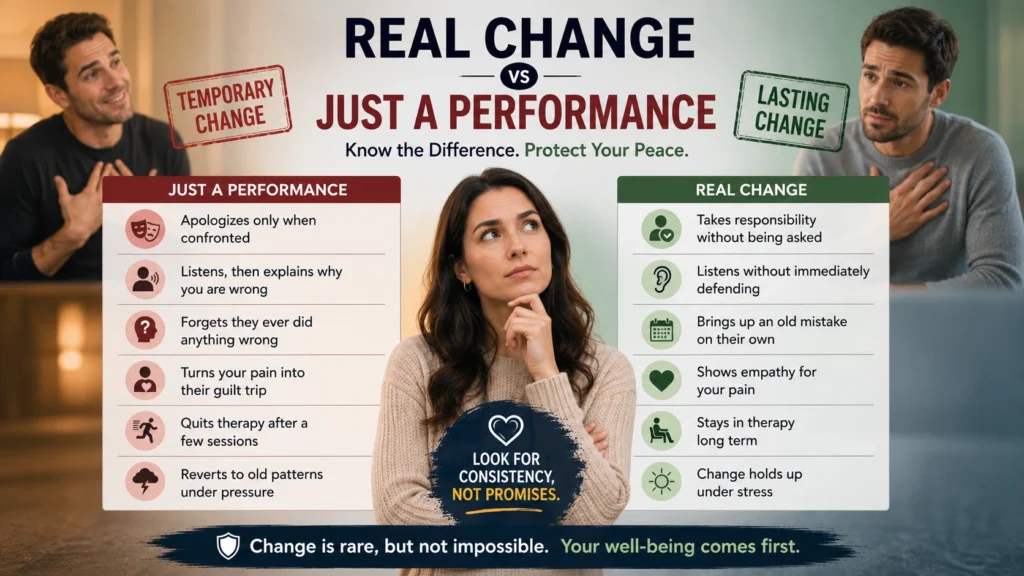
- They take responsibility without being asked. A narcissist who is truly changing owns their mistakes without you having to pull it out of them. Instead of “I am sorry you feel that way,” you hear “I was wrong. I hurt you. That was on me,” and they say it unprompted.
2. They can sit with uncomfortable emotions. Real change means tolerating guilt, shame, and regret instead of deflecting or raging. A person who is genuinely changing will pause and listen instead of immediately defending themselves. They might even cry, not to manipulate you, but because they are actually feeling something.
3. The change holds up under stress, not just during calm moments. Anyone can be pleasant for a week. The real test is whether they stay that way when things get hard. A narcissist who has genuinely changed does not revert to old patterns during an argument and does not use their progress as a weapon by saying things like, “I have changed so much, and you still do not appreciate it.”
| Sign of Real Change | Sign of Performance |
|---|---|
| Takes responsibility unprompted | Apologizes only when confronted |
| Listens without immediately defending | Listens, then explains why you are wrong |
| Brings up an old mistake on their own | Forgets they ever did anything wrong |
| Shows empathy for your pain | Turns your pain into their guilt trip |
| Stays in therapy long-term | Quits therapy after a few sessions |
| Changes hold up under stress | Reverts to old patterns under pressure |
Will a Narcissist Change for Someone They Love
This is the question that keeps people stuck. If they really loved me, would they not change?
The truth is, not necessarily.
Narcissists tend to love what someone does for them more than the person themselves. They value how you make them feel and the image you help them present to the world. That is different from loving you as a separate person with your own needs.
So when a narcissist says “I will change for you,” it often really means “I will change just enough to keep you around.”
That said, some narcissists do develop real attachment to certain people. It may not look like healthy love, but it is something, and sometimes that something is enough to motivate real effort.
Even so, love alone does not guarantee change. Without self-awareness and the willingness to sit with discomfort, love is not enough. The real question is not whether they will change for you. It is how long you are willing to wait and what that wait is costing you.
Does Age Affect Narcissism
Research suggests narcissistic traits do soften with age.
A study published in the journal Personality and Individual Differences found that narcissistic traits tend to peak in young adulthood and gradually decline over time. People in their fifties and sixties generally score lower on narcissism than people in their twenties.
A few reasons explain this pattern:
- Life experience forces accountability that is harder to avoid over time.
- The brain’s prefrontal cortex, which governs empathy and impulse control, keeps developing into a person’s sixties.
- Social roles shift too. Becoming a parent, grandparent, or mentor pushes people to think beyond themselves.
But this decline is an average across large populations. It is not a guarantee for any one individual. Some narcissists become more rigid and controlling with age instead of softer. Age can help, but it is never a promise.
Can Narcissists Be Good People
This question comes up often, especially from people who love a narcissist and want to believe there is real goodness underneath. It depends on what you mean by good.
A narcissist can absolutely do generous, funny, and kind things, especially in public or when it serves them. They can show up for major life events while still being emotionally distant in private. But can they consistently care about someone else’s well-being without expecting something back?
As psychologist Elinor Greenberg puts it, “Not all narcissists can change.” For most people with true NPD, deep and consistent selflessness is genuinely difficult, not because they are evil, but because their capacity for it is limited.
Some narcissists do build more capacity for care over time, especially with sustained therapy. They learn to act in caring ways even without feeling it naturally. But expecting full, consistent goodness from someone with NPD often sets you up for disappointment.
Understanding whether a narcissist can change also means accepting that goodness and genuine change do not always arrive together.
What Therapy Actually Helps With Narcissistic Personality Disorder
When a narcissist does commit to therapy, certain approaches tend to work better than others.
Traditional talk therapy often struggles here because it requires the patient to stay open to feedback, something narcissists tend to resist. A few specific methods have shown more promise.
- Schema therapy helps a person uncover the core beliefs driving their behavior, often deep insecurity or shame hiding underneath the narcissism. It works partly because it does not shame the person further; it helps them understand where the pattern came from.
2. Transference-focused therapy works through the relationship between the therapist and the client. The therapist gently points out patterns as they show up in real time, which can slowly build self-awareness.
3. Dialectical behavior therapy, originally built for borderline personality disorder, has also shown promise for narcissistic patterns. It teaches emotional regulation and healthier ways to handle conflict.
One important caution. Even with the right approach, many narcissists drop out once therapy gets uncomfortable. No therapy can force someone to change if they are not willing.
Should You Wait for a Narcissist to Change
This is the real question underneath everything else. Waiting for a narcissist to change while staying in the relationship often comes at a real cost to your own mental health.
Here is what that waiting usually looks like:
- You live in a cycle of hope and disappointment, seeing small signs of change and thinking maybe this time is different, only to watch them revert.
- You put your own goals on hold because so much energy goes into managing the relationship.
- Slowly, you start accepting things you never would have accepted before, because you have grown grateful for small moments of decency.
- Over time, you can lose track of who you are outside of managing them.
Is change possible? Yes. Is it likely? Not really. And the cost of waiting can be high.
The real question is not whether they will change. It is how long you are willing to wait and what you are giving up in the meantime. “In many Indian families, cultural pressure to stay in relationships—’log kya kahenge,’ arranged marriage obligations, joint family expectations—can make leaving feel impossible even when change is not happening. Your wellbeing matters more than family reputation.”
How to Protect Yourself While They Figure It Out
If you are still in this relationship and hoping for change, a few things can help protect your own well-being along the way.
- Set clear, specific boundaries. Instead of vague requests, say something concrete like, “If you raise your voice at me, I will leave the room,” and follow through every time.
- Keep your own life running. Hold onto your friendships and your goals instead of putting everything on hold.
- Get your own support. A therapist can help you process what is happening and build strategies that protect your own peace, separate from theirs.
- Track patterns, not just moments. Writing down what actually happens, not just how you feel in the moment, helps you see reality clearly when you are tempted to minimize it.
- Know your options. Having a plan for what you would do if things do not change does not mean you have to use it, but it gives you back a sense of control.
If constant guilt and self-doubt from this relationship feel familiar, it is worth reading about the signs of emotionally immature parents, since childhood patterns often explain why we accept certain behaviors as adults without realizing it.
Final Thoughts
Can a narcissist change? Yes, and now that you know what real change versus performance looks like, you can watch for it instead of hoping blindly. Will yours change? That is a separate question entirely.
The research is clear that change is possible but rare. It takes sustained motivation, genuine self-awareness, and a willingness to sit with real discomfort, and most narcissists never reach that point.
Some do. Some people with narcissistic traits recognize the pattern and put in the work. Some people with full NPD build enough self-awareness in therapy to make lasting progress.
If you are waiting for that shift, it is fair to hope for it. But it is just as important to take care of yourself while you wait, and to know that walking away, if it comes to that, is a valid and loving choice too, for both of you.
FAQs
People often ask these questions when wondering if a narcissist can change:
1. Can a narcissist be faithful?
A narcissist can stay faithful if the relationship keeps meeting their need for admiration and control. But if they feel bored or believe someone else offers more attention, they are more likely to stray. For a narcissist, fidelity is usually tied to control or image, not emotional loyalty.
2. How do you know if a narcissist has truly changed?
Real change shows up in consistency over months, not days. They take responsibility without being prompted. They listen without immediately defending themselves. They can tolerate your emotions without turning it back into something about them, and they hold onto these behaviors during conflict, not just when things are calm.
3. Can you successfully live with a narcissist?
Yes, many people do live with a narcissist and manage it. But it usually requires strong boundaries, a solid support system outside the relationship, and realistic expectations about what they can and cannot give you emotionally.
4. What is a narcissist’s biggest fear?
Abandonment and irrelevance. Narcissists rely on a steady stream of admiration and attention. When they sense they are losing that, or losing you, they often escalate their behavior to pull you back in.

Ayanshi is the founder of PersonaGuru.in, a blog focused on personality development, career, relationships, and mental well-being. With over 3 years of writing experience, she turns psychology and everyday experiences into practical, easy-to-understand advice for real life.