
Ask any adult why they react to stress the way they do. The answer almost always traces back to home. Not to a textbook. Not to a personality test. To the dinner table. The arguments. The hugs. The silences.
That is the family talking.
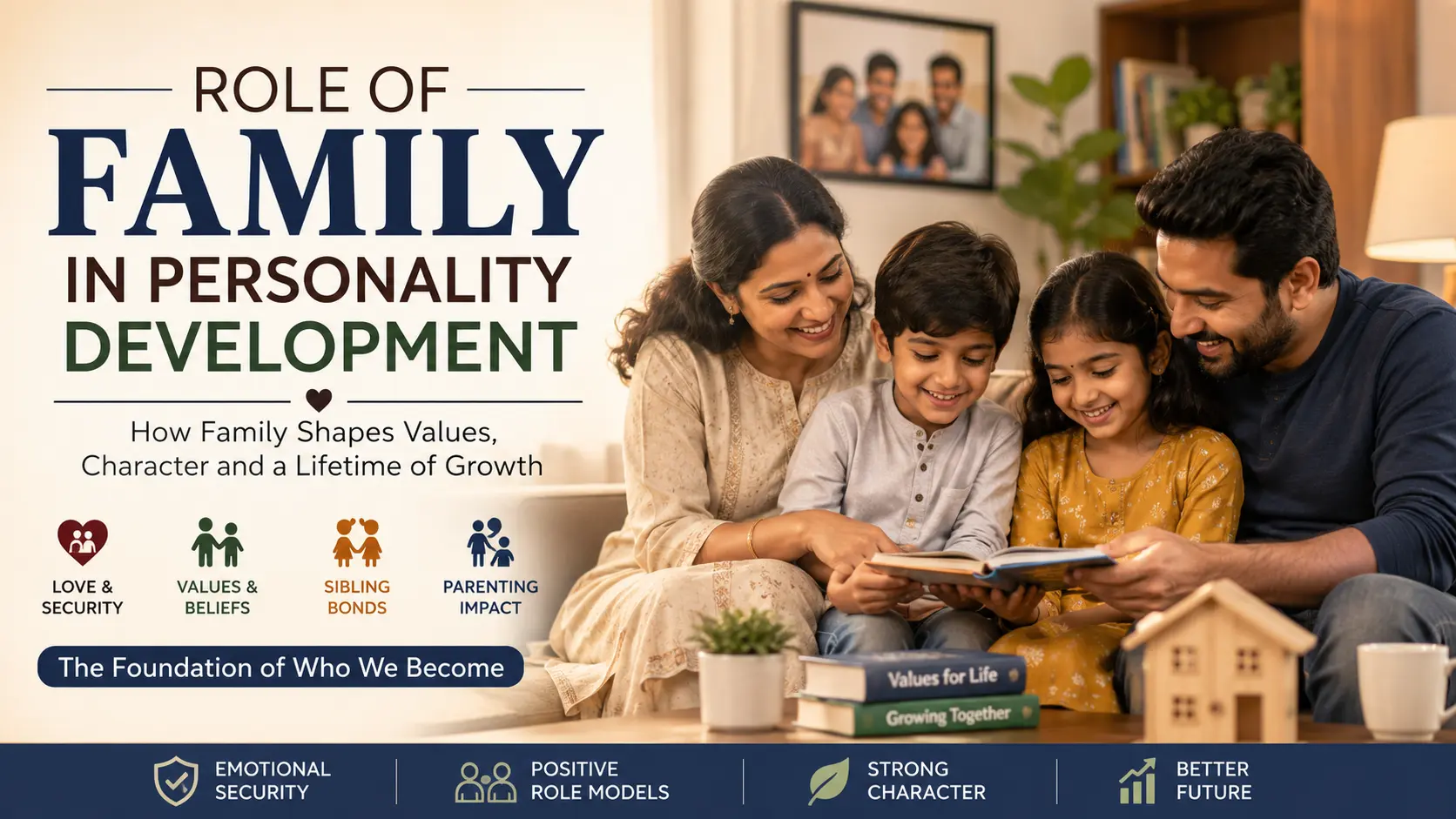
Family is the first classroom a person ever attends. School comes later. Friends come later. Social media comes later. Home comes first. It teaches a child how to feel, how to speak, and how to see the world. This article breaks down the real role of family in personality development, with research, real examples, and practical takeaways. Whether you are a parent, a student, or just curious about yourself, this is for you.
Key Takeaways
- The role of family in personality development starts with emotional bonding, behavior modeling, values, and daily interaction from infancy onward.
- A 2025 study found a moderate to strong link between parenting style and a child’s developmental outcomes. The correlation was 0.54.
- Authoritative parenting, warm but structured, leads to higher self-esteem and better emotional regulation. Recent studies confirm this again and again.
- India’s joint family system adds a layer most global research ignores. Multiple adult role models live under one roof.
- Personality is not fixed by family alone. Therapy, mentors, and self-awareness can reshape old patterns at any age.
What Is Personality Development?
Personality development never fully stops. It is an ongoing process. It builds the traits, habits, and thought patterns that make a person who they are. But the foundation gets laid early. Family is the architect of that foundation. Want the full picture? Our complete guide to personality development breaks it down step by step.
Why Family Is the Primary Agent of Personality Development
A newborn has no language. No beliefs. No habits. Everything gets absorbed from the people around them. For most children, that means parents, siblings, and extended family first.
Psychologists call this process socialization. A child learns which behaviors earn a smile and which ones earn a frown. This happens long before the child understands why. This is the earliest and most powerful stage in the role of family in personality development. It sets the tone for everything that follows.
A 2025 study in Frontiers in Psychology looked at parenting styles among preschool children. It found a moderate to strong statistical link, r = 0.54, between parenting and a child’s development. In plain words, the way a family behaves at home shows up in how the child grows. The link is measurable, not just a feeling.
Key Roles of Family in Personality Development
Emotional Security and Attachment
A child who feels safe at home explores the world with more confidence. This is the basis of attachment theory. A parent responds consistently to a child’s needs. The child builds an internal sense that the world is safe. They start taking small risks.
The opposite is true too. Inconsistent or cold responses can breed anxiety. Trust becomes harder to build later in life.
Real example: A toddler falls and looks up at a parent before reacting. This is a test. A calm, reassuring face says the fall is not a crisis. A panicked reaction says the opposite. This small signal repeats thousands of times over childhood. Slowly, it shapes how confident or anxious the child grows up to be.
Behavioral Modeling: Children Copy What They See
Kids do not do what you say. They do what you do.
Psychologist Albert Bandura called this observational learning. It is part of his wider Social Learning Theory. His experiments showed something simple. Children copy the adults they trust most. A parent shouts when frustrated. The child learns that shouting is how frustration gets handled. A parent stays calm and explains their feelings instead. The child picks that up too.
Real example: A mother says, “I am upset right now, give me a minute.” She does not snap. She names the feeling instead. Her child learns emotional labeling just by watching. Years later, that child says the same sentence at work. They do not lose their temper. They learned it at home, without a single lesson.
Moral and Cultural Values
Family is usually the first place a child hears words like honesty, respect, and gratitude. Festivals teach it. Family stories teach it. Small everyday rules teach it too, like touching elders’ feet or sharing food. These moments show a child what their community considers right and wrong.
These lessons stick. They often stay with a person long after they leave home. This is the role of family in personality development at its quietest and its most powerful. It forms the moral backbone of adult personality. A child raised on honesty carries that standard forward. It shows up in friendships. It shows up in exams. It shows up in workplace decisions, decades later, often without the person even noticing where it came from.
Social Skills Through Sibling Relationships
Siblings are often a child’s first peer group. Fighting over a toy. Sharing a room. Negotiating who gets the last piece of cake. These look like small events. But they teach negotiation, empathy, and conflict resolution.
Children with siblings often enter school already knowing how to share. They know how to take turns. Years of practice at home gave them a head start.
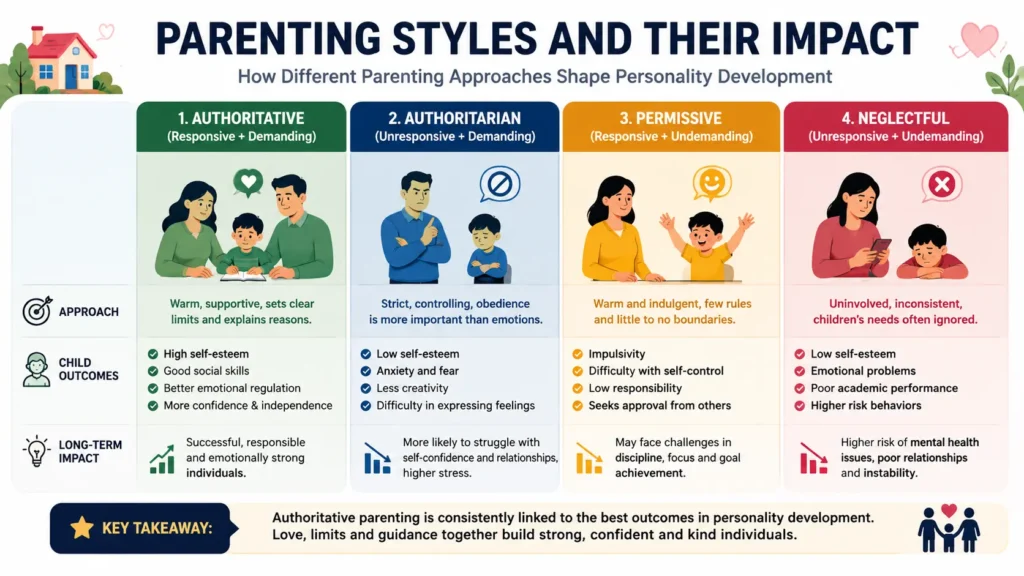
Parenting Styles and Their Impact
Psychologist Diana Baumrind built the classic framework here. Researchers Eleanor Maccoby and John Martin later expanded it. It remains the most widely used model for understanding how parenting shapes personality.
| Parenting Style | Approach | Common Personality Outcome |
|---|---|---|
| Authoritative | Warm, but sets clear rules | Higher self-esteem, better emotional regulation |
| Authoritarian | Strict, low warmth | Higher anxiety, lower self-confidence |
| Permissive | High warmth, few rules | Poor self-discipline, difficulty handling limits |
| Neglectful | Low warmth, low involvement | Insecurity, emotional withdrawal |
A 2025 study on Spanish adolescents, published in PMC, backs this up. Parenting style is directly tied to personality traits, self-esteem, and life satisfaction in the teenage years. Authoritative parenting came out on top. It won across almost every measure. Few things show the role of family in personality development more clearly than this single choice of parenting style.
Positive vs Negative Family Influences on Personality
Not every family factor pushes in the same direction. The same area of family life can build up a child’s personality. Or it can wear it down. It depends on how it plays out. Here is the breakdown.
| Family Factor | Positive Effect | Negative Effect |
|---|---|---|
| Communication | Builds confidence and emotional vocabulary | Breeds silence, resentment, or poor conflict skills |
| Discipline style | Teaches self-control and responsibility | Creates fear-based compliance or rebellion |
| Financial stress | Can build resilience and resourcefulness | Often raises anxiety and insecurity |
| Sibling relationships | Builds empathy and negotiation skills | Can cause rivalry, comparison, and low self-worth |
| Parental attention | Builds a strong sense of self-worth | Neglect can lead to attention-seeking or withdrawal |
Role of Family Across Life Stages
The role of family in personality development does not stop at childhood. It shows up differently at every stage of life.
Infancy and Early Childhood
This is when attachment forms. Whoever holds, feeds, and soothes a baby becomes their first model. That model shapes what relationships will feel like for years.
Adolescence
Teenagers push back against family rules. At the same time, they still need family approval. This tug of war shapes independence, identity, and self-worth. Some families allow autonomy while staying emotionally available. Their teenagers tend to grow up more confident, and eventually become self-dependent adults rather than staying reliant on others for validation.
Adulthood
Most adults move out. But they carry their family’s communication style with them. They carry the conflict habits too. And the emotional patterns. All of it shows up again, in relationships and at work. Researchers call this continuity the corresponsive principle of personality development. It is one more reason the role of family in personality development stretches far beyond childhood.
Indian Joint Family System and Personality Development
Most global research assumes a small, nuclear household. Two parents, their children, done. India often looks different, and this changes the role of family in personality development in ways most studies miss.
In a joint family, a child grows up around grandparents, uncles, aunts, and cousins. Everyone lives under one roof, or close by. This changes the personality-building equation in specific ways.
- More role models, more perspectives. A child does not just learn from mom and dad. Grandparents pass down patience and tradition. Cousins add a built-in peer group.
- Shared emotional load. Research on Indian families shows something interesting. Children in joint households often score higher on social adjustment and emotional stability. The caregiving gets shared across more adults, so no single person carries the whole load.
- Less individual autonomy. The same closeness that builds social skills can also limit personal space. Independent decision-making can suffer too. Researchers studying India’s changing family structures call this a genuine trade-off.
Neither structure is automatically better, joint or nuclear. What matters most is the quality of the relationships inside it. Not the number of people in the house.
A family does not need to be perfect to raise a whole person. It only needs to be present.
When Family Environment Goes Wrong: Their Long-Term Effects
Not every home is a safe one. Constant conflict. Harsh criticism. Favoritism between siblings. Emotional neglect. These leave marks. They last well into adulthood.
Common long-term effects of a difficult family environment include:
- Low self-esteem, carried into adult relationships and career decisions.
- People-pleasing habits, formed as a survival strategy in an unpredictable home.
- Difficulty trusting others, especially in close relationships.
- Repeating the same patterns, sometimes without even realizing it, in one’s own parenting or partnerships.
None of this is permanent. Awareness is the first real step. Once you see where a pattern came from, you can start to change it. Understanding the role of family in personality development is often what makes that recognition possible in the first place. If this resonates, read our article on how self-concept forms during childhood.
Can Personality Change Despite a Difficult Family Environment?
Yes. Say it clearly: a hard childhood does not lock a person into one fixed personality forever.
Research on neuroplasticity backs this up. The brain keeps forming new connections well into adulthood. That is why old emotional patterns can genuinely change with the right effort. A few things help make that shift real:
- Therapy or counselling. It helps someone name a pattern before they can change it.
- Mentors and chosen family. They model a different, healthier way of relating. A way the person may never have seen growing up.
- Supportive adult relationships. Friendships and partnerships offer the consistency a childhood home may have lacked.
- Self-awareness practices. Journaling helps. So does reflection. Understanding how childhood experiences shape personality development turns an unconscious pattern into a conscious choice.
- Deliberate personal development work. Slow, repeated practice of responding differently than the old pattern suggests.
A difficult family history explains a starting point. It does not have to be a life sentence.
How to Build a Positive Family Environment for Healthy Personality Development
If you are a parent, this is where you have the most control over the role of family in personality development. Small, consistent actions matter more than grand gestures. A few that actually move the needle:
- Name emotions out loud. Say “I feel frustrated” instead of slamming a door. This teaches children to do the same.
- Set rules with warmth, not fear. Explain the why behind a rule. Do not just enforce it.
- Make space for one-on-one time. Even ten minutes a day, with each child, counts.
- Let mistakes happen. Children who are allowed to fail small learn resilience. Not fear of failure.
- Watch your own reactions. Children absorb tone and body language faster than words.
- Offer acceptance without conditions attached. Psychologist Carl Rogers called this unconditional positive regard. It remains one of the strongest predictors of a secure, self-assured adult.
Conclusion
The role of family in personality development is not just where a person comes from. It is where a person first learns who they are. The emotional security, behavior patterns, and values absorbed at home shape decisions decades later. At work. In relationships. In how one raises the next generation.
Take a moment to think. Which family habit has influenced your personality the most? Recognizing it is the first step. Strengthen the patterns that serve you. Gently change the ones that no longer do. That, in the end, is what the role of family in personality development is really about: awareness and the choice to grow.
Want to go deeper? Explore our guide on locus of control and how it develops.
FAQs
1. What are the 5 roles of the family in personality development?
The role of family in personality development comes down to five core areas: emotional security, behavior modeling, moral and cultural values, social skills, and self-esteem through parenting style.
2. What is the 7-7-7 rule for parents?
It is a modern parenting guideline. Parents spend focused, distraction-free time with their child. It is structured around daily, weekly, and monthly check-ins. The goal is a stronger parent-child bond.
3. What are the 8 roles of family members?
Beyond the core five, family members also act as teachers, caregivers, disciplinarians, and a support system during stress. Together, they shape how a person copes with life’s challenges.
4. What are common family issues that affect personality?
Frequent conflict. Favoritism. Lack of communication. Financial stress. Inconsistent discipline. These are the most common issues linked to personality difficulties later in life.
5. What is the role of family, school, and society in personality development?
Family lays the emotional and moral foundation first. School builds on it with structured social rules and academic discipline. Society reinforces broader cultural norms as a person grows into adulthood.

Ayanshi is the founder of PersonaGuru.in, a blog focused on personality development, career, relationships, and mental well-being. With over 3 years of writing experience, she turns psychology and everyday experiences into practical, easy-to-understand advice for real life.