
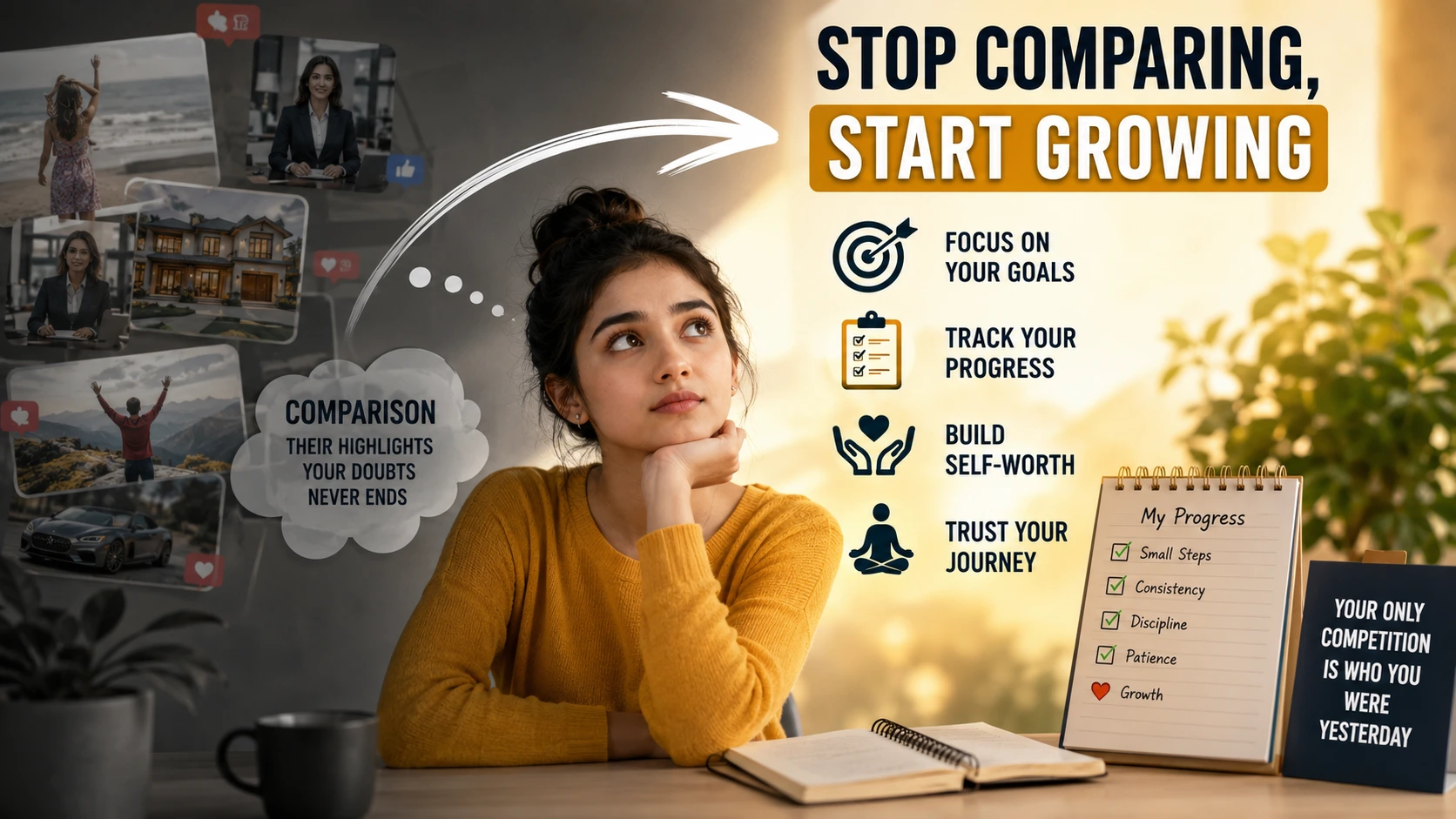
You open your phone for two minutes. You put it down feeling smaller than when you picked it up. Someone got promoted. Someone bought a house. Someone looks happier than you feel. Nothing bad happened to you in those two minutes, yet somehow your whole day shifted.
Learning how to stop comparing yourself to others and build self-worth is not about ignoring other people’s lives. It is about understanding why your brain reacts this way, and building a sense of worth that does not rise and fall with someone else’s highlight reel. This guide on how to stop comparing yourself to others and build self-worth walks through the psychology first, then the daily habits that actually work.
Key Takeaways
- Comparison is a built-in psychological drive, not a personal flaw, first explained by psychologist Leon Festinger in 1954.
- Upward comparisons on social media are directly linked to lower self-esteem, according to 2025 research in Frontiers in Psychology.
- Self-worth built on comparison is unstable by design, because there will always be someone ahead of you.
- Small daily habit shifts, not willpower alone, are what actually reduce comparison over time.
- Real self-worth comes from internal evidence you collect yourself, not from ranking above or below anyone else.
- The fastest way to learn how to stop comparing yourself to others and build self-worth is to replace comparison with a habit of tracking your own progress.
What Happens When You Constantly Compare Yourself to Others?
Before you can learn how to stop comparing yourself to others and build self-worth, it helps to see exactly what constant comparison does to your mind. Constant comparison quietly rewires how you see your own life. Instead of measuring your progress against your own starting point, you start measuring it against someone else’s middle or end point, which is never a fair comparison.
Over time, this creates a strange kind of dissatisfaction. You can achieve something genuinely good and still feel like you have failed, simply because someone else appears to have done it faster, bigger, or with less struggle. Research also shows a real cost to this pattern. A 2025 study in Frontiers in Psychology found that upward social comparisons on platforms like Instagram and Facebook directly reduced young adults’ global self-esteem, even when nothing in their actual life had changed.
Why Do We Compare Ourselves to Others? (The Psychology Behind It)
If you truly want to learn how to stop comparing yourself to others and build self-worth, you need to understand where comparison comes from first. Comparison is not a character weakness. It is a wired-in survival mechanism.
In 1954, psychologist Leon Festinger proposed Social Comparison Theory. His idea was simple: when people cannot measure their abilities or worth using an objective standard, they measure themselves against other people instead. Without a ruler, humans use each other as the ruler. You can read the full breakdown of Festinger’s theory on Simply Psychology if you want to go deeper into the research.
There are two directions this takes.
- Upward comparison happens when you compare yourself to someone you see as better off. This can motivate you, or it can crush you, depending on how attainable that success feels.
- Downward comparison happens when you compare yourself to someone you see as worse off, usually to feel temporarily better about your own situation. It works for a moment, but it does not build anything lasting.
Social media has made both types of comparison constant instead of occasional. Where your grandparents compared themselves to a handful of neighbors, you are now comparing yourself to thousands of curated, edited, best-moment posts every single day. This connects closely to cognitive distortions, since comparing your full, messy reality to someone else’s highlight reel is a distorted, unfair measurement from the start.
It is also worth understanding the wider impacts of social media on communication, since the same platforms driving comparison are reshaping how we talk to each other altogether.
How to Stop Comparing Yourself to Others: 7 Practical Steps
These are the exact steps that show you how to stop comparing yourself to others and build self-worth one habit at a time, starting with your mindset and moving into daily practice.
Shift Your Mindset First
1. Notice the trigger. Catch the exact moment you start comparing. Was it a scroll, a conversation, a family gathering? Naming the trigger takes away some of its power.
2. Use jealousy as information, not judgment. When you feel envious of someone, ask what specific thing you are actually longing for. Security? Recognition? Freedom? Jealousy is often just an unfulfilled goal wearing a different mask.
3. Remember you are seeing one chapter, not the whole book. You are comparing your full story, including the boring and hard parts, to someone else’s highlight reel. That was never a fair comparison.
Change Your Daily Habits
These daily habits are where you truly learn how to stop comparing yourself to others and build self-worth, since mindset shifts alone rarely stick without a routine behind them.
4. Track your own wins. Keep a simple running note of things you did well each week, however small. Priya, a 27-year-old graphic designer from Bengaluru, started writing down three small wins every night after work. Within a month, she noticed she reached for her phone to compare far less, because she had her own evidence of progress to look at instead.
5. Audit your social feed. Mute or unfollow accounts that consistently leave you feeling worse about yourself. This is not about avoiding reality; it is about removing a distorted, curated version of it.
6. Compete only with your past self. Once a week, ask one question: am I better than I was last month in any way? That is the only comparison that actually helps you grow.
7. Limit the moments that trigger you most. If evenings on social media consistently spiral into comparison, set a boundary around that specific time instead of trying to white-knuckle your way through it.
Comparing Yourself to Others in Different Situations
The habits above work everywhere, but the way you learn how to stop comparing yourself to others and build self-worth often needs a slightly different approach depending on where the comparison shows up.
How to Stop Comparing Yourself to Others and Build Self-Worth at Work
Career comparison often gets dangerous because job titles and salaries look like objective, measurable proof of worth. They are not. Two people can have the same title with completely different responsibilities, support systems, and starting points. Karan, a 31-year-old software engineer in Pune, spent two years feeling behind his college batchmates who had switched to management roles. When he finally sat down and listed his own priorities, he realized he genuinely preferred deep technical work over managing people.
The comparison had been measuring him against a goal he never actually wanted. His story is a clear example of how to stop comparing yourself to others and build self-worth around your own priorities instead of someone else’s career path.
How to Stop Comparing Yourself to Others and Build Self-Worth on Social Media
Social media comparison is worth treating separately from real-life comparison, because the input itself is manipulated. People post their best angle, their best day, their best news. A 2024 study in the European Journal of Mental Health found that heavy social comparison on social media was directly linked to higher loneliness and lower self-esteem, which in turn increased social media addiction, creating a loop that gets harder to exit the longer it continues. This is part of a much wider set of hidden dangers social media carries, well beyond just comparison alone.
How to Stop Comparing Yourself to Others and Build Self-Worth in a Relationship
Comparing your relationship to other couples’ social media posts, or to an ex, or to a friend’s marriage, sets an impossible standard, because you are comparing your private, complicated reality to someone else’s curated public version. Every relationship has disagreements, adjustments, and quiet ordinary days that never make it online.
How to Stop Comparing Yourself to Others and Build Self-Worth Academically
For students, comparison often centers on marks, ranks, and college admissions. This pressure is intense in the Indian education system in particular, where public rank lists and family comparisons are common. Building emotional intelligence early helps students separate their actual learning from their ranking against classmates, which is a distinction that pays off long after school ends.
How to Build Self-Worth Beyond Comparison
This is the section that actually completes the process of learning how to stop comparing yourself to others and build self-worth. Stopping comparison only solves half the problem. If you remove comparison but do not replace it with something else, you are left with a space where your self-worth used to be. This is the section most articles on this topic skip entirely.
Real self-worth is built the same way trust is built: through small, repeated evidence, collected over time, that does not depend on anyone else.
This three-part practice is the clearest answer to how to stop comparing yourself to others and build self-worth that actually lasts.
| Step | What to Do | Why It Works |
|---|---|---|
| Collect evidence | Write down one thing you handled well today, no matter how small | Gives you internal proof of your own capability |
| Separate identity from achievement | Ask, “Who am I, independent of this result?” after every win or loss | Prevents your worth from swinging with outcomes |
| Practice self-respect over self-esteem | Focus on how you treat yourself and others, not on how you rank | Self-respect stays steady even when circumstances change |
This kind of steady, internal self-worth is closely tied to becoming self-dependent, since both rely on trusting your own judgment instead of outsourcing your worth to outside opinions.
Ananya, a 24-year-old teacher from Delhi, described it well after six months of this practice. “I stopped needing to win the comparison,” she said. “I just needed to know I was becoming someone I actually respected.”
Quotes to Remember When You Feel Like Comparing
Keep these close whenever you need a quick reminder of how to stop comparing yourself to others and build self-worth in the moment.
- Your only real competition is who you were yesterday.
- Someone else’s success is not evidence of your failure.
- A highlight reel was never a fair measuring stick.
- Growth is quiet. Comparison is loud. Trust the quiet work.
Final Thoughts
Learning how to stop comparing yourself to others and build self-worth is not a one-time fix. It is a daily practice of noticing the trigger, questioning the comparison, and collecting your own evidence of growth instead.
Start small tonight. Write down one thing you did well today. That single habit, repeated, is where real self-worth begins to grow, independent of anyone else’s timeline.
FAQs
1. Should I compare my life to others?
Occasional comparison for inspiration is normal and even useful. The problem starts when comparison becomes constant, or when it consistently leaves you feeling worse instead of motivated. Learning how to stop comparing yourself to others and build self-worth simply means catching the point where comparison stops helping and starts hurting.
2. What causes people to compare themselves to others?
Comparison comes from a natural human drive to self-evaluate, first described by Leon Festinger’s Social Comparison Theory in 1954. Social media has made this drive far more constant than it used to be.
3. How do I stop jealousy and comparison?
Treat jealousy as information rather than a flaw. Ask what specific thing you are longing for, then build a plan toward that thing instead of resenting the person who already has it. This single shift is often the missing piece in how to stop comparing yourself to others and build self-worth long-term.
4. What is the root of comparison?
At its root, comparison is the brain’s attempt to answer one question: where do I stand? The goal is not to stop asking that question, but to answer it using your own progress instead of someone else’s life. That single shift is the real answer to how to stop comparing yourself to others and build self-worth for good.

Ayanshi is the founder of PersonaGuru.in, a blog dedicated to personality development, relationships, and mental health. With 3+ years of writing experience and 250+ published articles, she simplifies psychology into practical, everyday advice for real people.