
Last updated on November 4th, 2026 at 01:16 pm
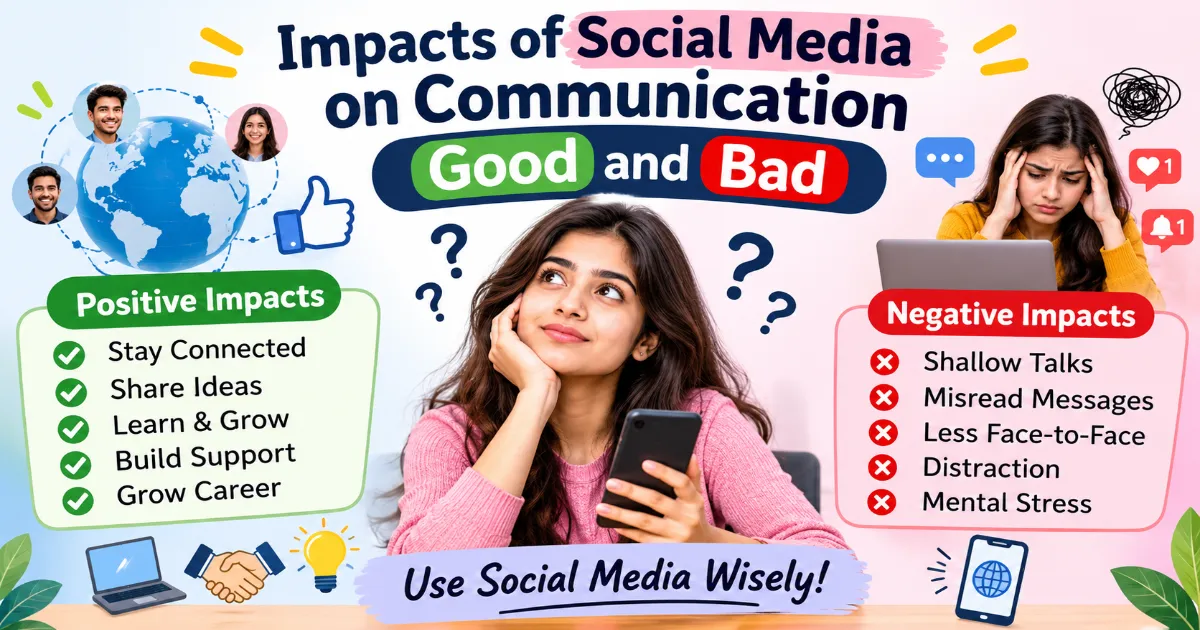
The impacts of social media on communication are both good and bad. It helps you reach people fast and share ideas widely, but it can also make talks shallow, rushed, and easy to misread. The result depends on how you use it.
Most of us talk to someone on a screen every day. A message to a friend, a comment on a post, a reply in a work group. So it is worth asking what this habit does to the way we speak, listen, and understand each other.
This guide covers 10 good effects, 10 bad effects, a few real examples, and simple habits to fix the weak spots. If you want the basics first, read our main guide on types of communication skills.
Key Takeaways
- Social media makes talking faster, cheaper, and wider.
- It also cuts tone, body language, and patience from our talks.
- Short messages are easy to misread. Add one clear line to avoid that.
- Heavy use can reduce face-to-face practice, which is where listening skills grow.
- Comparing yourself to highlight reels hurts confidence.
- You do not need to quit. You need rules for when, how long, and why you use it.
What Are the Impacts of Social Media on Communication?
Social media changes how fast we talk, who we can reach, and how much of our real self shows in the message. It adds speed and reach. It removes voice, face, and pause.
In person, you hear a tone and see a face. On a screen, you get words, an emoji, and a time stamp. That gap is where most trouble starts.
Here is a quick view.
| Area | Good effect | Bad effect |
|---|---|---|
| Speed | Replies in seconds | Rushed, careless words |
| Reach | Friends and teams in any city | Strangers can reach you too |
| Tone | Emojis add feeling | Jokes and sarcasm get misread |
| Depth | Easy to stay in touch | Talks stay on the surface |
| Learning | Free tips and advice everywhere | Wrong information spreads fast |
| Mind | Support groups and shared interests | Comparison, worry, and distraction |
What Are the Positive Impacts of Social Media on Communication?
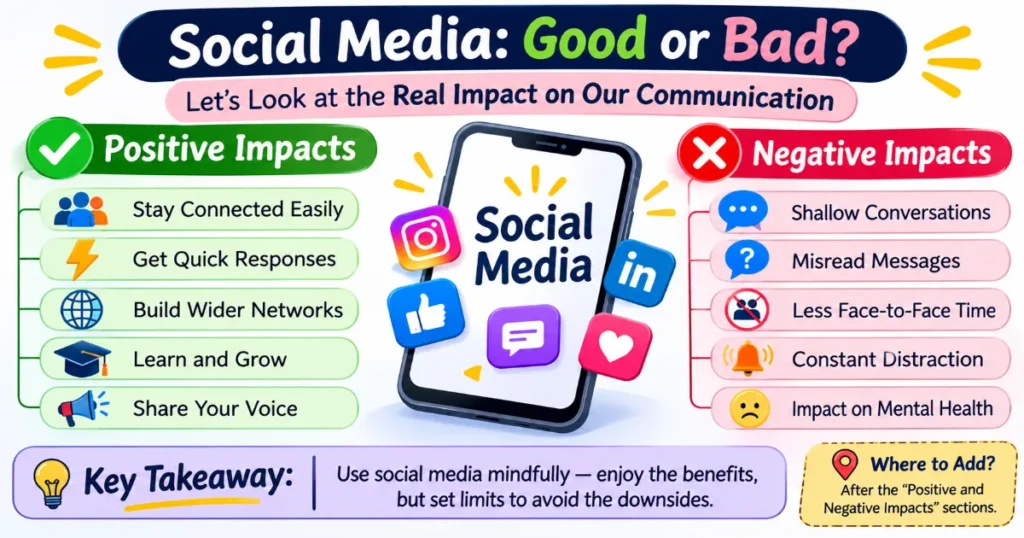
The main positive impacts are easy contact, quick replies, wider networks, and more ways to express yourself. Used well, these save time and open doors.
1. It Keeps Friends Close, Even Far Away
A cousin abroad, an old college friend, a team in another city. You can stay in touch with one tap. Before, this meant letters and costly calls.
2. It Makes Talks Fast
You can ask a quick question and get an answer in minutes. For small things, this is a real gain.
3. It Helps Your Career
Professional sites let you share your work, follow your industry, and meet new people. If you want to use this well, read our tips on networking skills for career growth.
4. It Builds Support Groups
People with the same problem find each other. A new parent, a student preparing for an exam, a person dealing with a health issue. Knowing you are not alone helps.
5. It Lets You Share in Many Forms
Photos, short videos, voice notes, and posts. Some people find it easier to say what they feel in writing or in a picture than face to face.
6. It Spreads News and Learning
In an emergency, news travels first on social media. Teachers and experts also post free lessons. Check the source before you trust a post.
7. It Helps Teams Work Together
Group chats and shared boards keep teams in step. If you work in a remote team, see our guide on communication skills for remote teams.
8. It Gives Businesses a Direct Line to Customers
Brands answer questions, handle complaints, and share offers in public. Customers get quick replies, and brands get honest feedback.
9. It Brings Cultures Closer
You can follow people from other countries, read their views, and learn how they live. This builds understanding when you listen first.
10. It Gives Many People a Voice
A student, a small shop owner, a local group. Anyone can share an idea with a wide audience. This was hard to do before.
What Are the Negative Impacts of Social Media on Communication?
The main negative impacts are shallow talks, misreading, less face-to-face practice, constant distraction, and harm to mental health. These do not hit everyone the same way, but they are common.
1. Talks Become Shallow
Quick likes and one-word replies feel like contact, but they are not a real talk. You can chat all day and still not know how your friend is doing.
2. Messages Get Misread
Tone does not travel in text. A short “ok” can feel cold. A joke can feel like an insult. Reading a message once before you send it catches many of these slips.
3. Face-to-Face Skills Get Less Practice
Listening, reading a face, and handling a pause all come from live talks. Less practice makes these skills weaker. Our guide on how to practise active listening skills can help you rebuild them.
4. Constant Alerts Break Your Focus
Every ping pulls you away. You start a task, check one message, and return ten minutes later. Over a day, that adds up.
5. Wrong Information Spreads Fast
A false post can travel before anyone checks it. People then repeat it in real talks as if it were true.
6. Cyberbullying and Rude Comments
People say things online that they would never say to a face. This can hurt, especially for young users.
7. Privacy Is at Risk
Photos, locations, and personal details can be saved, shared, or used by others. Think before you post anything you would not tell a stranger.
8. Comparison Hurts Confidence
You see other people’s best days and compare them to your normal day. This can leave you feeling behind. If this sounds like you, read how to stop comparing yourself to others.
9. It Can Affect Your Mental Health
The link between heavy use and worry or low mood is a topic of active study. In 2023, US Surgeon General Vivek Murthy said that teens who use social media for more than three hours a day face double the risk of depression and anxiety symptoms, as reported by Georgia Public Broadcasting. That is a link, not proof that social media alone causes it. Still, it is a reason to watch your own time.
10. It Can Become a Habit You Cannot Break
Scrolling without a goal eats time that could go to study, work, sleep, or people. If you wake up and reach for the phone before you think, that is a sign to pause.
How Much Do Young People Use Social Media Today?
Quite a lot. The Pew Research Center surveyed 1,391 US teens in the fall of 2024. According to the Pew Research Center, 46 percent said they are online almost constantly, up from 24 percent about ten years earlier.
This is a US survey of teens, so it will not match every country. But it shows the direction. If you are a student, our guide on communication skills for students shows how to balance screen talks with real ones.
Can You See the Impacts of Social Media on Communication in Daily Life?
Yes. Here are a few common cases.
- The group chat fight. Someone writes “fine.” Everyone thinks they are angry. They were only tired. A quick call would have fixed it in one minute.
- The silent dinner. Four people at one table, four phones. They are all talking to someone, just not to each other.
- The work message at midnight. A manager sends a note late at night. The team feels they must reply. Nobody agreed on this rule.
- The kind comment. A stranger leaves a warm reply under a student’s post. It makes her day. This is the good side at work.
How Can You Use Social Media Without Hurting Your Communication?
Use it on purpose. Set a goal, set a time limit, and move serious talks to a call or a meeting. These habits are easy to start.
- Pick the right channel. Use chat for quick things. Use a call for anything tense or complex.
- Read before you send. One pass catches tone problems.
- Add context. Write one extra line so the other person does not guess.
- Do not argue in comments. Take it to a private talk.
- Set a daily limit. Use your phone’s screen time tool to see where the hours go.
- Keep phones away at meals. Give the people in front of you your full attention.
- Check before you share. If you cannot find the source, do not post it.
- Practise live talks. Join a club, speak up in a class, or call a friend instead of texting.
A short check on feelings helps too. Understanding how you and others feel is part of emotional intelligence. If you want ready lines for spoken talks, see these oral communication examples.
What Should You Do If Social Media Talks Keep Going Wrong?
Look for the pattern in the impacts of social media on communication that you face. Do the same kinds of misunderstandings keep happening? Are they with the same person, on the same app, at the same time of day?
Then fix one thing at a time. Move that one talk to a call. Change that one habit. For a longer list of causes and fixes, read how to overcome communication barriers. Our page on the role of communication in personality development also shows why this matters beyond work.
Conclusion
The impacts of social media on communication are not all bad, and they are not all good. It gives us speed, reach, and a voice. It also takes away tone, focus, and practice with real talks.
I would start small. Pick one habit from the list above and try it this week. Maybe it is a phone-free dinner. Maybe it is calling instead of texting when a talk feels tense. Small changes make the biggest difference.
FAQs
What are the impacts of social media on communication?
Social media makes communication faster and wider, but it can make it shallower and easier to misread. Good effects include easy contact and support groups. Bad effects include distraction, comparison, and less face-to-face practice.
What are the positive effects of social media on communication?
Easy contact across distance, quick replies, networking, support groups, and more ways to share ideas. It also helps businesses talk to customers and helps teams work together.
What are the negative effects of social media on communication?
Shallow talks, misread tone, less face-to-face practice, constant distraction, wrong information, and harm to mental health for some users. Cyberbullying and privacy risks add to this.
How does social media affect face-to-face communication?
It can reduce practice in listening, reading faces, and handling pauses. Using phones during meals or meetings also makes people feel ignored.
How can I reduce the negative impact of social media on my communication?
Set time limits, use calls for serious talks, read messages before sending, and keep phones away during live talks. Practise speaking in person every week.

Ayanshi is the founder of PersonaGuru.in, a blog focused on personality development, career, relationships, and mental well-being. With over 3 years of writing experience, she turns psychology and everyday experiences into practical, easy-to-understand advice for real life.