
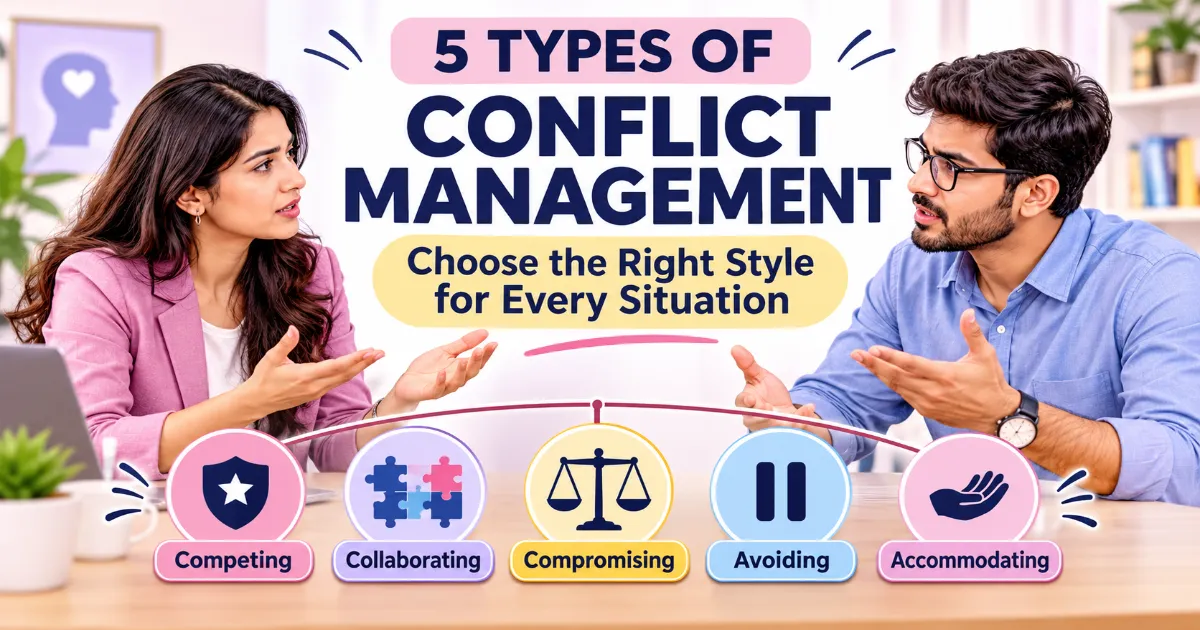
Types of conflict management include five styles. They are competing, collaborating, compromising, avoiding, and accommodating. Each style shows how firmly you ask for your own needs and how much you care about the other person’s needs.
Think about your last real disagreement. Maybe it was with a roommate. Maybe it was with a team member or someone at home. What did you do? Did you push hard? Did you stay quiet? Did you give in?
Most of us never choose our style. We copy it from our parents, our friends, or our first boss. College group projects are often where it shows up first. One person wants to finish early. Another wants it perfect. Nobody says it aloud, but everyone feels the tension.
When I studied, one thing became clear to me. Conflict is a normal part of every team. What matters is how people handle it. That is where the types of conflict management come in. Handling conflict well is also a big part of personality development.
Key Takeaways
- The five types of conflict management are competing, collaborating, compromising, avoiding, and accommodating.
- They are competing, collaborating, compromising, avoiding, and accommodating.
- Each style mixes assertiveness and cooperativeness.
- No style is best every time.
- Your personality nudges your style. You can still choose.
- The five C method helps in any conflict: calm, clarify, consider, choose, check.
- A 2025 ACAS survey found that 44% of working adults faced conflict at work.
What Is Conflict Management in Personality Development?
Conflict management is the way you handle a disagreement so the problem gets solved and the relationship stays healthy. In personality development, it is a core people skill. It works hand in hand with emotional intelligence and clear communication.
Conflict is normal. Two people have two sets of needs. Sooner or later, those needs clash. A strong personality does not run from conflict. It handles conflict with respect and a calm mind.
Why does it matter? There are three good reasons.
- It protects relationships. People trust you more after a fair talk.
- It saves energy. Small issues stop turning into big fights.
- It builds your name. Teams value people who stay calm and fair.
What Are the 5 Types of Conflict Management?
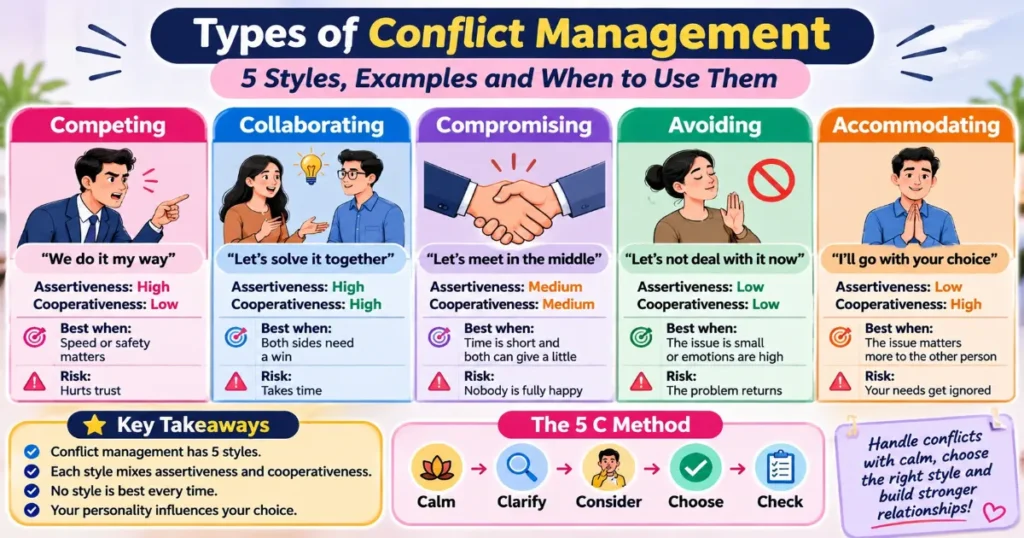
Psychologists Kenneth Thomas and Ralph Kilmann built the most widely used model. It is called the Thomas-Kilmann Conflict Mode Instrument, or TKI. Kilmann shares its background on the Kilmann Diagnostics history page. The model builds on earlier work by Blake and Mouton in 1964.
The model asks two simple questions. How hard do you push for your own goals? That is assertiveness. How much do you care about the other person’s goals? That is cooperativeness. The answers create five styles.
| Style | Assertiveness | Cooperativeness | Best used when | Main risk |
|---|---|---|---|---|
| Competing | High | Low | Speed or safety matters | Hurts trust |
| Collaborating | High | High | The issue and the relationship both matter | Takes time |
| Compromising | Medium | Medium | Time is short, and both sides can give a little | Nobody is fully happy |
| Avoiding | Low | Low | The issue is small or emotions are high | The problem returns |
| Accommodating | Low | High | The issue matters more to the other person | Your needs get ignored |
Now a simple scenario. Aryan and Kavya work at a startup in Bengaluru. Aryan wants to release a new app feature on Friday. Kavya wants two more days of testing. Here is how each style would sound.
1. Competing: “We do it my way”
Aryan says, “We launch Friday. This is my decision.” He wins the argument. Kavya feels ignored and stops sharing ideas.
Competing is a power style. It makes sense in an emergency, such as a security risk where a quick call protects people. In daily life, it costs trust. A person who always wins arguments soon finds fewer people willing to argue with them. Competing is also different from healthy confidence. Read the difference between aggression and assertiveness to see where the line sits.
2. Collaborating: “Let us solve it together”
Aryan and Kavya list what each person needs. Aryan needs a launch before a client demo. Kavya needs a stable product. Together they decide to release the safe features on Friday and the rest on Monday. Both goals are met.
This is the win-win style. It takes time, honesty, and active listening skills. Use it when the issue and the relationship both matter. A family planning a wedding budget is a good everyday example. Every need goes on the table, and the plan is built to fit them all.
3. Compromising: “Let us meet in the middle”
Aryan agrees to wait one day. Kavya agrees to test only the main features. Each person gives up something.
It is quick and fair. Nobody gets everything, so it suits situations where time is short. Two roommates who split the chores, each taking the task they dislike less, are compromising. Do not use it for a deep problem. A fast middle path can hide the real issue.
4. Avoiding: “Not now”
Kavya says, “Let us talk about this on Monday,” and moves on. She steps back to cool down.
A pause helps when the issue is small or tempers are high. A rude comment from a relative at a family function may not deserve a fight. Avoiding fails when you avoid forever. The problem usually returns, often bigger.
5. Accommodating: “I will let you have this one”
Kavya says, “Fine, launch Friday.” She gives way to keep the peace.
This works when the issue matters more to the other person, or when you are wrong. Letting your younger sibling pick the movie is accommodating. It becomes a trap for people pleasers. If you give in too often, practice these assertiveness techniques.
Which Style Should You Use?
There is no single best pick among the types of conflict management. Match the style to the situation.
| Situation | Style to try |
|---|---|
| A real emergency or safety risk | Competing |
| An important issue with someone you see every day | Collaborating |
| The deadline is close and both sides are partly right | Compromising |
| The issue is small, or tempers are high | Avoiding, then talk later |
| The other person cares more, or you are wrong | Accommodating |
Kilmann also points out that any style can be used in a respectful way or a harsh way. The same style can give very different results. He also notes that you can use several styles in order. For example, you can pause first and then collaborate.
How Does Your Personality Shape Your Conflict Style?
Your default among the types of conflict management often comes from home, school, and your past conflicts. Personality adds to it. Personality does not lock you into one style. It only nudges you.
Researchers study this link with the Big Five traits. They are openness, conscientiousness, extraversion, agreeableness, and neuroticism. You can learn each one in our guide to the Big Five personality traits.
A 1998 study by David Antonioni in the International Journal of Conflict Management tested 351 students and 110 managers. It matched the Big Five traits with five conflict styles. The main results were:
- Extraversion, conscientiousness, openness, and agreeableness all had a positive link with the integrating style. That is the same as collaborating.
- Extraversion also had a positive link with the dominating style. That is the same as competing.
- Agreeableness and neuroticism had a negative link with the dominating style.
In plain words, open and agreeable people tend to look for shared solutions. Outgoing people may push harder for their view. These are tendencies, not rules. Your choices matter more than your traits.
Try this today: Think of your last three conflicts. Write down the style you used each time. A pattern will show your default.
To change a default style, follow three small steps.
- Notice the moment you slip into it.
- Pause for ten seconds.
- Ask yourself, “Which style fits this problem?”
Practice on small issues first. Big conflicts are harder to change habits on.
What Are the 5 Stages of Conflict Management?
There is no official five-stage model. The five C method below is the PersonaGuru framework. It uses ideas from the Thomas-Kilmann research and common workplace practice. Use it as a simple checklist. You can use these steps with any of the types of conflict management.
- Calm: Pause and breathe. Do not reply while you are angry. Try saying, “Give me ten minutes. Then we can talk.”
- Clarify: State the issue in one sentence. Ask what the other person needs. Try, “What I understand is that you want more testing. Is that right?”
- Consider: List two or three options that could work. Write them down if the issue is big.
- Choose: Pick the style from the table that fits the situation.
- Check: Follow up after a few days. Ask, “Is the new plan working for you?”
Here is how it looks in practice. After the Friday debate, Kavya calms down and states the issue: “We both want a safe launch.” She lists three options and picks collaborating. On Monday, she checks if the plan worked.
How Do You Resolve a Conflict? 10 Practical Ways
- Pick the right time and place.
- Start with facts, not blame.
- Use “I” statements, such as “I feel stressed when the deadline moves.”
- Listen without interrupting.
- Repeat what you heard in your own words.
- Separate the person from the problem.
- Look for goals you share.
- Offer two or three options.
- Agree on next steps and a date.
- Ask a neutral person to help if you are stuck.
For more wording ideas, read our communication tips for effective conflict resolution.
What Mistakes Make Conflict Worse?
Even people with good intentions slip up. Watch out for these:
- Bringing up old issues that are already settled
- Using words like “always” and “never”
- Arguing over text messages, where tone gets lost
- Taking sides before hearing both stories
- Treating the talk as a contest to win
- Ignoring feelings and talking only about facts
What Are the Main Causes of Conflict?
People clash for many reasons. These are the most common ones:
- Unclear roles
- Limited time, money, or space
- Poor communication
- Different values
- Personality clashes
- Unfair treatment
- Competition for credit
- Sudden change
- Stress and tiredness
- Unmet expectations
What Are the Four Types of Conflict?
The types of conflict management work in all four types of conflict.
- Intrapersonal: a struggle inside you, such as a hard choice
- Interpersonal: a clash between two people
- Intragroup: a disagreement inside a team
- Intergroup: a clash between two groups or departments
Which Skills Do You Need for Conflict Management?
- Active listening: Hear the other side fully.
- Empathy: Try to feel what the other person feels.
- Assertiveness: Say what you need, clearly and politely.
- Emotional control: Stay calm when the talk gets hot.
- Problem solving: Move from blame to options.
How Can You Prevent Conflict?
- Set clear roles and goals.
- Speak up early, before a small issue grows.
- Give honest feedback in small doses.
- Agree on who makes which decision.
- Take a short break when stress is high.
Even a disagreement with a senior can stay polite. Learn how in our guide on how to disagree with your boss.
What Do the Latest Statistics Say About Conflict at Work?
In November 2025, the UK service Acas published a large survey on conflict at work in Great Britain. It asked 4,558 working-age people in August and September 2025. Here are the key numbers:
- 44% faced conflict at work in the past 12 months. Acas calls this the highest level ever reported in a survey of British workers.
- 38% of those in conflict named capability and performance as the topic. Another 33% named personal disagreements.
- 57% felt stress, anxiety, or depression because of the conflict.
- 45% spoke to their manager. 30% talked informally with the other person.
- 19% did nothing.
- Half said the conflict was largely or fully resolved.
Acas Chief Executive Niall Mackenzie wrote, “Disagreements might be inevitable, but the costs and harms of conflict are not.”
These numbers come from Great Britain. Still, the lesson applies anywhere. Talking early helps. Doing nothing can let the problem come back later. This is why the types of conflict management matter in real life.
Exam Corner: 5 Mark and 10 Mark Answers
5 marks: Explain the types of conflict management.
Conflict management means handling a disagreement so the issue is solved and the relationship survives. Thomas and Kilmann describe five styles based on assertiveness and cooperativeness. Competing is high on assertiveness and low on cooperativeness. Collaborating is high on both. Compromising is medium on both. Avoiding is low on both. Accommodating is low on assertiveness and high on cooperativeness. No single style is best. The right choice depends on the situation.
10 marks: Discuss conflict management in personality development.
Use this structure:
- Define conflict management in two lines.
- Explain the two dimensions: assertiveness and cooperativeness.
- Describe all five styles with one example each.
- Link personality traits to styles using the Big Five.
- Add the five C method: calm, clarify, consider, choose, check.
- Conclude that no style is best and that the choice depends on the situation.
Conclusion
Types of conflict management are tools, not labels. Competing, collaborating, compromising, avoiding, and accommodating each have a time and a place. Your job is to know your default, understand how your personality shapes it, and pick the style that fits the moment.
Start small. Use the five C method in your next disagreement. Then check how it went. For quick revision, download the free PDF notes on the types of conflict management.
Which style do you use most? Share it in the comments.
FAQs
How many types of conflict management are there?
There are five types of conflict management. They are competing, collaborating, compromising, avoiding, and accommodating. Each one has a right time.
What is the best type of conflict management?
Collaborating is often the best choice when the issue and the relationship both matter. Still, no style fits every case. Competing may suit an emergency. Avoiding may suit a small matter. The skill lies in choosing well.
Is conflict management a personal skill?
Yes. It is a skill you can learn. Your personality gives you a starting point. Practice changes your habits. Listening, emotional intelligence, and assertiveness all help.
Can my personality type change my conflict style?
Your traits can nudge you, as the Antonioni study shows. These are tendencies, not fixed rules. You can still choose a different style.
What is the difference between conflict management and conflict resolution?
Conflict resolution aims to end one specific dispute. Conflict management is wider. It covers how you handle, reduce, and prevent conflict over time.
How do I find my own conflict style?
The official TKI is a questionnaire sold by The Myers-Briggs Company. For a quick check, look at your last three conflicts. Write down what you did each time. The most common choice is your default style.

Ayanshi is the founder of PersonaGuru.in, a blog focused on personality development, career, relationships, and mental well-being. With over 3 years of writing experience, she turns psychology and everyday experiences into practical, easy-to-understand advice for real life.