
Trait theories of personality say that your personality is made of stable traits. Examples include being shy, careful, or outgoing. These traits differ from person to person. They show up in many situations. The four main models are Allport’s trait hierarchy, Cattell’s 16 Personality Factors, Eysenck’s PEN model, and the Big Five.
Naina and Kabir sit the same exam next week. Naina made her study plan a month ago. Kabir is still looking for his notes. The night before the exam, Naina sleeps well. Kabir stays awake and worries.
Why do two students act so differently in the same situation? The trait approach to personality tries to answer this. They look at the lasting patterns in a person, not at one moment. (Naina and Kabir are made up, but you probably know people like them.)
Trait theories of personality sit at the core of personality development. You will also see them in college syllabi and HR hiring tools. People use them every day when they say “what kind of person” someone is.
Key Takeaways
- A trait is a stable pattern of thought, feeling, and behaviour.
- Traits differ between people and show up across situations.
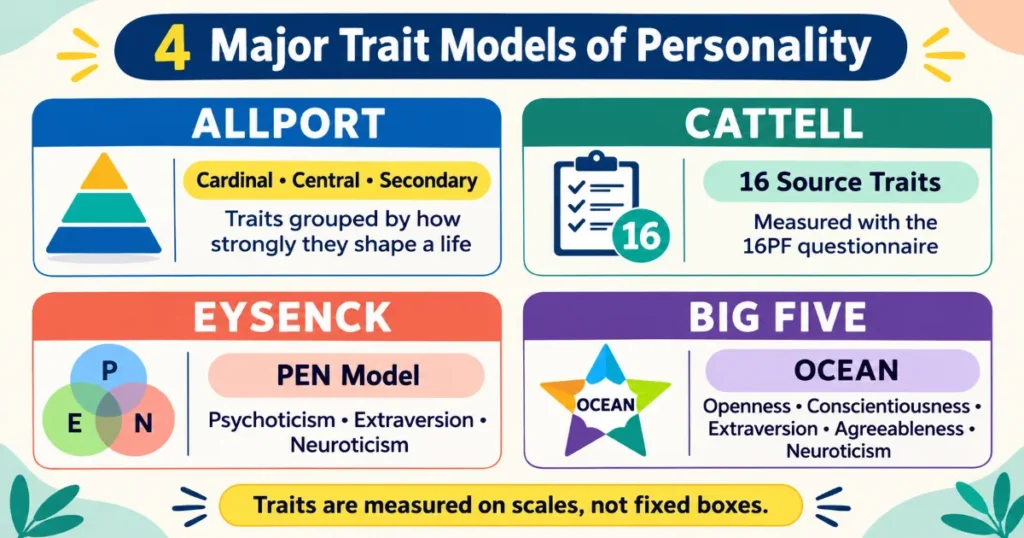
- Allport sorted traits into cardinal, central, and secondary.
- Cattell found 16 source traits.
- Eysenck used three: psychoticism, extraversion and neuroticism.
- The Big Five (OCEAN) is the most popular model today.
- The main criticism: trait theory describes people but does not explain why.
What Are Trait Theories of Personality?
Trait theories of personality explain behaviour by measuring stable traits. A trait is a lasting pattern of thought, feeling, and behaviour. It makes one person different from another. Trait theory focuses on describing and measuring these differences. It does not explain how they form.
Think of traits as dials, not switches. Nobody is “shy” or “not shy”. A person can be a little shy, quite shy, or very shy. Trait theories of personality give each person a score on each dial.
What Is a Trait?
A trait is a pattern that repeats. Psychologists separate it from a state.
- State: feeling nervous before a test. It passes.
- Trait: being a nervous person in most situations. It stays.
One bad day does not make you an anxious person. A pattern over months and years does.
What Are the Main Characteristics of Trait Theories?
Trait theories share three core ideas. Traits stay fairly stable over time. They differ from person to person. They show up across situations.
Trait theory has a fourth idea. Traits are measured on a scale, not sorted into boxes. This helps researchers study individual differences. This is the biggest difference from type theories, which you will see below.
Who Gave the Trait Theory of Personality?
Gordon Allport is seen as the pioneer of trait theory. In 1936, Allport and Odbert listed about 4,500 trait words. Later, Raymond Cattell and Hans Eysenck used factor analysis. They used factor analysis to cut the list down to a few core traits.
Cattell and Eysenck did not invent trait theories of personality. They gave it a statistical method. Factor analysis is a way to find which traits move together in the same people.
| Year | Person | What happened |
|---|---|---|
| 1936 | Allport and Odbert | Found about 4,500 English words that describe people |
| 1937 | Allport | Published his book on personality and set out his trait ideas |
| 1940s | Cattell | Cut the long list down to 16 source traits |
| 1947 | Eysenck | Studied 700 soldiers and found two main dimensions |
| Around 1970 | Eysenck | Added a third dimension, psychoticism |
| Later decades | Costa, McCrae and others | Built the Big Five model |
What Is Gordon Allport’s Trait Theory?
Gordon Allport’s trait theory sorts traits into three levels: cardinal, central, and secondary. Cardinal traits are rare and rule a person’s whole life. Central traits are the 5 to 10 core traits that describe most people. Secondary traits appear only in certain situations.
Allport and Odbert went through an English dictionary and found about 4,500 words that describe people. A long list is hard to use. Allport wanted to group the words by how strongly they shape a life.
Cardinal, Central and Secondary Traits
| Level | Meaning | Made-up example |
|---|---|---|
| Cardinal | One dominant trait that shapes almost everything. Rare. | Mrs. Rao, a teacher whose whole life is built around helping students |
| Central | The core traits that describe a person. Usually 5 to 10. | Honest, sociable, optimistic, careful |
| Secondary | Traits that show up only in some situations | Feeling nervous before a job interview |
Most people have no cardinal trait. Central traits are what a friend would list if you asked them to describe you.
Allport’s Big Idea: Traits Are Real
Allport saw traits as real structures inside a person. He did not see them as labels that other people invent. He also said traits come from both genes and experience.
This was a big shift for the trait theory of personality. Before Allport, many people spoke about personality as a loose idea. He made it something you could study and group.
What Is Cattell’s 16 Personality Factors Theory?
Cattell’s 16 Personality Factors theory says that personality is made of 16 source traits. Cattell found them with factor analysis. He started with thousands of trait words. He cut them to about 171 and then to 16 factors. He built the 16PF questionnaire to measure them.
Here is how he did it. Allport and Odbert had about 4,500 trait words. Cattell removed words that mean the same thing and cut the list to about 171 traits. He then ran factor analysis on ratings of real people. That left him with 16 source traits.
Surface Traits and Source Traits
- Surface traits are behaviours you can see and name. For example, a person who is always neat, early, and organised.
- Source traits are the hidden causes behind those behaviours. The 16PF was built to measure source traits.
The 16 Factors
| No. | Factor | Low score | High score |
|---|---|---|---|
| 1 | Warmth | Aloof, distant | Caring, sociable |
| 2 | Reasoning | Concrete thinking | Abstract thinking |
| 3 | Emotional Stability | Easily rattled | Steady, well-adjusted |
| 4 | Dominance | Accommodating, conflict-avoiding | Commanding, assertive |
| 5 | Liveliness | Sober, cautious | Exuberant, spontaneous |
| 6 | Rule-Consciousness | Flexible about rules | Principled, rule-bound |
| 7 | Social Boldness | Timid under pressure | Venturesome, daring |
| 8 | Sensitivity | Hard-nosed, unsentimental | Tender-minded |
| 9 | Vigilance | Trusting | Suspicious, guarded |
| 10 | Abstractedness | Down-to-earth, practical | Imaginative, lost in ideas |
| 11 | Privateness | Open, candid | Discreet, guarded |
| 12 | Apprehension | Self-assured, untroubled | Worried, self-doubting |
| 13 | Openness to Change | Attached to tradition | Open to new ideas |
| 14 | Self-Reliance | Goes along with the group | Independent, solitary |
| 15 | Perfectionism | Tolerant of disorder | Organised, self-disciplined |
| 16 | Tension | Relaxed, patient | Driven, impatient |
Reasoning is a short ability test with right and wrong answers. The other fifteen factors are self-descriptions.
Look at Dominance. The low end is “accommodating, conflict-avoiding”. The high end is “commanding, assertive”. This links to the types of conflict management. The same two ideas decide whether you give in or push hard.
How the 16PF Test Works
You answer questions about yourself. Your answers give a score on each factor, from low to high. The fifth edition of the test has 185 items. The sixth edition, from 2018, has 155 items.
The 16 factors also group into five wider “global” factors: Extraversion, Anxiety, Tough-Mindedness, Independence and Self-Control.
Critics raise two points about the 16PF and other trait models. The factors overlap a good deal. And the number 16 reflects the researcher’s choices as well as the data.
What Is Eysenck’s PEN Model?
Eysenck’s PEN model describes personality with three dimensions: Psychoticism, Extraversion, and Neuroticism. Each is a scale, and Eysenck linked them to how the brain and nervous system work. Extraversion and neuroticism came first. Psychoticism was added later.
Eysenck wanted fewer traits than Cattell, and he wanted them tied to biology. He saw personality as largely governed by biology.
Extraversion and Introversion
This scale runs from sociable and outgoing to quiet and needing more time alone.
Neuroticism and Emotional Stability
This scale runs from anxious to calm. A person high in neuroticism gets stressed easily. Their fight-or-flight response is quick to switch on. A person high in stability stays steady under pressure.
Psychoticism
Eysenck added this third dimension later. He called it psychoticism versus superego control. High scores link to coldness, impulsiveness, independence, and hostility. Low scores link to self-control, empathy, cooperation, and a conventional style. It is a personality scale, not a diagnosis.
Eysenck’s Four Types
Cross the first two dimensions, and you get four combinations. They match the four old Greek temperaments.
| Extravert | Introvert | |
|---|---|---|
| Stable | Sanguine | Phlegmatic |
| Unstable (neurotic) | Choleric | Melancholic |
How strong is the evidence?
Mixed. Eysenck’s first study used 700 soldiers who were being treated for neurotic disorders. That is a narrow group. Twin studies on his dimensions give conflicting results.
What Is the Big Five Theory of Personality?
The Big Five is a model of five broad traits: Openness, Conscientiousness, Extraversion, Agreeableness, and Neuroticism (OCEAN). Strictly speaking, it is a model built from data, not a complete theory. Costa and McCrae also proposed Five-Factor Theory to explain why the traits exist.
Textbooks call the Big Five the most popular model among all personality trait models. Some writers call it the five-factor model. In Five-Factor Theory, biology gives rise to basic tendencies, which are the traits. Those tendencies, together with outside influences, shape habits and behaviour.
OCEAN at a Glance
| Trait | High score | Low score |
|---|---|---|
| Openness | Curious, imaginative | Practical, prefers routine |
| Conscientiousness | Organised, dependable | Spontaneous, careless |
| Extraversion | Sociable, energetic | Reserved, quiet |
| Agreeableness | Kind, cooperative | Competitive, blunt |
| Neuroticism | Anxious, moody | Calm, steady |
For the full guide, read our article on the Big Five personality traits.
Why Is the Big Five Preferred Over the MBTI?
Researchers prefer the Big Five because it scores each trait on a scale. The MBTI sorts people into 16 either-or types. Say one person is “slightly extraverted” and another is “strongly extraverted”. They get different Big Five scores. In the MBTI, both land in the same box. Learn more in our guide to the 16 MBTI personality types.
What Are the Five Trait Theories of Personality?
There is no official list of five trait theories. Most sources name four main ones. They are Allport’s trait theory, Cattell’s 16PF, Eysenck’s PEN model, and the Big Five. Some lists add Guilford as a fifth. If a question says “five traits”, it means the Big Five.
| Model | Number of traits | How it was built | Key idea | Tool |
|---|---|---|---|---|
| Allport | 3 levels | Grouped a dictionary word list | Traits are real structures inside a person | A framework, no single test |
| Cattell | 16 source traits | Factor analysis | Hidden source traits drive visible behaviour | 16PF questionnaire |
| Eysenck | 3 dimensions | Factor analysis and biology | Personality has a biological base | Eysenck questionnaires, such as the EPI |
| Big Five | 5 broad traits | Statistical analysis of trait data | Five broad scales cover most of personality | Big Five questionnaires |
What Is the Difference Between Type and Trait Theories of Personality?
Type theories put people into a few fixed categories, such as introvert or extravert. Trait theories measure people on scales, so a person can be slightly shy or very shy. Sheldon, Kretschmer, and Jung gave type theories. Allport, Cattell, and Eysenck gave trait theories.
| Basis | Type theory | Trait theory |
|---|---|---|
| Idea | A person belongs to one category | A person has a score on many scales |
| Example | Introvert or extravert | Extraversion from low to high |
| Theorists | Sheldon, Kretschmer, Jung | Allport, Cattell, Eysenck |
| Main weakness | Most people sit between the boxes | Describes but does not explain |
Want to read the type side? See our guides to Jung’s theory of personality, Kretschmer’s body types and Sheldon’s somatotype theory.
The MBTI is closer to a type model than to the Allport trait theory or the Cattell 16 personality factors. Together, these two groups are often called type and trait theories of personality. Eysenck used both ideas. His four types come from two trait scales.
What Are the Major Theories of Personality?
There is no single official list of personality theories. Most textbooks group them into five to seven approaches. These are trait, psychodynamic, humanistic, behavioural, social-cognitive, biological, and type theories.
| Approach | Main idea | Key names |
|---|---|---|
| Trait | Personality is a set of stable traits | Allport, Cattell, Eysenck |
| Psychodynamic | Hidden drives and early life shape personality | Freud |
| Humanistic | People grow towards their potential | Maslow, Rogers |
| Behavioural | Personality is learned through rewards and habits | Skinner |
| Social-cognitive | Thinking, situation and behaviour work together | Bandura, Mischel |
| Biological | Genes and the brain shape traits | Eysenck, twin studies |
| Type | People fall into a few categories | Sheldon, Kretschmer, Jung |
For the psychodynamic side, read our article on how personality develops from genes to Freud.
What Are the Strengths of Trait Theory?
Trait theory of personality has clear strengths.
- It is simple. A trait is easy to name and understand.
- It can be measured with standard questionnaires.
- It lets you compare people on the same scales.
- It is useful in research, clinical work, and workplace assessment.
- It rests on a large amount of data.
Why Is Trait Theory Criticised?
Trait theory is criticised for three main reasons. It describes traits but does not explain how they form. It may overlook how much behaviour changes with the situation. Most tests rely on self-report and were built mostly on Western samples.
It Describes but Does Not Explain
Trait models tell you that Kabir is anxious. It does not fully tell you why. It also cannot predict future behaviour with certainty.
The Person-Situation Debate in Simple Words
In 1928, Hartshorne and May studied honesty in children. They found that a child who was honest in one situation was not always honest in another. Later, Mischel and Bandura argued that behaviour follows the situation more than the trait.
Trait researchers replied with a fair point. If you average a person’s behaviour over many situations, the pattern shows up clearly. Epstein made this argument in 1979. One test question says little. Many situations together say a lot.
Britannica’s overview of trait theories covers this debate and adds another point. People judge others by their traits but judge themselves by the situation. This is called the fundamental attribution error.
Self-Report and Faking
Most trait tests ask you to describe yourself. People can answer in a way that looks good. People can also misjudge themselves.
Cultural Bias
Critics say trait theories of personality reflect Western ideas. A study across seven languages found six factors, not five. The sixth was honesty-humility (Ashton and colleagues, 2004).
Traits May Change More Than Theory Suggests
Most trait models say traits are fairly stable. New research says they move more than most people expect. Two large 2026 studies, in Psychological Bulletin and Communications Psychology, followed thousands of people over many years. They found that people underestimate how much personality changes. Personality changed about as much as income, health, or life satisfaction.
Earlier research suggests a common direction. On average, conscientiousness and agreeableness rise with age, while neuroticism and extraversion decline. These are group averages, not a rule for any one person.
The German Institute for Economic Research has a plain-language summary of the 2026 personality studies. It reports that people “substantially underestimated” how much personality changes.
A Real-Life Example of Trait Theory
Go back to Naina and Kabir. Here is how each of these trait theories would describe them. (They are made up.)
- Allport: Naina has central traits such as organised and dependable. Kabir has central traits such as restless and anxious.
- Cattell: Naina scores high on Perfectionism and Emotional Stability. Kabir scores high on Apprehension and Tension.
- Eysenck: Kabir is high in neuroticism. Naina is low.
- Big Five: Naina is high in conscientiousness. Kabir is lower in conscientiousness and higher in neuroticism.
Four models, one picture. Different words, same pattern.
Where Is Trait Theory Used?
- Hiring and HR: Employers use personality questionnaires as one input.
- Career counselling: Traits help match people to work styles.
- Education: Teachers can spot how a student prefers to study.
- Clinical research: Researchers study how traits link to health and wellbeing.
One caution about personality trait tests. A score shows a tendency, not a guarantee. Use it as a starting point.
How Can You Use Trait Theory to Understand Yourself?
Try these four steps.
- Write five words that describe you at home, at work, and with friends. Compare the three lists.
- Ask two people who know you well to name your top three traits.
- Notice which traits change with the situation. This is the person-situation debate in your own life.
- Retake a free Big Five test after a year. Traits are fairly stable, but they do move.
A test result is a conversation starter, not a label. That is how the trait theory of personality works best. To go deeper, read how to improve self-awareness.
Exam Corner: 5 Mark and 10 Mark Answers
5 marks: State the characteristics of trait theories of personality.
Trait theories explain personality through stable traits. Traits stay fairly stable over time. They differ from person to person. They show up across situations. They are measured on a scale. Allport, Cattell, Eysenck, and the Big Five are the main models.
10 marks: Discuss trait theories of personality with criticisms.
Use this structure:
- Define a trait and trait theory in two lines.
- Write the characteristics.
- Explain Allport: cardinal, central, and secondary traits.
- Explain Cattell: 16 source traits and the 16PF.
- Explain Eysenck: psychoticism, extraversion, and neuroticism.
- Explain the Big Five: OCEAN.
- Give two strengths.
- Give three criticisms: descriptive only, the person-situation debate, and cultural bias.
- Conclude with one line on how the models fit together.
Conclusion
Trait theories of personality give you a clear way to describe people. Allport grouped traits. Cattell found 16 source traits. Eysenck tied three dimensions to biology. The Big Five now covers most of the ground with five scales.
Trait theory has limits. It describes more than it explains. It can miss how much the situation matters. And new research shows that traits change more than we thought.
Start with yourself. Write down three traits and check them against the situations in your week. For quick revision, download the free PDF notes on trait theories of personality.
Which trait do you notice most in yourself? Tell us in the comments.
FAQs
Which psychologist has not given a trait theory?
Sigmund Freud did not give a trait theory. He gave a psychodynamic theory. Jung, Sheldon, and Kretschmer gave type theories. Say an exam question lists Allport, Cattell, Eysenck, and Freud. Freud is the answer.
How many traits did Cattell identify?
Cattell identified 16 source traits. He measured them with the 16PF questionnaire. The 16 factors also group into five wider global factors.
Do personality traits change over time?
Yes. Traits are fairly stable, but they do change with age and life events. Two large 2026 studies found something new. People underestimate how much personality changes. On average, conscientiousness and agreeableness rise with age.
What is the difference between a trait and a state?
A trait is a lasting pattern. A state is a short-term feeling. Feeling nervous before a test is a state. Being nervous in most situations is a trait.
Is trait theory still used today?
Yes. The Big Five is the most popular model in personality research today. Researchers, HR teams, and career counsellors still use personality trait scales. They treat the scores as tendencies. They do not treat them as fixed labels.

Ayanshi is the founder of PersonaGuru.in, a blog focused on personality development, career, relationships, and mental well-being. With over 3 years of writing experience, she turns psychology and everyday experiences into practical, easy-to-understand advice for real life.