
Last updated on September 13th, 2026 at 11:59 am
The role of NSS in personality development goes far beyond a certificate on a resume. Most students join because a friend convinced them, or because it looks good for college applications. Very few expect it to change how they think. But talk to anyone who has spent a real season doing NSS fieldwork, and they will tell you the same thing. The scheme does something a classroom cannot. It puts you face to face with real people, real problems, and real consequences, and that combination quietly rebuilds your personality from the inside out.
Direct Answer Box
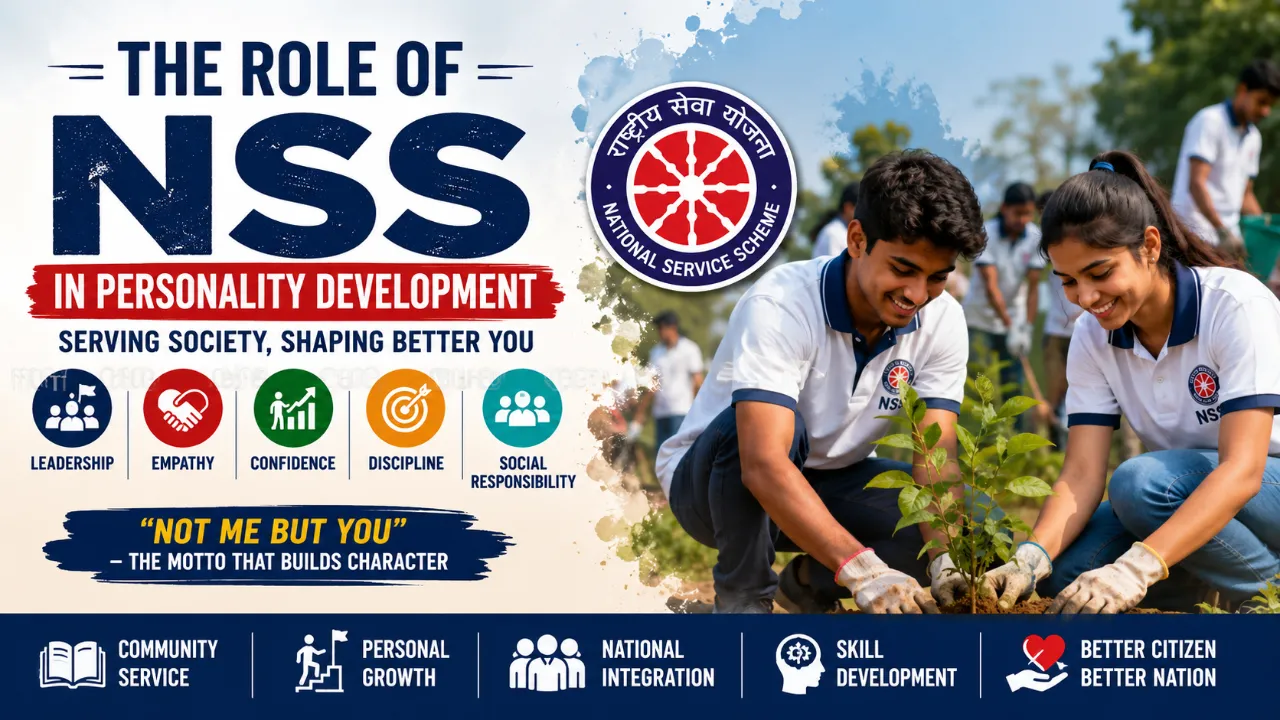
NSS shapes personality development through hands-on community service. Students learn leadership, empathy, discipline, and confidence by working directly with real communities. Its motto, “Not me but you,” pushes volunteers to build character through action rather than lectures.
Role of NSS in Personality Development: Where It All Began
Kavya joined NSS in her first year of college because a friend dragged her along. She stayed for three years because something shifted in her. Standing in a village with no proper drainage, listening to an elderly woman describe the same problem she had lived with for a decade, taught Kavya more about patience and empathy than any classroom ever did.
This is the real story behind NSS. Launched on 24 September 1969, in Mahatma Gandhi’s birth centenary year, NSS began in 37 universities with just 40,000 student volunteers. It now runs under the Ministry of Youth Affairs and Sports, with millions of active volunteers across the country, working alongside programs like motivation-building initiatives that many colleges pair with NSS activity.
Key Takeaways
- NSS builds personality through direct community service, not classroom theory.
- Its motto, “Not me but you,” is the philosophical core of everything the scheme does.
- Seven clear personality traits grow through NSS: leadership, empathy, confidence, discipline, integration, problem-solving, and civic responsibility.
- NSS differs from NCC in approach. NSS builds social and empathetic skills. NCC builds discipline and command skills.
- An NSS certificate carries real weight in college admissions and certain government job applications.
The Motto Behind the Movement
“Not me but you” is not a slogan NSS prints on a certificate and forgets. It is the operating principle behind every camp, every drive, and every project.
The motto reflects a simple idea. An individual’s own growth is tied to the well-being of the community around them. When a student internalizes this early, it changes how they treat people for the rest of their life, a shift closely tied to what we cover in our guide on the role of empathy in personality development.
As the official NSS portal explains, the scheme exists to develop “the personality and character of the student youth through voluntary community service.”
Where the NSS Symbol Comes From
Many students assume the NSS badge uses simple colors to represent values. It does not. The actual symbol is based on the wheel of the Konark Sun Temple in Odisha. This wheel represents the cycle of creation, preservation, and change, according to the Wikipedia entry on NSS. It is a small detail, but it shows how deeply rooted the scheme is in Indian cultural symbolism, not just administrative process.
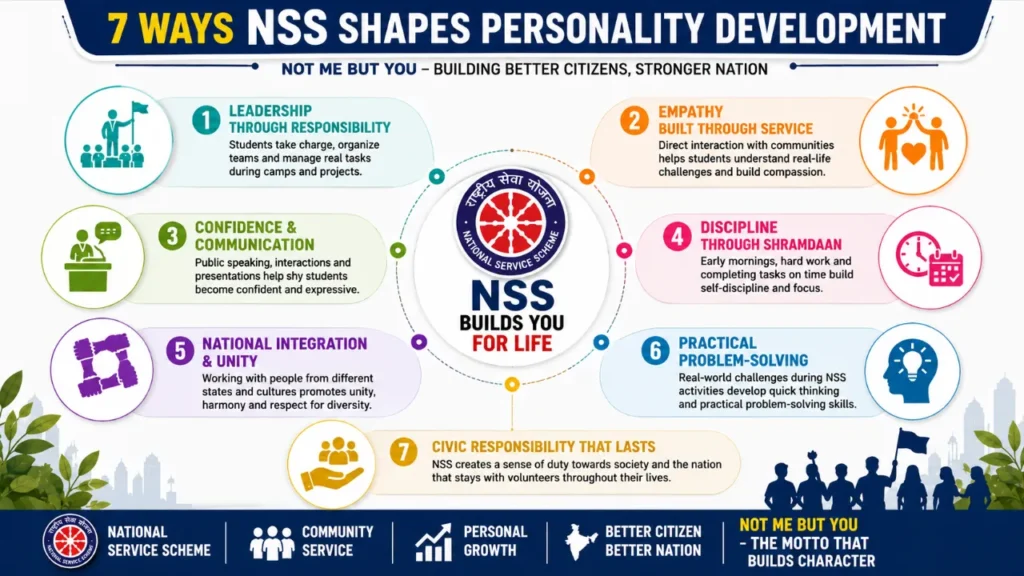
7 Ways NSS Shapes Personality Development
1. Leadership Through Real Responsibility
Camps do not run themselves. Someone has to organize the schedule, manage volunteers, and handle problems on the spot. Students who take on these roles learn leadership the way it actually works in the real world, under pressure, with real people watching. This mirrors the same pressure-tested growth we describe in our piece on the role of sports in personality development.
2. Empathy Built Through Direct Contact
Reading about poverty in a textbook and sitting in a household that experiences it are two different things. NSS volunteers spend real hours with communities facing real struggles. This contact builds empathy that theory cannot replicate.
3. Confidence and Public Communication
Talking to strangers, addressing a group of villagers, or presenting a plan to local officials forces a shy student out of their comfort zone quickly. Aryan, a second-year engineering student, described his first NSS camp speech as “the most nervous I have ever been, and also the moment I realized I could actually do it.”
4. Discipline Through Shramdaan
Shramdaan, or voluntary physical labor, is a core part of most NSS camps. Waking up early, working through heat, and finishing assigned tasks without shortcuts builds the same self-discipline muscle that shows up later in punctuality and follow-through at work.
5. National Integration and Unity
NSS camps often bring together students from different states, languages, and backgrounds. Working side by side on a shared goal breaks down regional assumptions faster than any classroom discussion on unity.
6. Practical Problem-Solving
NSS projects rarely go exactly as planned. A water project might hit a budget issue. A health camp might face low turnout. Volunteers learn to adapt on the spot, a skill that transfers directly to any unpredictable workplace situation.
7. Civic Responsibility That Lasts
Once a student experiences the direct impact of community work, the sense of civic duty tends to stick. Many former NSS volunteers report continuing some form of community involvement years after their certificate is filed away, the same lasting shift we explore in character building in personality development.
Objectives of NSS at a Glance
| Objective | What It Builds |
|---|---|
| Understand the community | Awareness and humility |
| Identify and solve local problems | Practical thinking |
| Develop social responsibility | Long-term civic mindset |
| Gain leadership and democratic attitude | Confidence under pressure |
| Meet emergencies and disasters | Calm decision-making |
| Practice national integration | Cultural openness |
Role of the NSS Programme Officer
Every NSS unit runs under a Programme Officer, usually a faculty member who plans activities, mentors volunteers, and connects the unit with local government bodies. A good Programme Officer often becomes the difference between a routine camp and one that genuinely changes how students think.
NSS vs NCC: Which Builds Personality Better
This comparison comes up often, and the honest answer is that both are strong but different. If you want a deeper breakdown of the discipline and command-focused side of youth training, our guide on the role of NCC in personality development covers that angle in detail.
Here is the simple difference:
- NSS builds empathy, social awareness, and civic responsibility through community service.
- NCC builds discipline, physical fitness, and leadership through structured military-style training.
Students who want people-facing, community-oriented growth usually gravitate toward NSS. Students drawn to structure and command tend to prefer NCC.
NSS Certificate Benefits Students Should Know
Beyond the role of NSS in personality development, the certificate itself carries practical value.
An NSS certificate is not just a formality. Many universities offer grace marks or admission weightage for NSS volunteers, particularly for postgraduate courses. Certain government job applications, including some UPSC and state civil service processes, also give recognition to verified NSS participation. Always confirm current benefits directly with your college or the specific application you are applying to, since rules vary by institution and change over time.
How to Get the Most Personality Growth From NSS
- Set one personal goal before each camp. Do not just attend; aim to improve one specific trait like public speaking or patience.
- Reflect after every activity. A five-minute journal note on what challenged you turns a routine day into real growth.
- Volunteer for uncomfortable roles. Growth happens at the edge of comfort, not inside it.
- Stay past the minimum hours if you can. The deepest lessons usually come in the second or third camp, not the first.
Conclusion
The role of NSS in personality development is not something you read about; it is something you live through one camp at a time. Every shramdaan session, every awkward first conversation with a stranger, and every early morning wake-up call adds up to a version of yourself that a classroom alone could never build.
Frequently Asked Questions
1. What is the motto of NSS?
The motto of NSS is “Not me but you.” It reflects the idea that individual growth depends on the well-being of the surrounding community.
2. What are the main objectives of NSS?
NSS aims to help students understand their community, identify and solve local problems, build social responsibility, and develop leadership and democratic attitudes through direct service.
3. What does NSS stand for?
NSS stands for National Service Scheme, a central government program under the Ministry of Youth Affairs and Sports.
4. What is the role of the NSS Programme Officer?
The Programme Officer plans NSS activities, mentors student volunteers, and coordinates with local authorities to run community service camps and projects.
5. When did NSS start in India?
NSS was launched on 24 September 1969, during Mahatma Gandhi’s birth centenary year, starting with 37 universities and 40,000 volunteers.
6. What are the benefits of an NSS certificate for students?
Many universities give admission weightage or grace marks to NSS volunteers, and certain government exams and civil service applications also recognize verified NSS participation.
7. What is the difference between NSS and NCC in personality development?
NSS builds empathy and civic responsibility through community service, while NCC builds discipline and leadership through structured, military-style training.

Ayanshi is the founder of PersonaGuru.in, a blog dedicated to personality development, relationships, and mental health. With 3+ years of writing experience and 250+ published articles, she simplifies psychology into practical, everyday advice for real people.