
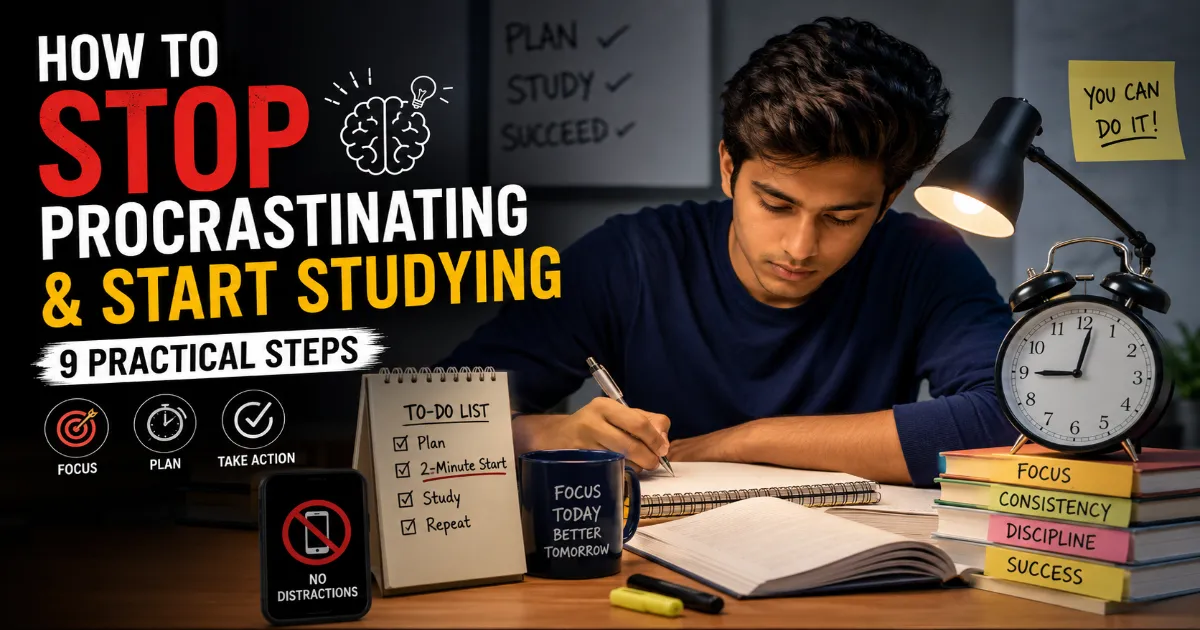
You open your books at nine. By nine fifteen, you are scrolling Instagram. By ten, you are cleaning your desk instead of studying. Sound familiar?
You are not lazy. If you have been searching for how to stop procrastinating and start studying, you are dealing with a real, research backed pattern, not a personality flaw, and it has a workable fix. If self doubt about your progress is part of what is holding you back, this piece on what is actually wrong when you feel stuck is worth a read alongside this one, but for now, let’s fix the habit itself.
To stop procrastinating and start studying, break your first task into a two minute action, set a short timer, and remove your phone from the room before you sit down. Action creates motivation, not the other way around. Most students only need the first five minutes to break the resistance. The rest follows on its own.
This guide is part of PersonaGuru’s Career and Workplace Growth series, which covers the productivity and self-management skills that procrastination sits under, whether you are a student or already working.
Key Takeaways
- Procrastination is a research backed emotional avoidance pattern, not a character flaw or a sign of laziness.
- Chronic procrastination affects roughly 15 to 20% of adults, according to a large meta analysis by psychologist Piers Steel.
- Starting a task for just two minutes lowers the mental resistance enough to keep going.
- Anxiety, perfectionism, and an unclear task are the three most common reasons students delay studying.
- Small, repeatable systems beat big motivation pushes every single time.
Why Do You Keep Procrastinating Before Studying?
Before fixing the habit, it helps to understand what is actually happening in your brain.
Procrastination is not about time management. It is an emotion regulation problem. When a task feels boring, difficult, or threatening to your self worth, your brain looks for a quick escape. Instagram, YouTube, or a sudden urge to clean your room gives your brain instant relief. Studying does not.
Psychologist Piers Steel reviewed more than 690 studies on this topic in a landmark 2007 review published in Psychological Bulletin. His research found that chronic procrastination affects around 15 to 20% of adults, and that 80 to 95% of college students procrastinate on academic work at least occasionally. Nearly half procrastinate consistently enough for it to hurt their grades.
That number matters. If you procrastinate, you are not broken. You are one of millions of students dealing with the exact same brain wiring.
Fear of Failure and Perfectionism
If a chapter feels overwhelming, your brain protects you by avoiding it. Not starting feels safer than starting and doing it badly. Learning to face that fear instead of dodging it is a skill on its own, and PersonaGuru‘s piece on how embracing challenges fuels personal growth breaks down how to build it.
Task Feels Too Big or Too Vague
“Study for the exam” is not a task. It is a vague goal, and vague goals are the easiest thing in the world to postpone.
Instant Gratification Trap
Reels and notifications are designed to give your brain a dopamine hit in under three seconds. A textbook cannot compete with that unless you remove the distraction first.
Is It Really Procrastination, or Something Else?
Sometimes what looks like laziness is actually anxiety, low mood, or an attention difficulty asking for help.
Can Anxiety Cause Procrastination?
Yes. When a task feels threatening (a tough exam, a subject you already feel weak in), anxiety pushes you to avoid it rather than face it. Research consistently links higher anxiety with higher procrastination, especially before exams.
Can Depression Cause Procrastination?
Depression lowers energy and motivation across the board, which makes even simple study tasks feel exhausting before you begin. If low mood, low energy, and procrastination have been going on for weeks, it is worth speaking to a counsellor rather than only trying productivity tricks.
Procrastination or ADHD? A Quick Self Check
Occasional procrastination before a boring task is normal. If you consistently cannot start tasks regardless of deadline pressure, across every subject and every setting, that pattern is worth discussing with a mental health professional. This article can help with everyday study procrastination. It is not a diagnostic tool, and a proper assessment always needs a qualified professional.
Two Minute Rule: How to Start When You Feel Zero Motivation
If you only take one idea from this guide on how to stop procrastinating and start studying, make it this one.
You do not need to feel motivated to study. You need to start, and motivation follows.
Turn your first study task into something so small it feels almost silly to skip.
- “Study Chemistry” becomes “Open the Chemistry notebook and read one page.”
- “Finish the assignment” becomes “Write the first sentence of the introduction.”
- “Revise for the exam” becomes “Read today’s date’s topic for two minutes.”
Once you start, the resistance usually drops within minutes, because starting is the hardest part, not finishing.
9 Step Framework to Stop Procrastinating and Start Studying
Use this as your working checklist. Keep it visible on your desk for the first two weeks.
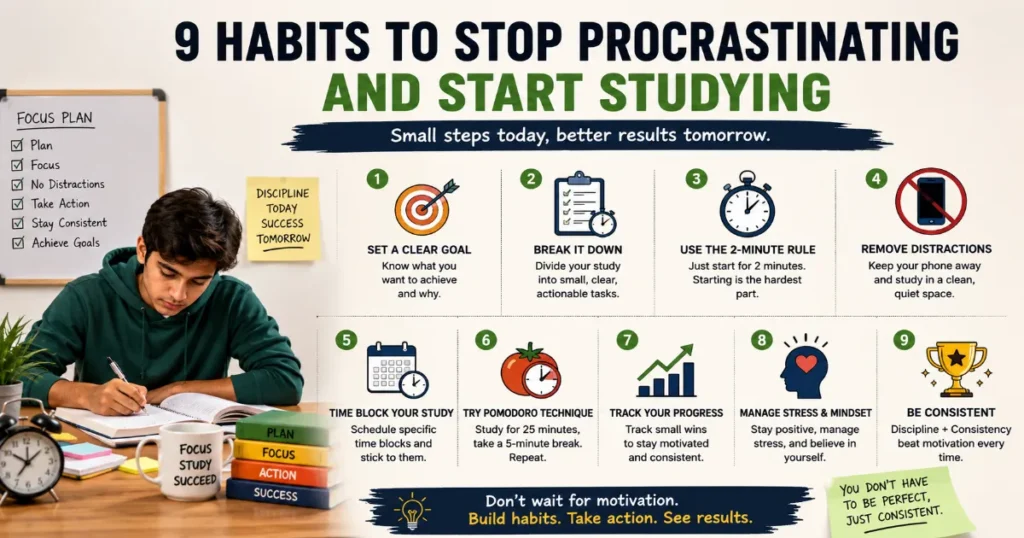
| Step | What To Do | Why It Works |
|---|---|---|
| 1 | Break the task into a two minute first move | Removes the mental barrier to starting |
| 2 | Set a 5 to 10 minute timer | Makes the commitment feel small and safe |
| 3 | Put your phone in another room | Removes the easiest escape route |
| 4 | Study the hardest subject first | Willpower is highest early in the session |
| 5 | Use the 3-3-3 rule if anxiety is the real block | Calms the nervous system before you begin |
| 6 | Build a five minute pre study ritual | Signals to your brain that focus time is starting |
| 7 | Forgive yourself for lost time | Guilt fuels more avoidance, not less |
| 8 | Track small wins daily | Builds real momentum over motivation |
| 9 | Design a realistic study space | A workable environment beats a perfect one |
Step 5 in Detail: The 3-3-3 Rule for Anxiety
The 3-3-3 rule is a grounding technique used in anxiety management and cognitive behavioural therapy. When you feel too anxious to open your books, try this before sitting down.
- Name three things you can see around you.
- Name three sounds you can hear right now.
- Move three parts of your body, your fingers, your feet, or your shoulders.
This pulls your attention out of anxious thoughts and back into the present moment, which is usually enough to sit down and begin the two minute rule above. If grounding techniques like this work for you, PersonaGuru’s guide on how to control your mind covers a similar method along with other ways to calm racing thoughts.
Step 7 in Detail: Self Forgiveness Actually Helps
A well known study by researcher Michael Wohl found that students who forgave themselves for procrastinating on an earlier exam procrastinated less on the next one. Guilt keeps you stuck in the same avoidance loop. Letting go of the guilt from yesterday is what frees up energy for today.
How Indian Students Can Beat Study Procrastination Before Exams
Board exams, JEE, NEET, and competitive exam pressure add a layer most global productivity advice ignores: family expectations and comparison with siblings, cousins, and classmates.
Take Aryan, a class 11 student preparing for JEE. Every evening he opened his Physics book and closed it within ten minutes, telling himself he would “really start tomorrow.” The pressure of comparison with his elder cousin, who had cracked JEE two years earlier, made every study session feel like a test of his worth, not just a chapter to finish.
What changed things was not a motivational video. Aryan started using a five minute rule before every subject: read one solved example, nothing more. Most days, five minutes turned into forty. On the days it did not, he still had five honest minutes of work behind him, and that was enough to stop the guilt spiral from the night before.
“I stopped waiting to feel ready,” Aryan says. “I just opened the book for five minutes and let the rest happen on its own.”
That is the entire framework in one sentence. For more habits Indian students specifically can use to build the confidence to keep going, PersonaGuru’s roundup of personality development books for students is a good next stop.
Why Willpower Alone Will Not Fix Procrastination
Willpower is a limited resource. It runs low as the day goes on, which is exactly why late night study sessions feel almost impossible to start. Relying only on willpower means you are fighting your own biology every single evening.
Systems fix this. A fixed study time, a phone free room, and a two minute starting ritual do the work that willpower cannot sustain alone. If you want to understand how willpower actually works and where its limits are, PersonaGuru’s guide on building willpower the right way breaks this down further, and pairs well with the steps in this article.
For a deeper look at staying consistent once you have started, PersonaGuru’s article on the role of self discipline in personality development is a useful next read. The consistency you build here also carries over well beyond the study table — see how the same habits show up in developing a strong personality at work.
That is really the whole system for how to stop procrastinating and start studying: small mechanics, repeated daily, without waiting for motivation to show up first.
Final Thoughts
At the end of the day, learning how to stop procrastinating and start studying is not about willpower, motivation, or waiting for the “right mood.” It comes down to one small, repeatable move: shrink the task, remove the phone, and give yourself two minutes. That is the entire system, and it works whether you are prepping for a school test or a board exam.
Your next step: Do not wait for tomorrow to try this. Pick your hardest subject, set a 5 minute timer right now, and open the book to page one. That single two minute start is genuinely how to stop procrastinating and start studying today, not someday.
Frequently Asked Questions
Why do I keep procrastinating everything?
Procrastination is usually an emotional avoidance response, not laziness. Tasks that feel boring, difficult, or threatening to your self worth trigger a short term escape into easier activities like scrolling or cleaning.
Can anxiety cause procrastination?
Yes. Anxiety makes a task feel threatening, and avoidance temporarily lowers that discomfort, which reinforces the delay the next time a similar task appears.
Can CBT help with procrastination?
Yes. Cognitive behavioural therapy techniques, including grounding methods like the 3-3-3 rule and breaking tasks into smaller steps, are commonly used to reduce procrastination linked to anxiety and perfectionism.
Is procrastination a form of ADHD?
Not always. Occasional procrastination is normal and common. Persistent difficulty starting tasks across every setting, regardless of deadline pressure, can be linked to ADHD in some people, and a proper diagnosis needs a qualified professional.
What is the 3-3-3 rule for anxiety?
It is a grounding technique where you name three things you see, three things you hear, and move three parts of your body. It brings your attention back to the present moment and calms anxious thoughts before you begin a task.
How can I stop procrastinating while studying at night?
Keep your phone outside the room, study your hardest subject first while your willpower is still fresh, and use a short timer instead of an open ended study block. Night study sessions fail most often because they rely on willpower that has already run out by evening.

Ayanshi is the founder of PersonaGuru.in, a blog dedicated to personality development, relationships, and mental health. With 3+ years of writing experience and 250+ published articles, she simplifies psychology into practical, everyday advice for real people.