
Assertive communication examples are clear, calm sentences where you say what you think, feel, or need, and still respect the other person. “I cannot take this on today. I can start on Monday” is one of them. It is polite. It is also firm.
Most of us know two ways to react. We stay quiet, or we snap. The third way is harder, because nobody teaches it. This guide gives you the actual words.
Here you will find 15 real situations, 20 quick sentences, a simple formula, and a free practice sheet. If you want the big picture first, read our guide on types of communication skills.
Key Takeaways
- Assertive means clear and respectful. It does not mean loud.
- There are four styles: passive, aggressive, passive-aggressive, and assertive.
- Use this formula: what happened, how I feel, what I need.
- Start with “I”, not “you”. It lowers the heat in any talk.
- You can say no without a long reason.
- Your face, posture, and voice must match your words.
- Practise small talk first. Save the hard ones for later.
What Is Assertive Communication?
Assertive communication means saying your views, feelings, and needs in a direct and respectful way. You protect your side. You also listen to the other side.
The Mayo Clinic calls assertiveness a core communication skill. It lets you state your views and stand up for yourself while respecting the rights and beliefs of others. According to Mayo Clinic, how you say a message matters as much as the message itself.
Healthline puts it in plain words. It says assertive communication involves “clear, honest statements about your beliefs, needs, and emotions.”
Think of two extremes. At one end, you stay silent and let things pass. At the other end, you shout to win. Assertive sits in the middle.
Is Assertive Communication Good for You?
Yes. It helps you reduce stress, protect your time, and keep relationships honest. Healthline notes that passive talk can build stress and resentment. Aggressive talk can scare people and damage trust, as explained by Healthline.
It also helps your career. The National Association of Colleges and Employers (NACE) surveyed 237 employers in 2024. According to NACE, more than two-thirds want to see verbal communication skills on a resume. Speaking clearly is a skill employers look for.
Many people find this hard because of how they grew up. Our guide on factors affecting assertiveness explains why speaking up feels difficult for some of us.
What Are the Four Communication Styles, With Examples?
The four styles are passive, aggressive, passive-aggressive, and assertive. Passive is also called submissive or non-assertive.
Here is one case. Your cousin keeps borrowing your charger and never returns it.
| Style | What you say | What happens next |
|---|---|---|
| Passive | “It is okay. Keep it.” | You feel upset. Your cousin learns nothing |
| Aggressive | “You always take my things. Stop being so selfish.” | Your cousin gets defensive. A fight starts |
| Passive aggressive | “Oh, no problem. I will just buy another one. I am used to it.” | Your cousin feels the sting but not the request |
| Assertive | “Please return my charger by tonight. I need it for work tomorrow. Can you do that?” | Your cousin hears the problem and a clear fix |
Look at the last row. It has a fact, a reason, and a request. There is no blame.
If you are not sure where the line sits between firm and harsh, read about aggression vs. assertiveness.
What Are the 3 Cs of Assertive Communication?
One common version of the 3 Cs is Control, Clarity, and Confidence. Sources word this a little differently, so treat it as a helpful guide, not a fixed rule.
- Control. Stay calm. Breathe before you speak. “Give me a minute to think.”
- Clarity. Say your point plainly. “I need the report by Thursday.”
- Confidence. Believe you have a right to speak. Keep your voice steady.
What Are the 5 Steps of Assertive Communication?
A simple five-step way is: know what you need, pick the right moment, use an “I” sentence, make one clear request, and then listen. No single official list exists, so this is a practical version that works for most talks.
- Know what you need. Write it in one line before you speak.
- Pick the moment. Do not start a serious talk when someone is rushing.
- Use an “I” sentence. “I feel worried when the deadline moves.”
- Make one request. Ask for one clear action.
- Listen to the reply. Let the other person speak. Stay calm.
What Are Five Assertive Behaviours?
Five assertive behaviours are using “I” statements, keeping steady eye contact, using an even tone, offering a solution to the problem, and respecting the other view. You do not need all five at once. Start with one.
Want more methods? Try these assertiveness techniques.
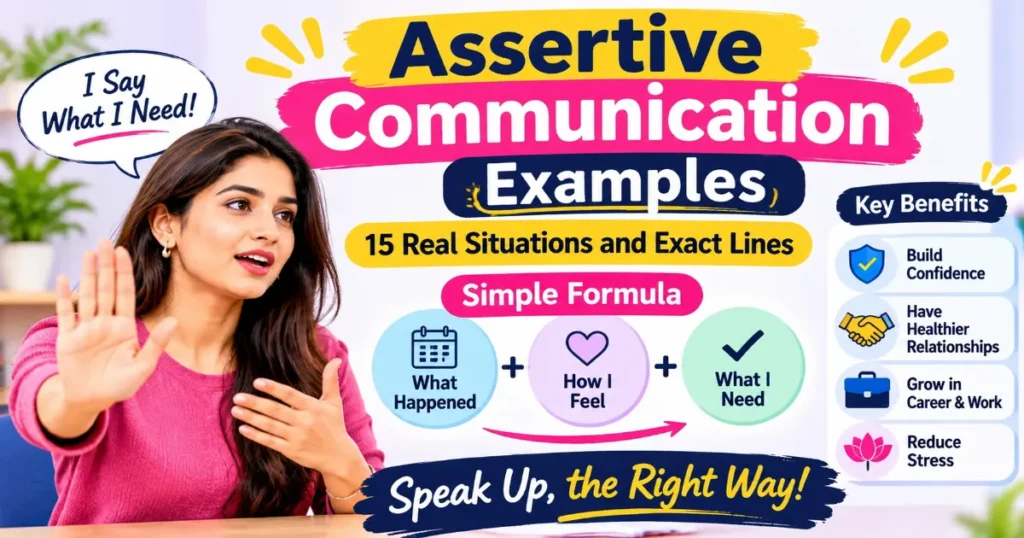
What Is a Simple Formula for Assertive Sentences?
Use three parts: what happened, how you feel, and what you need. Keep each part to one short sentence.
- What happened. State the fact. No blame.
- How I feel. Name the feeling.
- What I need. Ask for one action.
Example: “When you interrupt me in the meeting, I feel my idea is not being heard. I would like to finish my point first.”
What Do You Say When Someone Pushes Back?
Repeat your point calmly, offer a choice, and do not add new excuses. If your friend says, “Come on, just this once,” you can say, “I understand. I still cannot do it today. Can we meet on Sunday?”
Say the same line once or twice. Do not argue. Calm repetition works better than a long reason.
What Are 15 Assertive Communication Examples in Real Situations?
Here are 15 assertive communication examples. Change the names and details to match your life.
Assertive Communication Examples in the Workplace
1. Saying No to Extra Work
You are leaving on time, and your manager adds a task.
| Style | What you say |
|---|---|
| Passive | “Sure, I will stay.” |
| Aggressive | “No way. Ask someone else.” |
| Assertive | “I would like to help, but I am at full capacity today. I can start on Monday morning. Does that work?” |
You said no, and you offered a real option. For more lines like this, read how to say no to extra work.
2. Disagreeing With Your Manager
“I see this a little differently. May I share my view before we decide?”
This is calm and direct. It does not attack the plan or the person. Our guide on how to disagree with your boss has more ideas.
3. Asking for a Raise
“I have taken on two new projects this year, and both finished on time. I would like to talk about my salary. When can we meet?”
Stick to facts and ask for a meeting. Avoid threats.
4. Speaking Up When You Are Interrupted
“Please let me finish this point. Then I would like to hear yours.”
Say it slowly. A steady voice does more work than a clever line. If you freeze in group talks, see how to speak up in meetings.
5. Giving Hard Feedback
“The report has three wrong numbers on page two. Can you fix them by tomorrow noon? I can check it again after that.”
Talk about the work, not the person.
6. When a Colleague Takes Credit
“I worked on the data part of this project. I would like that to be mentioned when we present.”
Say it in private first. If nothing changes, take it to your manager. We cover this in detail in our guide on what to do when a coworker takes credit.
Assertive Communication Examples for Students
7. Group Project With Uneven Work
| Style | What you say |
|---|---|
| Passive | You do the whole project and say nothing |
| Aggressive | “You people are useless. I am doing everything.” |
| Assertive | “I have finished my part. The slides are still empty. Can we agree who does them by Thursday?” |
You state a fact and ask for a plan. No blame needed.
8. Asking a Teacher for Help or More Time
“I did not understand the second step in this problem. Could you explain it once more?”
Or: “I was unwell for two days. May I submit the assignment on Friday?” Asking for help is not weak. It is honest.
9. Refusing to Share Notes Every Time
“I am happy to share this week. I need my notes for my own revision next. Let us study together instead.”
Offer an option so your friend does not feel pushed away.
Assertive Communication Examples in Relationships and at Home
10. Sharing Household Work
| Style | What you say |
|---|---|
| Passive | You do all the dishes and feel tired |
| Aggressive | “You never help in this house.” |
| Assertive | “I feel tired when I do the dishes every night. Can we share the work? I can do Monday, Wednesday, and Friday.” |
Name the feeling, then give a clear plan.
11. Setting a Limit With Family Advice
“I know you worry about me. I need to make this decision myself. I will tell you how it goes.”
This works well with parents and relatives who give a lot of advice. For tougher cases, read about setting boundaries with toxic people.
12. Telling a Friend You Need Space
“I care about you, and I am tired today. Can we talk tomorrow?”
You protect your energy and keep the friendship safe.
13. Raising a Worry With a Partner
“I feel anxious when you do not reply for hours. Can we agree on a quick message when you are busy?”
Describe your feeling. Do not accuse. Then ask for something small and doable.
Assertive Communication Examples in Daily Life
14. A Shop Gives You the Wrong Item
“This is not the item I ordered. I would like to exchange it today.”
Be calm and specific. Politeness plus clarity gets results.
15. Someone Cuts the Queue
“Excuse me. I have been waiting here. The line starts behind me.”
Short, polite, and clear.
What Are 20 Examples of Assertive Sentences?
Short assertive sentences start with “I”, name one need, and stay polite. Here are 20 you can use today.
| Purpose | Assertive sentences |
|---|---|
| Saying no | “I cannot do this today.” / “Thank you for asking. I will pass.” / “I am not comfortable with that.” / “I can help next week, not this week.” |
| Asking for help | “Could you explain this once more?” / “I need more time to finish this.” / “Can you share the details in writing?” / “I would like your advice on this.” |
| Disagreeing | “I see it differently.” / “I understand your point. Here is mine.” / “I do not agree, but I want to understand.” / “Can we look at both options?” |
| Sharing feelings | “I feel stressed when plans change late.” / “I feel hurt when I am left out.” / “I am happy to be part of this.” / “I feel overwhelmed. I need a short break.” |
| Setting limits | “Please do not raise your voice at me.” / “I need to finish before I answer.” / “This is not okay with me.” / “I will reply after work hours.” |
Say them aloud. If you want more lines for spoken talks, see these oral communication examples.
What Are Nonverbal Assertive Communication Examples?
Nonverbal assertive signs are steady eye contact, an upright posture, a calm face, an even voice, and relaxed hands. Your body should say the same thing as your words.
| Signal | Passive | Aggressive | Assertive |
|---|---|---|---|
| Eye contact | Looks down or away | Stares hard | Steady and friendly |
| Posture | Shoulders drop | Leans in, points | Upright and open |
| Voice | Soft, shaky | Loud, sharp | Calm and even |
| Hands | Fidgeting | Fists, finger pointing | Relaxed and open |
| Distance | Steps back | Too close | Comfortable space |
The Mayo Clinic suggests standing or sitting tall, keeping steady eye contact, and leaving your arms uncrossed. You can read more in our guide on body language in personality development.
When Does Assertive Turn Into Aggressive?
The line is thin. Here are signs you may have crossed it.
- You raise your voice to win.
- You use “always” and “never” about the other person.
- You do not let them reply.
- You use sarcasm or insults.
- You ask for something and refuse to hear a no.
If you see these signs, pause. Slow down and ask, “What do you think?” Then listen.
How Can You Practise Assertive Communication Every Day?
Start with small, safe talks and build up. You do not need to begin with your boss.
| Day | What to do |
|---|---|
| 1 | Pick two lines from this guide that fit your life |
| 2 | Say them aloud three times |
| 3 | Use one in small talk, such as ordering food |
| 4 | Use one with a friend and ask for one tip |
| 5 | Write one hard message with the three-part formula |
| 6 | Say it aloud, then send it or say it for real |
| 7 | Write down what worked and what felt hard |
Download the free practice sheet (PDF). It has the formula, 10 starter lines, and 3 practice situations.
Practise with someone you trust first. For tense talks, our conflict-resolution communication tips also help.
What Mistakes Should You Avoid?
- Saying sorry at the start of every sentence.
- Giving five reasons for one no.
- Waiting until you are angry to speak.
- Using “you” sentences that sound like blame.
- Expecting the other person always to agree.
- Giving up after one hard try.
Being assertive does not mean you always get a yes. It means you speak honestly and respectfully, and you accept their answer.
Conclusion
Assertive communication examples work because they are simple. You state the fact, you state the feeling, and you ask for what you need. Your tone stays calm, and you listen to the reply.
I would pick two lines from this list and say them aloud tonight. Then use one in a real talk this week. The first time feels odd. The third time feels normal.
FAQs
What are some examples of assertive communication?
“I cannot take this on today, but I can start Monday” and “I feel frustrated when plans change late. Please text me first” are two examples. Any clear, calm, and respectful statement of your needs counts.
What are the three styles of communication?
Passive, aggressive, and assertive. A fourth style, passive-aggressive, shows anger in a hidden way, such as with sarcasm or silence.
What are the 3 Cs of assertive communication?
One common version is Control, Clarity, and Confidence. Different sources word it a little differently.
What are the 5 steps of assertive communication?
Know what you need, pick the right moment, use an “I” sentence, make one clear request, and listen to the reply. This is a practical version, not an official list.
What is the difference between assertive and aggressive communication?
Assertive talk states your needs and respects the other person. Aggressive talk pushes your needs over theirs. Tone, word choice, and body language show the difference.
Is assertive communication rude?
No. It is direct and respectful. Rude talk attacks the person. Assertive talk deals with the problem.

Ayanshi is the founder of PersonaGuru.in, a blog focused on personality development, career, relationships, and mental well-being. With over 3 years of writing experience, she turns psychology and everyday experiences into practical, easy-to-understand advice for real life.