
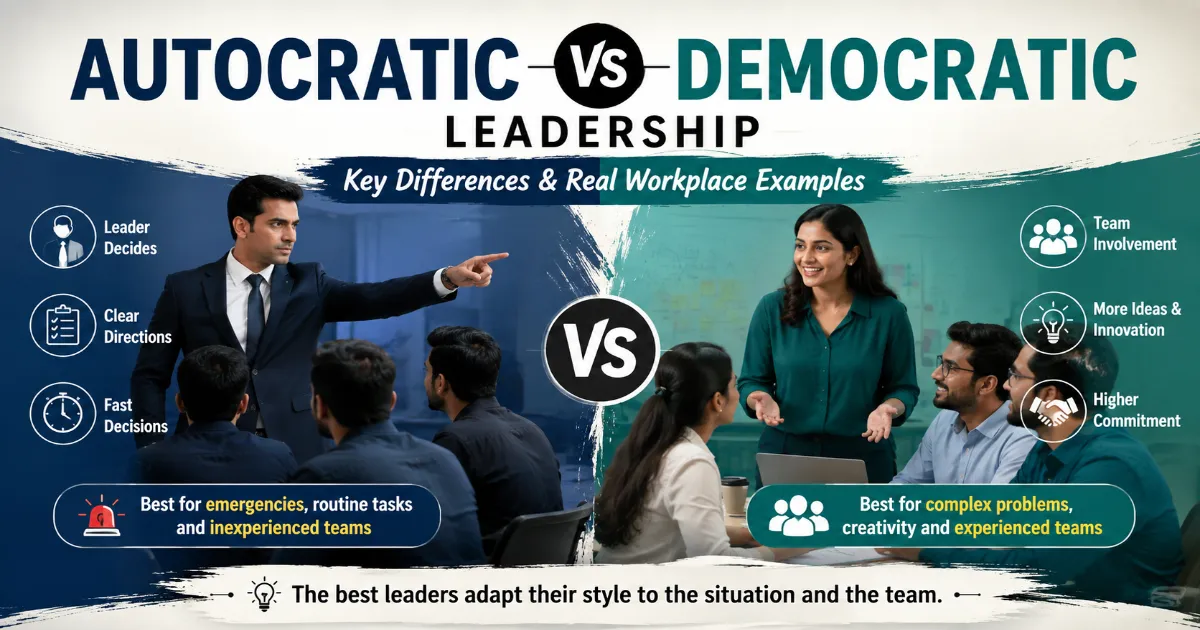
Vikram ran two teams at the same logistics company in Chennai. With his warehouse crew, he gave short, direct instructions and expected them to be followed immediately. With his strategy team, he opened every meeting with a question and let the group argue out the answer. Same manager, same company, two completely different approaches. He was not being inconsistent. He was choosing between autocratic vs democratic leadership based on what each situation actually needed.
That choice sits at the center of one of the oldest debates in management. Below, you will find clear definitions, a side-by-side comparison, and real workplace scenarios so you can see exactly when each autocratic vs democratic leadership style works and when it backfires.
Key Takeaways
- Autocratic leadership means one person makes the decisions. Democratic leadership means the team shares in the decision.
- Neither style is universally better. The right choice depends on the task, the team’s experience, and the time available.
- Autocratic leadership tends to work best in emergencies or with inexperienced teams. Democratic leadership tends to work best for complex problems that need buy-in.
- Both styles stem from Kurt Lewin’s 1939 study, alongside a third style, laissez-faire, also known as free-rein leadership.
- Transformational leadership is a different axis altogether. It is about inspiring a vision, not about who makes the decisions.
Direct Answer: The difference between autocratic and democratic leadership comes down to who holds the decision. In autocratic leadership, one person decides and the team follows. In democratic leadership, the leader gathers input from the team before deciding. Autocratic suits emergencies and inexperienced teams. Democratic suits complex problems and experienced teams.
What Is Autocratic Leadership? (Quick Answer)
Autocratic leadership is a style where one leader makes decisions alone, sets clear expectations, and expects the team to follow without debate. There is no committee, no vote, and usually very little back-and-forth
Autocratic leadership is a top-down management style where a single leader holds complete decision-making authority, sets direction without team consultation, and expects the team to execute without debate.
Example: Ishaan managed a night shift at a manufacturing plant. When a machine broke down at 2 a.m. with a client deadline hours away, he did not call a meeting. He assigned tasks on the spot, told each technician exactly what to check, and made the final call on which fix to try first. The shift met its deadline because someone decided fast.
This is autocratic leadership at its most useful. It is not the same as being harsh or dismissive. It simply means the leader owns the decision.
What Is Democratic Leadership? (Quick Answer)
Democratic leadership is a style where the leader gathers input from the team before deciding. The leader still makes the final call in most cases, but the team’s voice genuinely shapes the outcome.
Democratic leadership, also called participative leadership, is a collaborative management style where team members actively contribute to decisions, while the leader keeps final accountability for the outcome.
Example: Meera led a product team redesigning their app’s onboarding flow. Instead of dictating the new design, she ran two brainstorming sessions, let junior designers pitch ideas alongside senior ones, and built the final version around the two strongest suggestions from the group. The team felt ownership over the result because they had actually shaped it. Being trusted with real input like this is also one of the quieter ways teams build self-confidence at work, especially for junior members who rarely get asked for their opinion.
Autocratic vs Democratic Leadership: Side by Side Comparison
Here is the difference between autocratic and democratic leadership at a glance, and once you see it laid out, autocratic vs democratic leadership stops feeling like an abstract debate and starts looking like a practical checklist.
| Factor | Autocratic Leadership | Democratic Leadership |
|---|---|---|
| Decision-making speed | Fast, made by one person | Slower, needs group input |
| Team morale | Can drop if people feel unheard | Usually higher, people feel valued |
| Innovation | Limited, few voices contribute | Stronger, more perspectives combine |
| Best for | Emergencies, new or inexperienced teams | Complex problems, experienced teams |
| Leader’s role | Director | Facilitator |
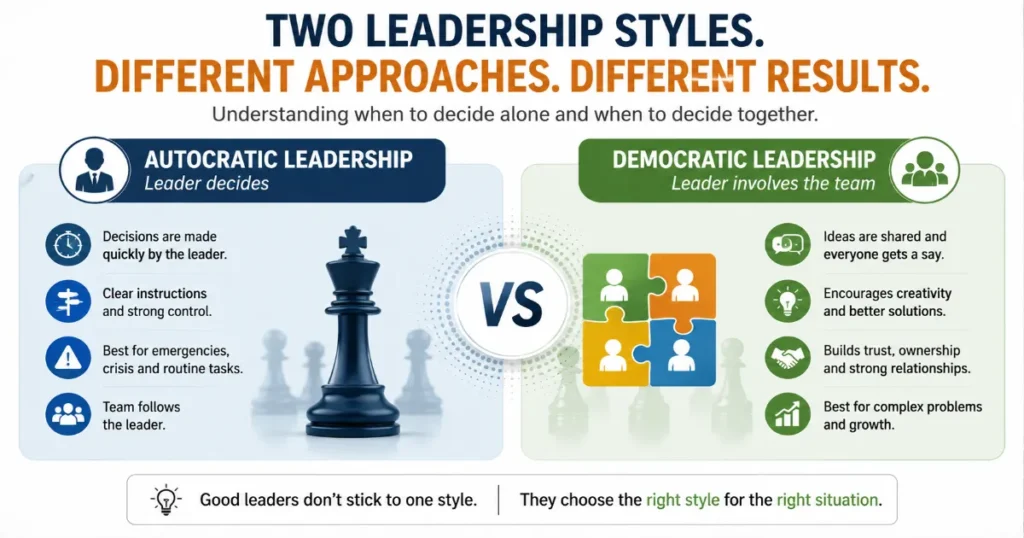
Autocratic and Democratic Leadership Examples in the Workplace
Theory is easy to nod along to. Watching autocratic vs democratic leadership play out in real situations is where it actually clicks.
Autocratic Example: The Crisis Deadline
A hospital’s IT team lost access to its patient scheduling system an hour before opening. The IT lead did not ask for opinions. She split the team into three tasks, gave each person thirty seconds of instruction, and had the system back up before the first patient walked in. Nobody complained about not being consulted. In that moment, speed mattered more than consensus.
Democratic Example: The Strategy Pivot
A mid-sized marketing agency in Pune was losing a major client and needed a new pitch within a week. Instead of dictating the direction, the founder pulled in six people from different departments, ran a structured discussion, and let the room build the strategy together. The final pitch used ideas from three different team members. The client stayed, and the team felt they had earned the win together.
Switching Between the Two: The Same Manager, Different Days
Rohan, a project manager, ran his sprint planning meetings democratically, asking his developers to weigh in on estimates and priorities. But when a production server went down during a client demo, he switched instantly into autocratic mode, giving rapid-fire instructions with zero discussion. The same manager used both styles within the same week, and both calls were right for their moment.
This is closer to situational leadership, where the leader reads the moment instead of committing to one fixed style. If you want to go deeper into matching your style to the person and the task, our guide on situational leadership theory examples breaks this down with more scenarios.
Where Laissez-Faire (Free Rein) Fits Into the Picture
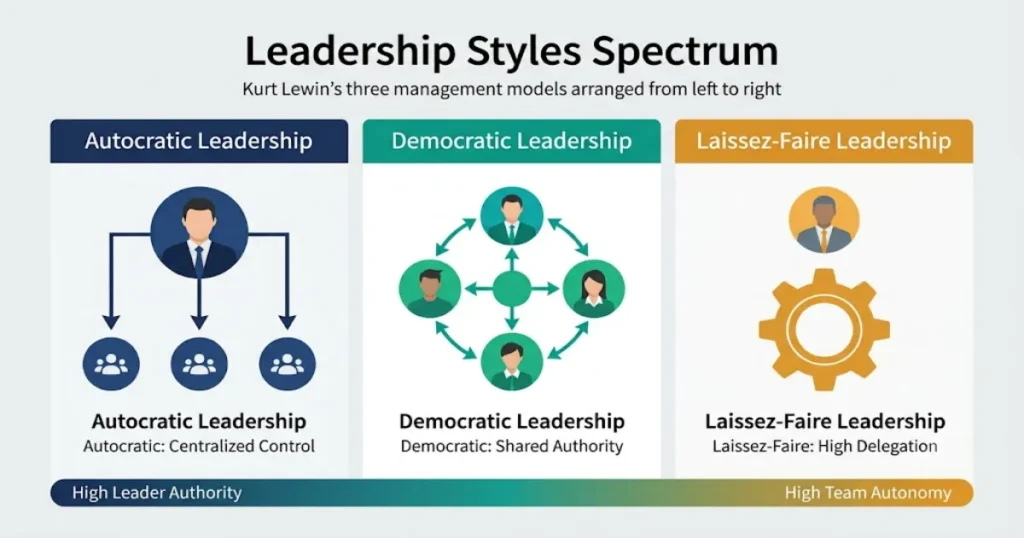
Autocratic vs democratic leadership is not the only comparison worth making. Kurt Lewin, working with Ronald Lippitt and Ralph White at the University of Iowa in 1939, studied a third style alongside these two, known as laissez-faire or free rein leadership. In this study, boys’ clubs were assigned adult leaders trained to act autocratically, democratically, or hands-off, and researchers observed the results.
Laissez-faire leaders step back almost entirely and let the group decide everything on its own. In Lewin’s original research, this style consistently produced the least output and the most disorganized work, since groups without any structure often struggled to get started.
If you want the full academic account of this landmark study, Psychology Today’s breakdown of the 1939 Iowa experiment covers the original methodology and findings in detail.
So when someone searches for autocratic vs democratic vs laissez-faire leadership, this is the full picture. Autocratic leaders decide alone. Democratic leaders decide with the group. Laissez-faire leaders barely decide at all, for better and often for worse.
How This Compares to Transformational Leadership
Autocratic and democratic leadership describe how decisions get made. Transformational leadership describes something different entirely. It is about how a leader inspires long-term vision, motivation, and change, regardless of how decisions happen day to day.
A transformational leader can run their team democratically or autocratically depending on the situation. What defines them is the ability to paint a picture of where the team is headed and get people genuinely excited to get there. So when you see autocratic vs democratic vs transformational leadership searched together, remember that transformational sits on a different axis, not as a third option in the same list as the other two. Our detailed piece on the transformational leadership model explores this style on its own terms.
Advantages and Disadvantages of Each Style
Weighing autocratic vs democratic leadership honestly means looking at what each style costs you, not just what it gives you.
Autocratic Leadership
Advantages:
- Fast decisions: no delay waiting for group consensus
- Clear direction: useful for new or unskilled teams
- Works under pressure: holds up well in real time-crunch situations
Disadvantages:
- Morale risk: can lower morale over time if overused
- Limited input: creative ideas from the team get missed
- Control creep: risks becoming controlling if it becomes the default
Democratic Leadership
Advantages:
- Builds trust: usually leads to higher morale
- More ideas: draws on a wider range of perspectives
- Stronger buy-in: people commit harder to decisions they helped shape
Disadvantages:
- Slower pace: not ideal in genuine emergencies
- Can stall: may drag on if the group cannot agree
- Facilitation skill needed: requires a leader who can guide a discussion, not just decide
Which Leadership Style Should You Use?
There is no single winner in the autocratic vs democratic leadership debate, whatever a quick search might suggest. Use this short checklist instead.
- Is there a hard deadline right now? Lean autocratic.
- Does the team have deep experience with this exact problem? Lean democratic.
- Is the decision reversible if it goes wrong? If yes, democratic is usually safer to try.
- Does the team seem disengaged lately? Democratic input often re-engages people faster than more instructions.
Autonomy is not a soft, nice-to-have factor either. Gallup’s 2026 State of the Global Workplace research found that employees who feel they have real choice in how they work are far more likely to say it is a good time to look for a new job elsewhere, which is a strong signal that leaders who never involve their teams are quietly increasing turnover risk. If you want to dig further into what keeps people engaged at work, our career and workplace growth guide covers this alongside other professional skills.
Practical Tips Before You Choose a Style
Choosing between autocratic vs democratic leadership gets easier once you stop treating it as a personality trait and start treating it as a tool you pick up for the situation.
- Question your default: do not default to autocratic just because it feels faster. Ask if the decision genuinely needs speed, or if that is just a habit.
- Question fairness too: do not default to democratic just because it feels fairer. Some decisions do not need six opinions.
- Watch the reaction: notice how your team responds after each decision. Withdrawal and silence are signs your style is not landing.
- Build the skill: reading these signals accurately is its own skill. Our guide on emotional intelligence is a useful next read if this is an area you want to strengthen.
Reading team readiness accurately is not something every leader picks up naturally, and if this framework feels new, our broader guide on the types of leadership styles is worth reading alongside this one for the fuller picture, including our own complete guide to leadership fundamentals.
Conclusion
Autocratic vs democratic leadership are not opposing philosophies to pick once and follow forever. The opposite of autocratic leadership is democratic leadership in theory, but in practice, the best leaders move between the two based on the moment in front of them. Watch the deadline, watch the team, and choose accordingly.
Frequently Asked Questions
1. What is an example of autocratic leadership?
A manager during a crisis who assigns tasks immediately without asking for team input, because the situation needs a fast, single decision, is a clear example of autocratic leadership.
2. What is an example of democratic leadership?
A team lead who runs a brainstorming session and builds the final plan around the group’s best ideas, rather than deciding alone, is practicing democratic leadership.
3. What are the key differences between autocratic and democratic leaders?
Autocratic leaders decide alone and expect the team to follow. Democratic leaders involve the team in the decision itself, which usually takes longer but builds more buy-in.
4. What is the difference between authoritarian and autocratic leadership?
The two terms are largely used interchangeably in leadership research, including in Lewin’s original 1939 study, which referred to this style as both authoritarian and autocratic. In everyday use, authoritarian sometimes carries a harsher connotation, but they describe the same basic pattern of one person holding all decision-making power.
5. Is autocratic leadership the same as a dictatorship?
No. Autocratic leadership is a workplace management style used within a team or organization, often temporarily and for specific situations. A dictatorship is a political system of governing an entire country. They share the trait of one person holding decision-making power, but they operate in completely different contexts with different consequences.
6. What are the three main leadership styles?
According to Kurt Lewin’s original framework, the three main styles are autocratic, democratic, and laissez-faire, also called free rein.
7. Who introduced autocratic and democratic leadership styles?
Kurt Lewin, along with researchers Ronald Lippitt and Ralph White, introduced this framework in a 1939 study conducted at the University of Iowa.

Ayanshi is the founder of PersonaGuru.in, a blog dedicated to personality development, relationships, and mental health. With 3+ years of writing experience and 250+ published articles, she simplifies psychology into practical, everyday advice for real people.