

What are assertiveness techniques? They are specific verbal and body language methods that help you express your needs clearly, without being passive or aggressive. Common ones include the broken record method, fogging, using “I” statements, and holding steady eye contact with an open posture while you speak.
Manisha had a clear point to make in the meeting. She had already rehearsed it in her head twice. When her turn came, the words came out apologetic and vague, and the point got lost.
This happens to almost everyone at some stage. The good news is that assertiveness is not a personality trait you either have or do not have. It is a set of learnable techniques. This guide walks through nine of them, with real examples you can use the next time you need to speak up.
Key Takeaways
- Assertiveness techniques are specific, learnable methods, not a fixed personality type.
- The broken record and fogging methods come from a well-documented 1975 book by psychologist Manuel J. Smith.
- Verbal techniques matter, but posture, eye contact, and tone carry just as much weight.
- Practicing one technique in a low-stakes moment builds confidence for harder conversations later.
- These assertiveness techniques work at home too, not only at work.
Where Do These Assertiveness Techniques Come From?
Several of the most common assertiveness techniques come from a 1975 book by psychologist Manuel J. Smith, titled “When I Say No, I Feel Guilty.” The book introduced practical methods for saying no and holding a position without guilt, and many of those methods are still taught in workplace training today.
Assertiveness training itself has older roots. Psychologist Joseph Wolpe explored it in the 1950s as a way to reduce anxiety in social situations. His idea was simple. A person struggles to feel assertive and anxious at the same time. Smith’s book later turned that idea into a practical toolkit that ordinary people could use, without needing therapy.
Knowing this history matters for one reason. These are not just vague self-help tips. Many of them have roots in established approaches to assertiveness training and behavior therapy.
What Are 5 Signs of Assertive Behaviour?
An assertive person keeps steady eye contact and states their point in clear “I” statements. They hold a calm tone under pressure, set a boundary without over-explaining, and listen to pushback without becoming defensive.
| Sign | What it looks like |
|---|---|
| Steady eye contact | Neither staring nor looking away |
| Clear “I” statements | “I need this by Friday,” not “Sorry, but maybe by Friday?” |
| Calm, even tone | Voice stays level, even when the topic is tense |
| Firm boundary | States the limit once, without a long list of excuses |
| Open to pushback | Listens fully, then repeats the point if needed |
9 Assertiveness Techniques You Can Use at Work
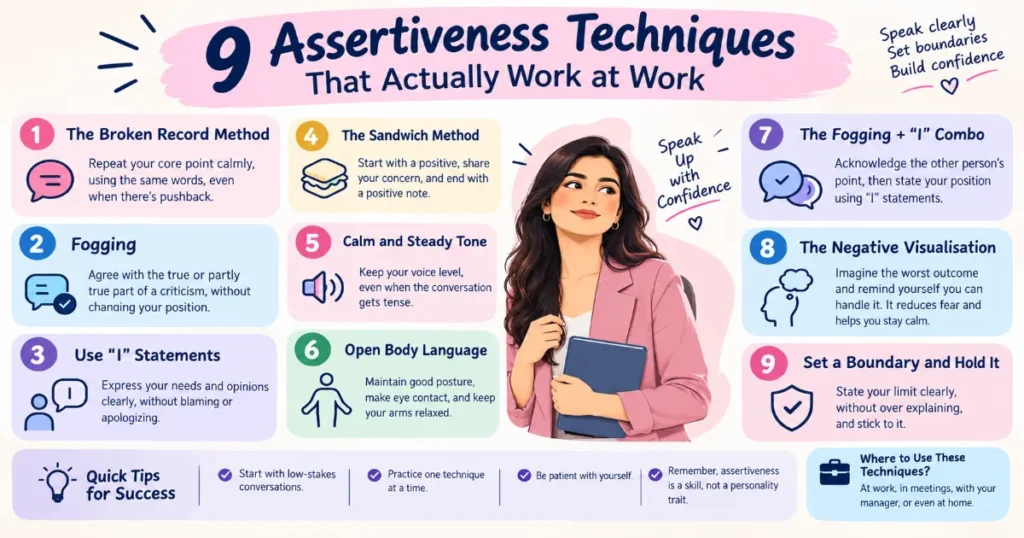
Each of these assertiveness techniques solves a slightly different problem. Pick the one that fits your situation.
Verbal Techniques
1. The Broken Record Method
Repeat your core point calmly, using the same words, every time the other person tries to argue or distract you.
Example: Your colleague keeps asking you to cover their shift. You say, “I cannot cover this weekend.” When they push back with reasons, you repeat, “I understand, and I still cannot cover this weekend.”
This technique works because it removes the temptation to invent new excuses each time, which is often where a firm no turns into a soft maybe.
2. Fogging
Calmly agree with any true or partly true part of a criticism, without agreeing to change your position.
Example: Your manager says, “You always take too long to reply to emails.” You respond, “You are right, I do take a while to reply sometimes. I still need the extra time to give a proper answer.”
Fogging works because it takes the emotional charge out of criticism. There is nothing left to argue with once you have agreed with the fair part.
3. “I” Statements
State your own feeling or need, instead of describing what the other person did wrong.
Example: Instead of “You never tell me about changes in advance,” try “I feel caught off guard when plans change without notice.”
The shift from “you” to “I” makes the other person less likely to get defensive, since you are describing your own experience, not accusing them.
4. Negative Assertion
Calmly agree with a real mistake, without adding excessive apology or self-criticism.
Example: “You are right, I did miss that deadline. I have already started on the report, and it will be ready by tomorrow.”
This technique disarms criticism quickly. Most people expect either defensiveness or over-apologising. A calm agreement, followed by a next step, often ends the conversation faster than either. This also helps when a coworker takes credit for your work, and you want to correct the record without a fight.
5. Negative Inquiry
Ask a calm follow-up question when criticism feels vague, so it becomes specific and useful.
Example: “You said my work has been sloppy lately. Can you tell me which project you mean, so I can fix it?”
This turns an unclear complaint into something you can actually act on, and it often reveals that the criticism was smaller than it first sounded.
6. DESC Script
Structure a difficult conversation in four parts. Describe the situation, express how it affects you, specify what you want, and state the Consequence or benefit.
Example: “When the report comes in late (Describe), it pushes my own deadline back (Express). Could you send it by Wednesday instead (Specify)? That would let me finish on time for the client call (Consequence).”
Nonverbal Techniques
Words are only part of the message. These three carry the rest of it.
7. Posture and Body Language
Stand or sit upright, with your shoulders relaxed rather than hunched. Avoid crossing your arms, since it can read as defensive even when you do not mean it that way. Our guide on body language in personality development goes deeper into this, with more postures and gestures you can practice.
8. Eye Contact
Hold steady, natural eye contact while you speak. According to Mayo Clinic, maintaining eye contact and a calm expression is a core part of communicating assertively. A relaxed posture and a steady voice matter just as much.
9. Tone of Voice
Keep your voice at an even pace and volume. A voice that is too quiet undercuts your words. A voice that gets louder under pressure can shift the moment from assertive to aggressive, without you meaning it to. This guide on the difference between aggression and assertiveness breaks down exactly where that line sits.
10 Assertive Sentence Examples for Work
Use these as a starting template, then adjust the wording to sound like you.
- “I need until Thursday to finish this properly.”
- “I am not able to take this on right now.”
- “I see it differently, and here is why.”
- “Can we agree on a deadline before we end this call?”
- “I would like to finish my point before we move on.”
- “That does not work for me. Here is what I can do instead.”
- “I noticed my name was left off the update. Can we fix that?”
- “I want to understand your concern better. Can you give me an example?”
- “I am comfortable saying no to this one.”
- “Let me think about it and get back to you by tomorrow.”
Example: Priya Uses the Broken Record Method
Priya works in customer support at a firm in Chennai. This is a fictional example, built to show how one technique plays out in real life.
A regular client kept asking Priya to bend the refund policy every month, always with a new reason. She had tried explaining the policy in detail each time, and it never seemed to land.
The next time it came up, Priya used the broken record method. She said, “I cannot approve this refund outside our policy.” When the client offered a new reason, she repeated the same sentence, calmly, without adding new explanations.
The conversation ended in under two minutes, compared to the usual back and forth that had taken up to twenty. Nothing about the policy changed. What changed was that Priya stopped inventing new justifications each time, which had been giving the client room to keep negotiating.
How to Practice These Assertiveness Techniques
Start small, with low-stakes situations, before you use these techniques in a high-pressure moment.
- Practice out loud once, even alone, before an important conversation. Hearing your own voice say the words once makes the real moment easier.
- Try one technique on a small, low-stakes situation first. A minor request you can decline is a good place to start, before using it on something that matters more.
- Write down what happened afterward. A quick note on what worked and what felt awkward helps you refine the technique for next time.
Building general self-awareness speeds this process up. You start noticing your own patterns of over-explaining or apologising sooner. These skills sit well alongside the other guides in our career and workplace growth section. If you tend to think before you speak, these techniques fit well alongside your natural personality development as an introvert.
These techniques also connect directly to two everyday workplace moments. Saying no to extra work often uses the broken record method. Speaking up in meetings benefits from clear “I” statements delivered with steady eye contact.
Conclusion
Assertiveness techniques are not about becoming a different person. They are specific tools, like the broken record method or fogging, that you can pick up one at a time.
Choose one technique from this guide. Practice it once, out loud, before your next difficult conversation. The words will come out clearer than they did for Manisha in that meeting, because this time, they will already be rehearsed.
Frequently Asked Questions
What are the three C’s of assertive communication?
Different sources define this slightly differently, so it is worth knowing both. The version more commonly cited, including by Psychology Today, is Clarity, Consistency, and Courtesy. A newer, less academic version uses Clarity, Confidence, and Control. Either framing points to the same core idea: being clear and calm rather than vague or harsh.
What are five assertive behaviors?
Steady eye contact, clear “I” statements, a calm tone, a firm boundary stated once, and openness to pushback without defensiveness. These five signs cover both the verbal and nonverbal sides of assertiveness.
Is assertiveness training based on CBT?
Assertiveness training grew out of behavior therapy in the 1950s. It shares some principles with CBT, though it is not the same thing. Many CBT programs include assertiveness techniques as one part of a broader toolkit, particularly for anxiety and workplace stress.
Can introverts use these assertiveness techniques too?
Yes, and often more comfortably than extroverts expect. The broken record method and the DESC script both work well when written out and practiced beforehand. That suits a more reflective communication style.

Ayanshi is the founder of PersonaGuru.in, a blog focused on personality development, career, relationships, and mental well-being. With over 3 years of writing experience, she turns psychology and everyday experiences into practical, easy-to-understand advice for real life.