

Teamwork in personality development means working with others toward a shared goal. It builds empathy, active listening, accountability, adaptability, and conflict-handling skills. These are the same skills that shape how people see you.
Nobody builds a personality alone. You grow when you share space, time, and problems with other people.
A mirror shows you your face. A team shows you your habits. You see how you react when someone disagrees. You see what you do when work piles up. You see if people trust you.
If you want the full picture, read this guide to personality development first. This article goes one step closer. It shows how teamwork in personality development plays out, which skills it builds, and how to practice them.
You will also see where teamwork goes wrong because it does.
Here is a situation almost every group faces. Five people share one presentation. Two days before the deadline, one person goes silent and misses her part.
The first reaction is anger. Most of the group wants to report her.
My HR training taught me to ask before judging. A private message like “Is everything okay?” often shows a different story. It could be a family problem. It could be a task she did not understand. It could be her health.
Once the group knows the reason, the plan changes. You reshuffle the work. You cover the slides together. You present as one team.
That is the real lesson. Teamwork is not about pushing people to meet deadlines. It is about making room for people when life gets in the way.
Key Takeaways
- Teamwork is a skill, not a fixed personality trait. You can train it.
- Seven skills grow fastest in a team: communication, active listening, empathy, accountability, adaptability, conflict resolution, and humility.
- A Stanford study found that people who felt part of a team stayed with a hard task 48 to 64 percent longer.
- Employers still ask for it. NACE’s 2026 survey lists teamwork among the top skills they look for on entry-level resumes.
- Teamwork has a bad side too. Free riding, groupthink, and one loud voice can hurt a group.
What Is Teamwork? Meaning in Personality Development
Teamwork is a group of people combining their efforts to reach one shared goal. In personality development, it matters because the group also shapes the person.
A team can be a college project group. It can be a cricket side. It can be a family planning a wedding.
The goal changes. The learning does not.
In every team, you practice the same things. You listen. You share the load. You handle people who think differently. Slowly, these habits become part of who you are.
Helen Keller put it simply: “Alone we can do so little; together we can do so much.”
Is Teamwork a Personality Trait?
Teamwork is not a personality trait. It is a skill. Traits like agreeableness make it easier, but anyone can train it.
A trait is a steady tendency, like being outgoing or careful. A skill is something you learn by doing. Psychologists describe traits with models like the Big Five. You can read more in this guide to Big Five personality traits.
So a shy person is not “bad at teams”. They may just need more practice.
7 Teamwork Skills That Build Your Personality
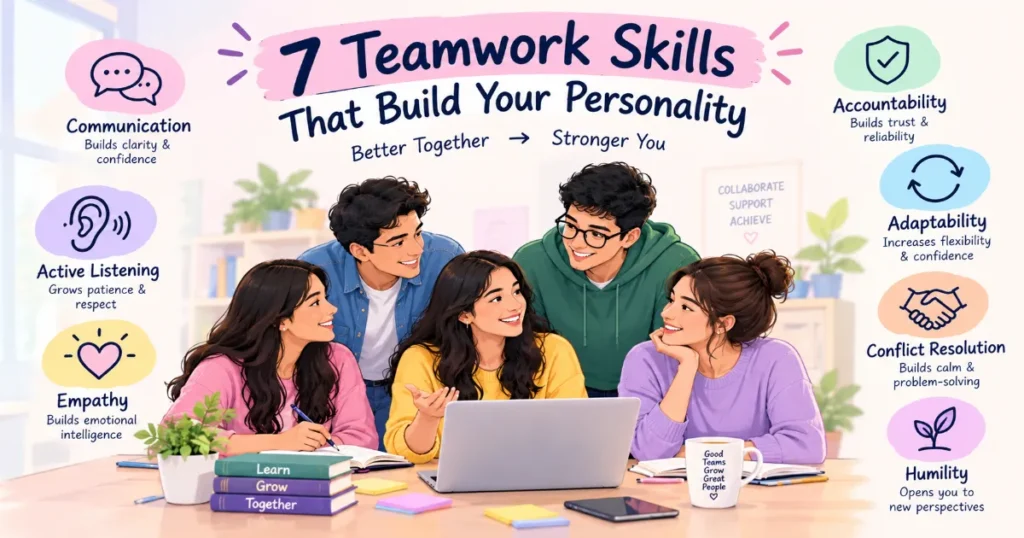
The 7 teamwork skills are communication, active listening, empathy, accountability, adaptability, conflict resolution, and humility.
There is no official list. This is a practical one. Each skill below is something teamwork in personality development makes you practice.
| Skill | What it builds in you | One daily practice |
|---|---|---|
| Communication | Clarity and confidence | Write your update in 3 lines |
| Active listening | Patience and respect | Repeat the point before you reply |
| Empathy | Emotional intelligence | Ask “What is hard for you right now?” |
| Accountability | Trust and reliability | Say who does what and by when |
| Adaptability | Flexibility | Accept one change without complaining |
| Conflict resolution | Calm under pressure | Attack the problem, not the person |
| Humility | Openness to feedback | Ask “What can I do better?” |
1. Communication
Most team problems start with unclear words. One person says “soon”. Another hears “today”.
Teamwork teaches you to be specific. You learn to say what you need, by when, and why.
Tip: End every message with one clear ask. Example: “Please send your slides by Thursday 5 pm.”
2. Active Listening
In a group, everyone wants to talk. Few people listen.
When you listen fully, people feel heard. They trust you faster. You also catch details that others miss.
Tip: Before you answer, say the other person’s point back in your own words. Our step-by-step guide on how to practice active listening skills has more drills.
3. Empathy
Your teammate may be quiet because of stress at home. Or because they do not understand the task. You will not know unless you ask.
Teams push you to look beyond your own view. This is how empathy grows. Read more on the role of empathy in personality development.
Tip: Ask one real question in every meeting. “How is your part going?” works well.
4. Accountability
Imagine four students share a presentation. Three finish their slides. One says, “I will do it tonight,” and does not.
The group now has a problem. And the missing slide has a name on it.
Accountability means you do what you said, or you tell the team early. Both build trust.
Tip: Write down who owns each task and the date. Keep it where everyone can see it.
5. Adaptability
Plans change. A teammate falls sick. A client moves the deadline.
Teams train you to adjust without panic. You learn to ask, “What can we still do?”
Tip: When plans change, take one minute. List what stays the same and what must change.
6. Conflict Resolution
Disagreement in a team is normal. It is not a sign of failure.
What matters is how you handle it. You can attack the person or fix the problem. Only one of these works.
Tip: Use this line: “I see it differently. Can I share why?” For more, read these communication tips for conflict resolution.
7. Humility
Good team members can say, “I was wrong”. They can also say, “Your idea is better”.
Humility does not make you weak. It makes you easy to work with.
Tip: After a project, ask one teammate, “What is one thing I could do better next time?” Then listen without defending yourself.
Many people think silence keeps the peace. It does not.
When you swallow your opinion, the problem does not go away. It sits there. Over time, it turns into resentment.
Speaking up works better. Keep your words soft. Keep your focus on the problem, not on the person. Most teammates respect that.
Disagreement does not break a good team. Avoiding it does.
Personality Traits That Help in Teamwork
Some traits make teamwork in personality development feel easier. The Big Five model gives a handy way to look at them.
| Trait | How it shows up in a team | Watch out for |
|---|---|---|
| Agreeableness | Kind, cooperative, easy to talk to | Saying yes to everything |
| Conscientiousness | Reliable, organized, on time | Becoming too strict |
| Emotional stability | Stays calm when stress rises | Hiding real concerns |
| Openness | Welcomes new ideas | Dropping tasks for new ideas |
| Extraversion | Energizes the group, speaks up | Talking over others |
Notice the “watch out” column. Every trait has a cost. No trait is a perfect fit for every team.
Can Introverts Be Good Team Players?
Yes. Introverts often make strong team players because they listen well, prepare early, and think before they speak.
They may not speak first in a meeting. But their ideas are often well thought out.
If you are an introvert, try sending your ideas in writing before the meeting. Our guide on personality development for introverts has more tips.
5 Examples of Teamwork
Five everyday examples of teamwork are a college group project, a cricket or kabaddi team, a family function, a hospital shift team, and an office project.
Here is what each one teaches.
1. A College Group Project
You split the work, set a deadline, and merge everything the night before. You learn who is reliable and who needs reminders.
2. A Cricket or Kabaddi Team
You may be the best batter. But if the team loses, you lose too. Sports teach you to put the group first.
3. A Family Function
Think of a wedding at home. Someone handles food. Someone handles guests. Someone handles money. No one can do it all. It is teamwork with real emotions.
4. A Hospital Shift Team
A nurse hands over patient notes to the next shift. One missing detail can cause harm. Clear handovers show why communication matters.
5. An Office Project
A sales lead, a designer, and a developer work on one launch. Each person has a different job. The launch only works if all three share updates.
What Are the 5 C’s of Teamwork?
There is no single official list. One common version names five C’s: communication, collaboration, commitment, confidence, and conflict resolution.
Different authors use different words. So do not memorize a list for an exam without checking your syllabus.
What matters is the idea. A strong team talks, shares the work, stays committed, trusts each other, and settles disagreements.
What Are the 5 Stages of Teamwork?
The five stages of teamwork are forming, storming, norming, performing, and adjourning. Psychologist Bruce Tuckman proposed the first four in 1965. He added adjourning in 1977 with Mary Ann Jensen.
Each stage also teaches you something about yourself.
| Stage | What happens | What you learn about yourself |
|---|---|---|
| Forming | Members meet and test the waters | How you act around new people |
| Storming | Disagreements appear | What your conflict style is |
| Norming | Roles and rules settle | How you adjust to group habits |
| Performing | The team works smoothly | What it feels like to trust others |
| Adjourning | The project ends | How you handle goodbyes and closure |
Most people want to skip storming. Do not. This is where the real growth happens.
Team Building in Personality Development
Teamwork and team building sound alike. They are not the same.
Teamwork vs Team Building
Teamwork is the daily act of working together. Team building is a planned activity that helps a group work together better.
A quiz or a game can help a group bond. But it will not fix a team that never shares updates.
Use team building as a start. Real teamwork is what you do on ordinary Tuesdays.
Why Teamwork Matters: 10 Benefits for You
Teamwork in personality development pays off in ways that go beyond one project.
A Stanford study by Gregory Walton and Priyanka Carr ran five experiments. People who were told they would work “together” with someone else persisted 48 to 64 percent longer on a hard task. The group did not need to meet. Simply feeling part of a team raised motivation.
Employers also care. The NACE Job Outlook 2026 survey covered 185 employers between February 12 and March 17, 2026. Employers reviewing Class of 2026 entry-level resumes said they look for polished teamwork, problem-solving, and communication skills. NACE is a US association, so check local job ads too.
Google studied 180 teams for two years in its Project Aristotle research. It found that psychological safety mattered most. Amy Edmondson, who introduced the term, describes it as a shared belief that the team is safe for taking interpersonal risks.
In plain words, people do better when they can speak up without fear.
Here are 10 benefits you can expect from regular teamwork:
- You get better at explaining your ideas.
- You learn to listen before judging.
- You build empathy for people who think differently.
- You become more reliable.
- You handle disagreement with less stress.
- You get feedback you would never give yourself.
- You learn to share credit.
- You stay motivated on hard tasks.
- You make stronger professional connections.
- You build a skill employers ask for.
When Teamwork Goes Wrong
Most articles skip this part. But you will face it, so here it is.
Free Riding
One person does little and takes equal credit. The rest get tired and angry.
What to do: Give each person a named task and a date. Talk to the person privately first. Ask what is blocking them.
Groupthink
Everyone agrees because no one wants to disagree. Psychologist Irving Janis described this in 1972. Bad decisions follow.
What to do: Ask one person to play the doubter in every important decision.
When One Person Dominates
One loud voice takes over. Quiet members stop sharing.
What to do: Go around the room once. Let everyone speak for one minute before any debate.
Remote and Hybrid Teams
Written messages can sound rude when you did not mean it. Silence can look like a lack of interest.
What to do: Add a short greeting and a clear ask to every message. Use a call when a chat goes back and forth more than three times.
How to Practice Teamwork Skills
Practicing teamwork in personality development does not need a course. It needs small, repeated actions. Try this 5-step plan.
- Say yes to one group task this week. A study group or a family event counts.
- Reflect after the project. Write what went well and what did not. Use two lines each.
- Ask for feedback. Pick one person and ask one clear question.
- Work with someone different. Choose a person with a different style or background.
- Volunteer. A local drive or a college event puts you in a mixed team fast.
Pair this with other habits. Our post on interpersonal skills and social intelligence can help. Both build on the same base as emotional intelligence.
A Quick 5 Question Self-Check
Answer each with Yes (2 points), Sometimes (1 point), or No (0 points).
- Do I finish my part on time without being reminded?
- Do I listen to the end before I reply?
- Do I ask for help early?
- Can I accept feedback without getting defensive?
- Do I give credit to others in public?
Score 8 to 10: You are a strong team player. Keep it up. Score 5 to 7: You are growing. Pick one weak area and work on it for two weeks. Score 0 to 4: Start with one skill. Active listening is a good first choice.
This is a simple self-check, not a scientific test.
Final Thoughts
Teamwork in personality development is one of the fastest ways to grow. Not because it is easy. But because it shows you who you really are.
You will fail at some parts. That is fine. Each rough project teaches you something no book can.
Aristotle is often quoted as saying, “The whole is greater than the sum of its parts.” A good team proves it. And so does a good person who learns from one.
So pick one skill from this article today. Practice it in your next group task. Then come back and pick the next one.
FAQs
How does teamwork help personal development?
Teamwork in personality development helps you grow by making you practice communication, empathy, accountability, and conflict handling with real people. You learn faster than you would alone. You also get honest feedback.
How do I show teamwork in an interview?
Share one real example with a clear result. Say what the goal was, what your part was, and what the team achieved. For more tips, see our guide on top interview skills.
What should I do if my teammates do not do their work?
Talk to them privately and ask what is blocking them. Then agree on a clear task and a date. If nothing changes, tell your lead early. Do not wait for the last day.

Ayanshi is the founder of PersonaGuru.in, a blog focused on personality development, career, relationships, and mental well-being. With over 3 years of writing experience, she turns psychology and everyday experiences into practical, easy-to-understand advice for real life.