
Every school and college in India has that one cadet who stands a little straighter in the assembly line. Uniform pressed. Shoes polished. Answering with a sharp “Yes Sir” when called. This is not an accident. Three years of NCC training builds this into a teenager, one drill session at a time— and it is exactly this kind of structured routine that makes the role of NCC in personality development so different from a classroom lecture.
The National Cadet Corps has grown from 17 lakh to close to 20 lakh cadets as of January 2026, according to Director General Lt Gen Virendra Vats. But the number is not the real story. The real story is what happens inside a cadet during weekend parades, summer camps, and drill sessions. The role of NCC in personality development goes far beyond marching in a straight line. It quietly reshapes how a young person thinks, speaks, and carries themselves.
This article breaks down exactly how that change happens, backed by real data and NCC’s own training structure.
Key Takeaways
- NCC cadets train not only for defence careers but for leadership roles in any field they choose.
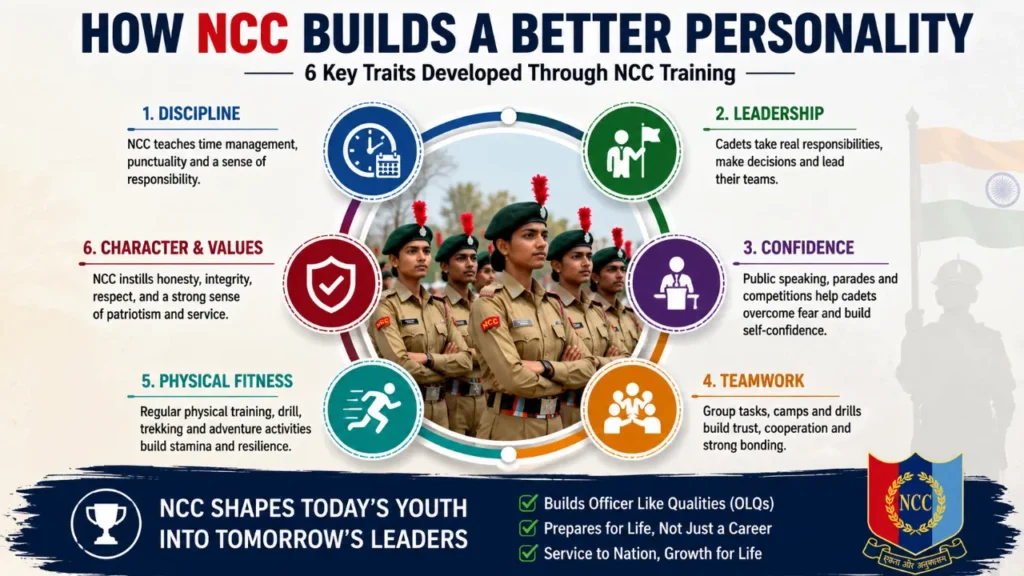
- NCC builds six core personality traits: discipline, leadership, confidence, teamwork, physical fitness, and ethical character.
- Cadets get hands-on leadership practice through rank responsibilities like Corporal, Sergeant, and Under Officer.
- NCC training directly develops Officer-Like Qualities (OLQs), the same traits assessed during SSB interviews for the armed forces.
- As of January 2026, NCC strength stands at nearly 20 lakh cadets, with girls making up around 40 percent of the total.
What Is NCC? A Quick Background
NCC stands for National Cadet Corps. It was formed in 1948, a year after India’s independence, based on the recommendations of a committee headed by Pandit Hriday Nath Kunzru.
It runs as a joint effort of the Army, Navy, and Air Force, working inside schools and colleges across the country. Students from Class 9 onward can join as cadets, with training on weekends and annual camps.
The motto of NCC is simple: Unity and Discipline. Those two words explain most of what the organisation tries to build in every cadet, and they are the starting point for understanding the role of NCC in personality development in practical terms.
What Is the Role of NCC in Personality Development?
The role of NCC in personality development is to place teenagers in situations that demand discipline, responsibility, and quick decisions, then let them repeat those situations until the behaviour becomes natural. That is the short answer. Here is what it looks like on the ground.
1. Discipline Becomes a Habit, Not a Rule
Ask any cadet what NCC taught them first, and most will say the same thing: time management.
Parades start on time. Uniforms follow a strict code. Late arrivals get noticed instantly. This is repetition, and repetition is what turns a rule into a habit. A student who learns to wake up at 5 AM for drill practice twice a week rarely struggles with deadlines later in life. That habit carries into exams, job interviews, and workplace routines— the same internal drive that shapes motivation in personality development more broadly.
2. Leadership Through Real Responsibility
Most school activities hand leadership roles to a handful of toppers. NCC works differently.
Cadets earn ranks like Lance Corporal, Corporal, Sergeant, and Under Officer based on performance, not just marks. Each rank comes with real duties. A Sergeant has to organise a squad, settle small disputes, and answer for the team’s mistakes.
This is leadership by doing, not leadership by reading a chapter on management. A shy student who becomes a squad leader for even one camp often walks away with a different sense of what they are capable of— a hands-on version of how personality development enhances leadership quality in general.
3. Confidence Built on a Parade Ground
Public speaking fear is common among teenagers. NCC chips away at it early.
Cadets give commands in front of their entire unit. They present reports to officers. They compete in drill competitions where every eye is on them. There is nowhere to hide on a parade ground.
One NCC cadet, sharing her experience in a camp talk video, said NCC changed her from someone who avoided social situations into someone who could walk up and start a conversation with a stranger. That kind of shift rarely comes from a classroom alone.
4. Teamwork That Extends Beyond the Classroom
NCC camps run for days, sometimes weeks. Cadets share tents, share duties, and depend on each other for everything from cleaning to cooking.
This forces cooperation in a way that group projects at school never do. You cannot skip your share of the work when your bunkmate is depending on you.
5. Physical Fitness and Mental Toughness
Drill practice, obstacle courses, route marches, and adventure activities like trekking and rock climbing are part of regular training.
The physical side matters, but the bigger gain is mental. Cadets learn to push through discomfort. A five-kilometre route march at dawn teaches patience and grit in a way no lecture can.
6. Character and Ethical Grounding
NCC training includes lessons on national integration, social service, and citizenship. Cadets take part in blood donation camps, tree plantation drives, and disaster relief work— the kind of hands-on character building in personality development that no textbook chapter can replicate.
During Operation Sindoor, about 75,000 NCC cadets were deployed to assist civil administration, including voluntary blood donation and medical support, according to the Director General of NCC. That is not textbook patriotism. That is a teenager stepping up during a real crisis.
6 Ways NCC Plays a Role in Personality Development (Recap)
- Discipline through daily routine
- Leadership through real rank responsibility
- Confidence through public performance
- Teamwork through shared camp life
- Physical fitness through training and adventure activities
- Character through service and ethics
The infographic below summarizes the six core personality traits that NCC helps students develop through regular training, camps, and leadership activities.
5 Areas of Personality Development NCC Focuses On
NCC training is not random. It is structured around five broad areas of growth, and together they explain the full role of NCC in personality development rather than just one side of it.
| Area | What It Covers | How NCC Builds It |
|---|---|---|
| Physical | Fitness, stamina, coordination | Drill, PT, route marches, adventure camps |
| Mental and Emotional | Focus, stress handling, patience | High-pressure camps, timed tasks |
| Social | Communication, cooperation | Team duties, community service |
| Intellectual | Decision making, awareness | Map reading, current affairs, planning tasks |
| Moral | Integrity, discipline, respect | Code of conduct, rank accountability |
Every camp, every drill session, every parade touches at least one of these five areas without the cadet even realising it.
How NCC Builds Officer Like Qualities (OLQs)
If a cadet plans to appear for the Services Selection Board someday, NCC gives them a head start most candidates never get.
OLQs are the exact traits SSB assessors look for, and NCC training builds them naturally.
- Initiative. Cadets are often given a task with minimal instructions and expected to figure out the rest.
- Decision-making under pressure. Camp schedules change without warning. Cadets adapt on the spot.
- Adaptability. Moving between drill, academics, and camp life within the same week builds flexibility.
- Integrity. A cadet who reports a mistake honestly earns more respect than one who hides it.
A research paper published in the International Research Journal of Humanities and Interdisciplinary Studies noted that NCC’s leadership camps and adventure activities directly strengthen initiative, adaptability and cooperation among cadets, the same qualities that later help them clear officer selection processes.
What Is the Role of NCC in National Development?
NCC does not stop at shaping individuals. It plays a visible role in the country’s response to emergencies and social needs.
Cadets assist during floods, earthquakes and other disasters. They run vaccination drives, literacy campaigns and cleanliness programmes in villages. Prime Minister Narendra Modi, himself a former NCC cadet, has spoken about this directly, saying NCC cadets are always present whenever there is a disaster, whether floods, earthquakes or accidents.
This is the quiet, unglamorous side of NCC. It rarely makes headlines, but it builds a generation that shows up when it matters.
Benefits of Joining NCC
Beyond personality growth, NCC offers practical advantages that many students overlook.
- Bonus marks and reserved seats in several colleges and universities for NCC certificate holders.
- Direct entry benefits in the Combined Defence Services exam for top-performing ‘C’ certificate holders.
- Career exposure to the Army, Navy and Air Force before committing to a defence career.
- Certificates that add weight to a resume, showing recruiters proof of discipline and leadership.
- A stronger, more grounded personality, which honestly matters more than any certificate on paper.
If a student cannot join NCC, working through structured self-improvement exercises, such as a Johari Window self-check or a Locus of Control assessment, can build several of the same self-awareness and discipline skills through guided, hands-on practice.
Quick Facts About NCC
A few numbers help put the role of NCC in personality development into perspective.
- NCC was raised in 1948 and is one of the largest uniformed youth organisations in the world.
- Total cadet strength stood at close to 20 lakh as of January 2026, according to Director General Lt Gen Virendra Vats.
- Girls now make up around 40.68 percent of total NCC strength, up from 35.50 percent in 2021, based on the official enrollment data released by the Ministry of Defence.
- The organisation runs through 17 state and union territory directorates.
- You can read more about how the programme was originally structured on NCC’s official history page.
Final Thoughts
The role of NCC in personality development does not show up in a single test score. It shows up years later, in how a former cadet handles pressure at work, speaks up in a meeting, or takes charge when something goes wrong.
As one former cadet put it during an NCC camp talk session, NCC does not just train your body. It rebuilds how you see yourself.
If you are a student on the fence about joining, the parade ground discipline might feel tough in the first few weeks. Give it three months. Most cadets say that is exactly when the change starts to show.
FAQs
1. Was Narendra Modi an NCC cadet?
Yes. Prime Minister Narendra Modi was an NCC cadet during his school days. He has spoken about it publicly on NCC’s Raising Day, crediting it for building discipline and leadership in him early on.
2. Who is called the father of NCC in India?
Pandit Hriday Nath Kunzru is widely regarded as the father of NCC. He chaired the Cadet Corps Committee formed in 1946, and its recommendations led directly to the formation of NCC in 1948.
3. What is the motto of NCC?
The motto of NCC is Unity and Discipline. It reflects the two core values the organisation tries to build in every cadet.
4. What are the three main objectives of NCC?
NCC’s three main objectives are to develop character, courage, discipline, and leadership among youth, to create a pool of trained and motivated young people who can serve the nation in any field, and to provide a steady stream of officers for the Armed Forces.

Ayanshi is the founder of PersonaGuru.in, a blog focused on personality development, career, relationships, and mental well-being. With over 3 years of writing experience, she turns psychology and everyday experiences into practical, easy-to-understand advice for real life.