

How do you disagree with your boss? Start by agreeing on the shared goal. Share your view using facts or a question, not a flat “you are wrong.” End with one clear alternative. Choose a private moment, keep your tone calm, and accept that your boss makes the final call, even if they don’t choose your idea.
Your boss just approved a plan you think is a mistake. You can see the problem clearly. Everyone else in the room is nodding along.
Do you speak up, or do you let it go?
Most people choose silence. It is not that they lack opinions. They are just not sure how to disagree with their boss without sounding like they are arguing, so they never learn how to disagree with their boss the right way. The good news is that disagreeing well is a skill, not a personality trait. This guide gives you the exact steps, scripts, and an email template to use the next time this happens.
I write about workplace communication on PersonaGuru.in. My background is in HR. Learning how to disagree with your boss is one of the moments I see people freeze on most often. It is rarely a lack of ideas. It is not knowing how to say them.
Key Takeaways
- Decide if the disagreement is worth raising before learning how to disagree with your boss on a specific issue.
- Start with the shared goal, not the disagreement itself.
- Use facts or a question instead of a flat “you are wrong.”
- Offer one clear alternative, not a list of complaints.
- Accept the final decision calmly, even if your idea is not chosen.
Should You Say Something, or Stay Quiet?
Weigh the risk of staying silent against the risk of speaking up. If staying quiet could hurt the outcome, the project, or your team, it is usually worth raising.
Harvard Business Review contributing editor Amy Gallo has described this as a simple risk comparison. Before you speak, ask what could go wrong if you say nothing. Then ask the same question about speaking up.
Research from Lehigh University psychologist Dominic Packer points to something useful here. People who care the most about a group’s success are often the ones most willing to raise a concern. It is rarely the people who care the least. Disagreeing well is not disloyalty. It is frequently the opposite.
Not every disagreement is worth a conversation. Save your energy for the ones that affect the outcome, your team, or a real risk down the line. That judgment call is really the first step in learning how to disagree with your boss well.
How to Disagree With Your Boss in 3 Steps
Start with the shared goal, share your view with facts instead of blame, then offer one clear alternative. This structure is really what how to disagree with your boss professionally looks like in practice, and it keeps the conversation calm and focused.
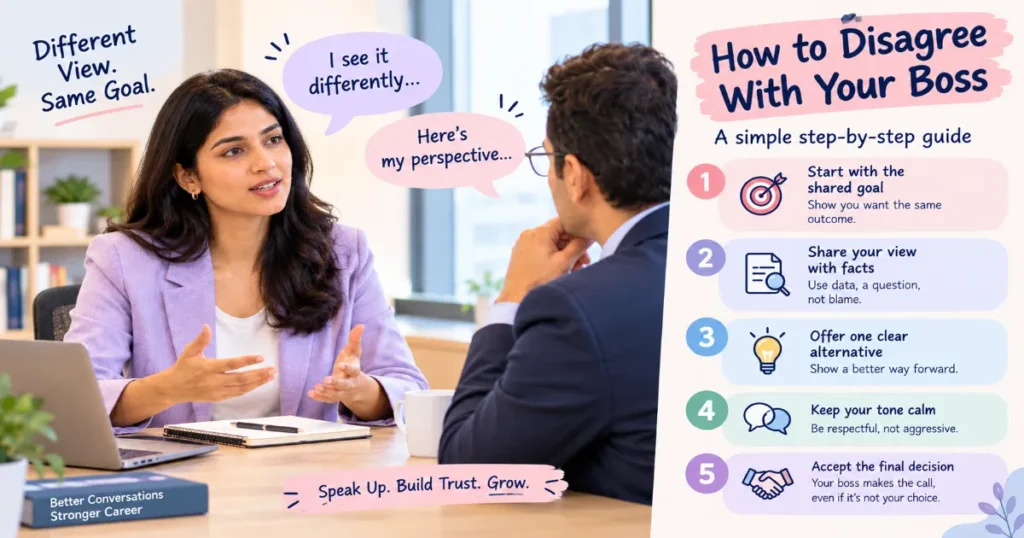
Step 1: Start with the shared goal
Open by showing that you want the same outcome they do. This single move changes the entire tone of the conversation.
Try this: “I know we both want this launch to go smoothly. I wanted to share a concern before we lock the plan in.”
Step 2: Share your view with facts, not blame
Avoid “you are wrong” or “this will not work.” Use a fact, a number, or a specific question instead.
Executive coach Melody Wilding, who has coached leaders at Google and Amazon, has shared similar language for this exact moment. Here are five ready phrases:
- “That’s a fair point. I would also add that the timeline might be tight given the current workload.”
- “I would like to add a nuance to that. The last time we tried this approach, response times slowed down.”
- “My concern with that approach would be the client’s turnaround time. Could we build in a buffer?”
- “I want to make sure we are seeing the same data. Can I walk you through what I found?”
- “Help me understand the thinking here. What made this option stand out over the other one?”
Step 3: Offer one clear alternative
A disagreement without an alternative sounds like a complaint. One with an alternative sounds like a contribution. That is the real skill behind how to disagree with your boss well.
Try this: “Given the timeline risk, could we split this into two phases instead of one?”
Assertive, not aggressive, is the goal here. This guide on the difference between aggression and assertiveness explains exactly where that line sits. This skill also feeds into your wider career and workplace growth.
How to Ask Permission to Disagree
Before making your case, ask a short question that signals you are about to share a different view. This small step lowers the other person’s defenses before you even start.
Communication coach Dr. Laura Sicola recommends this as one of the simplest ways to soften a disagreement without softening the point itself. If you only remember one line from this guide on how to respectfully disagree with your boss, make it this one.
Try this: “Would it be okay if I shared a different take on this?”
Most people say yes, and the permission itself changes how they listen to what comes next.
How Do You Disagree With Your Boss in an Email?
Keep the email short, lead with the shared goal, and end with one specific ask. Knowing how to disagree with your boss in email matters just as much as knowing what to say out loud, since it creates a written record that is useful for decisions affecting a team or a timeline.
Email template
Subject: Quick thought on the Q3 rollout plan
Hi Rohan,
I know we both want the Q3 rollout to go smoothly. Before we finalise the plan, I wanted to flag one concern.
The current timeline overlaps with the vendor’s maintenance window, which could delay testing by a few days. Would it help to move the testing phase up by a week, or should we build in a buffer instead?
Happy to walk through the details whenever works for you.
Best, Aditi
When email works better than a live conversation
Email works well when the topic involves numbers or a timeline you want documented, or when you need time to phrase it carefully. A live conversation works better when the topic is sensitive or needs back-and-forth discussion.
Disagreeing With a Senior Leader, Not Just Your Direct Manager
Use the same three steps, but add one more layer of formality and give them more room to ask questions before you offer your alternative.
Senior leaders often have context you do not. Instead of leading with your alternative, lead with a question that invites their view first.
Try this: “Before I share my thinking, I would love to understand the constraints you are working with on this.”
This does two things. It shows respect for what they know that you might not. It often reveals information that changes your own view before you even make your case.
Example: Rohan Disagrees With a Risky Deadline
Rohan works in operations at a logistics firm in Pune. This is a fictional example, built to show the difference one structured conversation can make.
His manager set a delivery deadline that skipped a required quality check. Rohan thought it was risky, but he was not sure how to raise it without sounding like he was questioning his manager’s judgment.
| Approach | What happened |
|---|---|
| Stay silent | Rohan says nothing. The shipment goes out on time, but a quality issue is found later, causing a bigger delay. |
| Structured disagreement | Rohan opens with the shared goal, shares the specific risk with a fact, and offers a one-day buffer as an alternative. |
With the structured approach, his manager adjusted the timeline by one day. The shipment went out on time, and the quality check still happened. Nothing about Rohan’s role changed. What changed was that he gave his manager a clear, fact-based alternative instead of staying quiet or sounding critical.
What to Do If Your Boss Reacts Badly
Stay calm, do not match their tone, and give the conversation room to settle before you push further.
Stay calm; do not match their tone
If your boss raises their voice or sounds defensive, keep your own voice steady. Matching their energy usually escalates the moment rather than resolving it.
Try this: “I hear you. Let’s take a moment and come back to this.”
Accept the final decision
Your boss makes the final call, even when you disagree with it. Say so clearly, and mean it.
Try this: “I have shared my concern, and I trust your call on this. I am fully on board moving forward.”
When to loop in HR
If disagreeing respectfully leads to repeated hostility, being sidelined, or retaliation, that is no longer a communication issue. These tips for effective conflict resolution can help with the earlier stages, but a pattern like this is worth raising with HR.
Disagreeing With Your Boss in the Indian Workplace
Hierarchy carries more weight in many Indian workplaces. Softening the opening slightly, without softening the point, usually lands better.
Leading with respect for the person’s position, not just the idea, matters here. A line like “I want to respect your experience on this, and I also have a concern” does real work before you share the concern itself.
This does not mean staying silent. It means pairing the same three-step structure with a tone that acknowledges seniority explicitly, rather than assuming it is understood.
Conclusion
Knowing how to disagree with your boss does not have to feel like a gamble.
Start with the shared goal. Share your view with facts, not blame. Offer one clear alternative, and accept the final call with grace.
Pick one phrase from this guide and keep it ready. The next time you need to disagree with your boss, you will already know exactly what to say.
If you want to make your voice heard in more everyday moments, these assertiveness techniques and the factors that shape assertiveness are good places to continue. And if a coworker keeps steering meetings away from your points before you even get this far, here is how to handle miscommunication at work early, before it becomes a bigger issue.
Frequently Asked Questions
Can I get fired for disagreeing with my boss?
Disagreeing respectfully, on its own, is rarely a firing offense. Repeated hostility, ignoring a final decision, or disagreeing in a way that undermines your boss publicly is a different matter. The structure in this guide is built to avoid exactly that risk.
How do I disagree without sounding rude?
Lead with the shared goal, use facts instead of blame, and keep your tone calm. This is really what how to disagree with your boss respectfully comes down to. Rudeness usually comes from tone and timing, not from the disagreement itself.
What if my boss never changes their mind?
You are not responsible for the outcome, only for raising the concern clearly. Share your view once, with a clear alternative. If they still choose differently, accept the decision and move forward without resentment.
Is it okay to disagree in a group meeting?
A quick, light addition is fine. Save the fuller disagreement for a private follow-up. Publicly disagreeing in detail can put your boss on the spot, which often backfires regardless of how reasonable your point is.

Ayanshi is the founder of PersonaGuru.in, a blog focused on personality development, career, relationships, and mental well-being. With over 3 years of writing experience, she turns psychology and everyday experiences into practical, easy-to-understand advice for real life.