

Factors leading to demotivation in personality development are fear of failure, a fixed mindset, unclear goals, burnout, no feedback, unsupportive people, comparison with others, goals that belong to someone else, and life pressure. Four come from inside you. Five come from outside.
Think about last January. You joined a gym. You bought a planner. You told your friends about your new goals.
By March, you had stopped.
Most people go through this. There is always a reason behind it, and you can find it.
This guide explains nine causes of demotivation. These are the factors leading to demotivation in personality development that people face most often. Each cause has a simple solution. At the end, there is a short self-check.
If you are new to this topic, read our guide to personality development first.
I studied HR in my MBA. We learned that low motivation always has a cause. I now ask “why” first, even for myself.
Key Takeaways
- Every fall in motivation has a reason. Find the reason first.
- There are nine common factors of demotivation. Four are inside you. Five are outside.
- Removing a problem does not create motivation. You also need a reason to move ahead.
- Gallup found that only 20% of employees worldwide were engaged at work in 2025.
- If you feel low for many weeks, talk to a doctor or counsellor.
What Is Demotivation in Personality Development?
Demotivation is when you lose the interest or energy to work on yourself. It happens because of a specific reason, such as failure, pressure, or lack of support.
The word “specific” matters. Demotivation usually starts at one point. A bad result. A harsh comment. A month of too much work.
You were motivated before. Something changed that.
This is why the factors leading to demotivation in personality development are worth knowing. When you know the cause, you can fix it.
Demotivation vs Lack of Motivation vs Burnout
These three look the same from the outside. They are different.
| Term | Meaning | Example |
|---|---|---|
| Demotivation | Motivation fell for a reason | You stopped practicing after a harsh review |
| Lack of motivation | Motivation never started | You never felt interested in the goal |
| Burnout | Long-term tiredness from stress | You feel tired even after rest |
The World Health Organization describes burnout as “a syndrome conceptualized as resulting from chronic workplace stress that has not been successfully managed.” You can read the full wording in the WHO statement on burnout. WHO uses this term for work only.
What Are the Factors Leading to Demotivation?
The main factors leading to demotivation are fear of failure, a fixed mindset, unclear goals, burnout, no feedback, toxic people, comparison with others, goals that are not your own, and life pressure.
Here is a quick look at the factors of demotivation.
| # | Factor | What you think | Quick fix |
|---|---|---|---|
| 1 | Fear of failure | “What if I fail again?” | Start with a very small step |
| 2 | Fixed mindset | “I am not that type of person” | Add the word “yet” |
| 3 | Unclear or very big goals | “Where do I start?” | Set a 10-minute goal |
| 4 | Burnout | “I am tired of everything” | Cut your list in half |
| 5 | No feedback | “Nobody notices my work” | Ask one person for honest input |
| 6 | Toxic people | “They think I will fail” | Share less with them |
| 7 | Comparison | “Everyone is ahead of me” | Compare with your past self |
| 8 | Goals of others | “I am doing this for them” | Write your own reason |
| 9 | Life pressure | “I have no energy left” | Lower the target, do not quit |
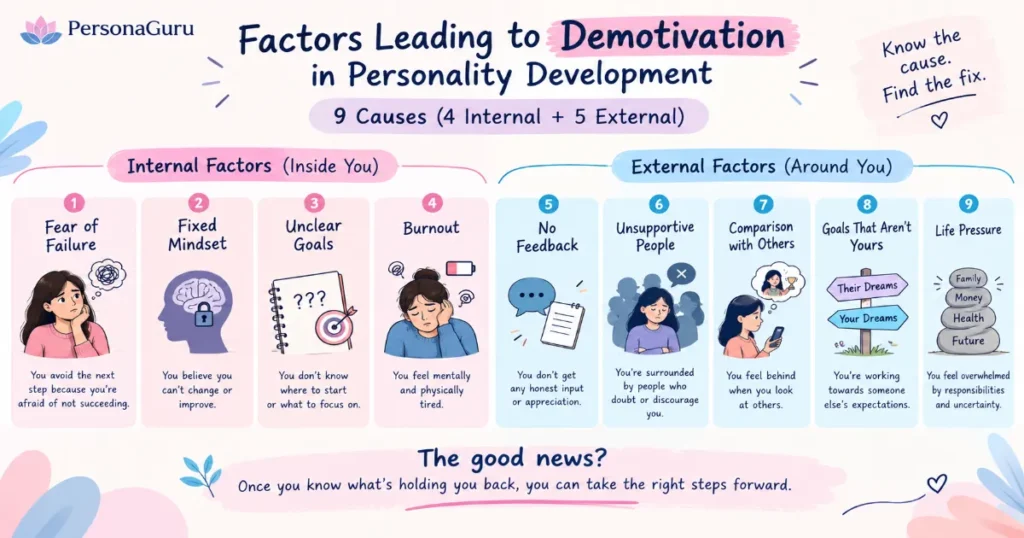
Internal Factors (Inside You)
The first four factors leading to demotivation in personality development start in your own mind. You have the most control over these.
1. Fear of Failure and Self-Doubt
You avoid the next step because the last one hurt.
Take a student named Riya. She failed one SSC mock test. Now she skips every mock test. She knows the syllabus well. She is afraid of the score.
Signs:
- You keep saying “I will start tomorrow”.
- You feel happy when plans get cancelled.
- You avoid anything that will be graded.
Fix: Start with a very small step. Attempt five questions, not the full paper.
Read our guide on how to overcome fear of failure. If doubt keeps coming back, try these steps to stop self-doubt at work.
2. Fixed Mindset
“I am not good at speaking.” “Maths is not for me.” Many people say this without thinking.
Psychologist Carol Dweck calls this a fixed mindset. You believe your skills cannot change. So you stop trying.
Fix: Add one word to the sentence. “I am not good at speaking yet.” Then practice for five minutes a day. Our guide on how to adopt a growth mindset has more ideas.
3. Unclear or Very Big Goals
“Become a better person” is not a clear goal. You cannot measure it.
“Speak fluent English in 30 days” is also a problem. By day ten, you feel far behind.
Fix: Choose a goal you can finish in one sitting. For example, “Speak for two minutes in tomorrow’s meeting.” Use these steps for goal setting that works.
4. Burnout From Doing Too Much
Self-improvement can become a second job. Wake up at 5. Gym. Reading. Online course. Journal.
Two weeks later, you do not want to do any of it.
Signs:
- You feel tired even after sleep.
- You do not want to start your own routine.
- You stop caring about the results.
Fix: Cut your list in half. Keep only one habit for a week. Try these stress management techniques for personal growth.
External Factors (Around You)
The next five factors leading to demotivation in personality development come from people and events. You cannot always change them. You can change how you respond.
5. No Feedback or Recognition
When nobody notices your effort, you cannot tell if it is working.
Gallup tracks engagement at work. Its report says, “In 2025, 20% of employees worldwide were engaged at work.” That was down from 21% in 2024, as per the Gallup State of the Global Workplace 2026 report.
Engagement is close to motivation, but it is not the same thing. Still, the number shows how common this problem is.
Fix: Do not wait for praise. Ask one trusted person, “What am I doing well? What should I improve?” Every Friday, write down your own wins.
6. Toxic or Unsupportive People
A boss who laughs at your ideas. A friend who mocks your plan. A relative who says, “Leave all this and take a stable job.”
Words like these stay in your mind. Slowly, you start to believe them.
Fix: You do not need to cut anyone off. Share less with people who mock you. Set limits. Our guide on setting boundaries with toxic people explains how.
7. Comparison With Others
You open Instagram. A classmate got a big job. A cousin bought a car. Your own progress looks small.
People post their wins. They do not post their struggles.
Fix: Compare yourself with the person you were three months ago. Mute accounts that make you feel behind. Read how to stop comparing yourself to others.
8. Goals That Belong to Someone Else
Many people choose a course because their family wanted it. Later, they wonder why they have no interest in it.
When the goal is not yours, every task feels heavy.
Fix: Finish this sentence. “I want this because ______.” If you cannot finish it, the goal may belong to someone else. Think about your personality development values.
9. Life Pressure You Cannot Control
Money worries. A parent in the hospital. A loss in the family. Exam results.
These take a lot of energy. It is normal to feel low.
Fix: Lower the target. Do not quit. Ten minutes a day is enough for now. Sleep well. Ask one person for help.
Why Motivation Drops: Value and Belief
Two things keep you going. You must feel the goal matters. And you must believe you can do it.
When one of them falls, motivation falls too. Most factors leading to demotivation in personality development affect one of these two.
Cognitive Factors: What You Believe About Yourself
Psychologist Albert Bandura named the second part self-efficacy. It means your belief that you can handle a task.
People with low self-efficacy try less and quit sooner. You can see this in impostor feelings. “I got lucky. They will find out.” Our guide on how to overcome impostor syndrome can help.
Fixing a Demotivator Is Not the Same as Adding a Motivator
Frederick Herzberg, a psychologist, made this point in his two-factor theory. Removing what irritates people only stops the fall. It does not create interest.
For example, you fix your messy schedule. You feel calmer. But you still need a reason to move ahead. Progress. Learning. A goal you care about.
See how Herzberg’s idea fits into motivation in personality development.
Maslow’s Needs: When Basic Needs Come First
If you are hungry, tired, or unsafe, growth feels far away. Abraham Maslow described this in his hierarchy of needs. Read our guide on Maslow’s hierarchy of needs.
How Personality Traits Affect Motivation
Personality traits shape what motivates you and how you react to setbacks. For example, an organized person tends to keep going with routine tasks. A person who worries a lot may lose motivation after one failure.
This is a tendency. It is not a rule. Traits do not decide your future. They only change how factors leading to demotivation in personality development affect you.
Here is how the Big Five traits may touch your motivation.
| Trait | Where motivation may fall | Tip |
|---|---|---|
| Conscientiousness (organized) | When plans fall apart | Keep a flexible plan B |
| Emotional stability | After criticism or failure | Wait one day before judging yourself |
| Openness (curious) | When work feels repetitive | Add one new thing each week |
| Agreeableness (kind) | When you always put others first | Keep time for your own goals |
| Extraversion (social) | When you work alone for long | Practice with a partner |
Learn more in our guide to the Big Five personality traits.
How Personality Affects Motivation at Work
Here is how personality traits affect motivation at work. The same trait can help in one job and hurt in another. A curious person may enjoy a project that keeps changing. The same person may feel bored in a routine role.
So the fit matters. If your motivation keeps falling at work, ask one question. Does this role match how I naturally work?
4 Warning Stages Before You Quit on Yourself
Each stage can follow any of the factors leading to demotivation in personality development. These stages are a simple guide. They are my own practical pattern, not a research model.
| Stage | What it looks like | What to do |
|---|---|---|
| 1. Excitement | You start strong | Plan for a low phase |
| 2. Doubt | “Is this working?” | Note one small win |
| 3. Avoidance | You skip days and make excuses | Do only 10 minutes |
| 4. Quitting | You drop the goal | Restart with a smaller goal |
Most people notice stage 3 too late. Catch it early. Small changes work best at this point.
Try the two-day rule. You may skip one day. Do not skip two days in a row.
Quick 9 Question Self-Check
This check covers all nine factors leading to demotivation in personality development. Give 2 points for “Often”, 1 for “Sometimes”, and 0 for “Rarely”.
- I avoid starting because I fear I will fail.
- I believe my skills cannot change.
- I do not know my next step.
- I am tired of my own routine.
- Nobody gives me useful feedback.
- People around me doubt my goals.
- I often compare myself with others.
- I am following a goal someone else chose.
- Money, family, or health worries take most of my energy.
Score 0 to 6: Your motivation is mostly fine. Watch any statement where you scored 2.
Score 7 to 12: A few demotivating factors are active. Pick the statement with the highest score. Read that section again.
Score 13 to 18: Several factors of demotivation are at work. Fix one at a time. Start with the one you can change this week.
This is a simple self-check. It is not a medical test.
How to Get Your Motivation Back: 5 Steps
You do not need a big change. Once you know which factors leading to demotivation in personality development apply to you, a small restart is enough.
- Name the cause. Use the self-check. Pick one factor.
- Make the goal smaller. Keep it to 10 minutes a day.
- Keep a record. Write one line every night about what you did.
- Ask for feedback. One person. One question.
- Rest on purpose. Sleep and breaks also count as progress.
Do you delay tasks a lot? Try this guide on how to stop procrastinating. Need more willpower? Read how to build willpower. For better focus, see these tips on staying focused on your goals.
Find Your Personal Motivation Factors
What motivates you is personal. Some examples:
- Learning something new
- More responsibility at work
- Seeing visible progress
- Making your family proud
- Earning more money
- Helping someone else
Pick two. Write them on a sticky note. Look at it when your motivation falls.
Final Thoughts
The factors leading to demotivation in personality development do not mean you have a weak character. They show you what needs to change.
Maybe the goal is too big. Maybe the people around you bring you down. Maybe you are just tired.
Find the cause. Fix one thing. Start again with a smaller goal.
Some weeks will be slow. That happens with every plan. Be patient with yourself.
FAQs
What are the 4 main factors that influence personality development?
The four factors people name most often are heredity, family environment, culture and society, and education or life experience. These shape who you are. They do not explain why you lose motivation. For the full picture, read our guide on key factors affecting your personality.
What are the 5 P’s of motivation?
Writers use different words for the five P’s, so there is no single official list. Check your syllabus or source before you use one.
What is the strongest type of motivation?
Many psychologists see intrinsic motivation, doing something because you value it, as the most lasting. The other main type is extrinsic motivation. It comes from rewards or pressure. See motivation in personality development for both.
What are the four stages of motivation?
There is no single official model. This article uses four warning stages for demotivation: excitement, doubt, avoidance, and quitting.
Is it normal to lose motivation while working on yourself?
Yes. Almost everyone loses motivation at some point. Factors leading to demotivation in personality development can affect anyone. It becomes a concern when it lasts for many weeks.
When should I speak to a professional?
Speak to a doctor or counsellor if you feel low for many weeks, your sleep or appetite changes, or you have hopeless thoughts. Hopeless thoughts need quick help. Do not wait.

Ayanshi is the founder of PersonaGuru.in, a blog focused on personality development, career, relationships, and mental well-being. With over 3 years of writing experience, she turns psychology and everyday experiences into practical, easy-to-understand advice for real life.