
Presentation skills in personality development mean the habits you use to plan, build, and deliver a talk, and the traits those habits train, such as confidence, clarity, and calm. You do not need a big stage for this. A class seminar, a viva, a team update, or one answer in an interview all count.
Presentation skills in personality development are one part of the wider personality development path. They are also one of the few parts you can practise in a single week and see a result.
Think of a common case. A student is told on Monday, “You will present on teamwork on Friday.” Her hands go cold. She opens a blank slide deck and stares at it for an hour.
She does not lack talent. She lacks a process. Most students are in the same spot. This guide on presentation skills in personality development gives you that process, step by step.
Key Takeaways
- Presentation skills in personality development cover planning, slides, voice, body language, and handling questions.
- Each skill trains a personality trait. Planning builds discipline. Handling questions builds calm.
- Good presentation skills in personality development start with a plan, not with slides.
- Slide rules like 5 5 5, 7 by 7, and 10/20/30 are guides, not laws.
- Nerves do not mean you are bad at this. A fixed structure reduces them.
- A 4-week plan with 10 minutes of daily practice works better than one long night of rehearsal.
What Are Presentation Skills in Personality Development?
Presentation skills are the abilities you use to share an idea with a group in a clear and organised way. They include what you say, how you say it, and how you show it on a slide or a board.
Think of them as a bundle. One part is content. One part is delivery. One part is how you handle people in the room.
Many students mix up three terms. This table clears it up.
| Skill | Main focus | Usual setting |
|---|---|---|
| Presentation skills | A planned talk with a goal and often slides | Class seminar, team update, client meeting |
| Public speaking | Speaking to an audience, planned or not | Speeches, events, debates |
| Group discussion | Sharing views with peers, without a script | Placement rounds, admissions |
The three overlap. But this article stays with the planned talk.
Why Do Presentation Skills Matter for Personality?
They matter because every presentation tests your confidence, your communication, your emotional control, and your credibility at once. That makes it a small practice field for your whole personality.
It Builds Confidence
Confidence grows from proof, not from slogans. Each time you plan a talk and finish it, you collect a little proof. Read our guide on self-confidence development to see how this proof builds up over time.
It Trains Emotional Intelligence
A good presenter watches the room. Are people nodding or looking at their phones? Do they look lost? That is social awareness in action. It is the same skill we explain in emotional intelligence in personality development.
It Shapes First Impressions and Credibility
Coursera notes that you may have less than one minute to capture your audience. So your opening matters. A clear start tells people you are prepared. A messy start makes them doubt the rest.
How Do Presentation Skills Connect With Personality Traits?
Each of the presentation skills in personality development below trains a trait. Use the table to see where you are strong and where you need work.
| Presentation skill | Personality trait it builds |
|---|---|
| Planning the talk | Discipline and focus |
| Voice control | Calm and presence |
| Body language | Confidence and openness |
| Storytelling | Creativity and empathy |
| Listening | Respect and patience |
| Handling questions | Composure under pressure |
| Self awareness | Honesty and growth mindset |
Notice one thing. None of these traits are fixed at birth. You train them by doing.
What Are the 5 Good Presentation Skills?
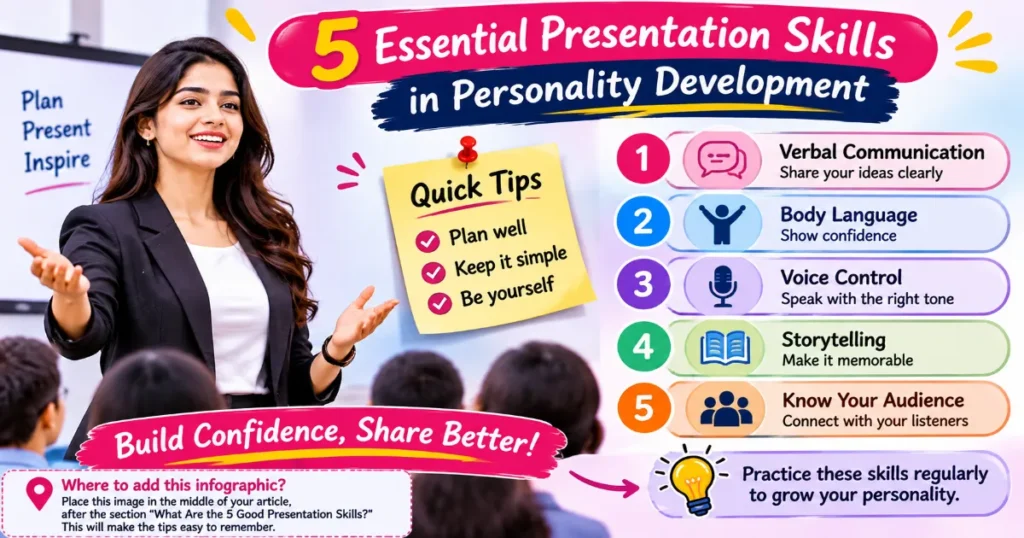
The five presentation skills that matter most are verbal communication, body language, voice control, storytelling, and understanding your audience. Coursera lists ten presentation skills in total. These five give you the biggest return when you are starting.
1. Verbal Communication
Use short sentences. Pick simple words. Say one idea at a time. If you cannot explain a point in two lines, you have not understood it yet.
2. Body Language
Stand straight. Keep your hands visible. Look at people, not at the screen. We cover this in detail in our guide on body language in personality development, so use it as your checklist.
3. Voice Control
A flat voice puts people to sleep. Vary your speed. Pause after key points. For simple drills, try these voice modulation exercises.
4. Storytelling
People remember a short story better than a list of facts. Use a simple example from college, a family event, or a workplace moment. Keep it true and keep it short.
5. Understanding Your Audience
Ask three questions before you build a single slide. Who will listen? What do they already know? What do I want them to do after my talk? Good listening helps here, and our guide to active listening skills shows how.
What Are the 7 Presentation Skills in Personality Development, With Examples?
The seven skills are verbal communication, body language, voice control, storytelling, audience awareness, active listening, and self-awareness. The table shows each one in a college class and at work.
| Skill | Example in a college class | Example at work |
|---|---|---|
| Verbal communication | Explaining a case study in plain words | Giving a clear project update |
| Body language | Facing the class, not the screen | Sitting upright in a client call |
| Voice control | Slowing down on key numbers | Pausing before the main ask |
| Storytelling | Opening with a short real life story | Using a customer story to explain a result |
| Audience awareness | Using terms your classmates know | Skipping jargon in a talk to a new team |
| Active listening | Noting a question before answering | Repeating a concern before you reply |
| Self awareness | Knowing you rush when nervous | Asking a friend for feedback on your pace |
What Are the 10 Qualities of a Good Presentation?
A good presentation has a clear goal, a simple structure, short slides, a strong opening, a steady voice, honest examples, good timing, eye contact, calm answers, and a clear ending. Use this as a checklist before you present.
- It has one clear goal.
- It follows a simple structure.
- The slides are short.
- The opening grabs attention.
- The voice is steady.
- The examples are true and simple.
- The timing is right.
- The speaker looks at people.
- The answers are calm.
- The ending tells people what to do next.
What Are the 7 Basic Steps to Deliver a Presentation?
The seven steps are: set a goal, know your audience, build a structure, make simple slides, practise out loud, deliver calmly, and answer questions. Follow them in this order.
- Set a goal. Write one line: “After my talk, the audience should know or do this.”
- Know your audience. Think about who listens and what they need.
- Build a structure. Use an opening, three main points, and a close.
- Make simple slides. One idea per slide. Few words.
- Practise out loud. Reading in your head does not count.
- Deliver with calm. Breathe, pause, and look at people.
- Answer questions. Listen first. Then reply.
What Are the 5 Ps in Presentation Skills?
The 5 Ps are Planning, Preparation, Practice, Performance, and Passion. This is the version listed by Teleprompter.
Be aware that other sources use different lists. Some use Prepare, Plan, and Practice, with practice repeated three times. So if your teacher gives a different list, follow your teacher for exams.
What Is a Good 5 Minute Presentation?
A good 5 minute presentation has a short opening, three clear points, and a quick close. Here is a simple time split you can copy.
| Part | Time | What to do |
|---|---|---|
| Opening | First 30 seconds | State your topic and why it matters |
| Roadmap | Next 30 seconds | Tell people your three points |
| Point 1 | 1 minute | One idea and one example |
| Point 2 | 1 minute | One idea and one example |
| Point 3 | 1 minute | One idea and one example |
| Summary | 30 seconds | Repeat the three points in one line each |
| Close | 30 seconds | Give one action or one question |
What Are the Slide Rules Students Ask About?
Slide rules are simple guides that help you keep slides short and clear. They are not laws. Use them to stop yourself from adding too much text.
What Is the 5 5 5 Rule?
The 5 5 5 rule says to use no more than five words per line, five lines per slide, and five text-heavy slides in a row. SlideModel explains this rule as a guideline. So if a slide needs a table or a chart, use it.
What Is the 7 by 7 Rule?
The 7 by 7 rule says to keep each slide to about seven lines and about seven words per line. People also search for it as the 7 7 7 rule. SlideModel describes the 7 by 7 rule in the same way. It is a looser cousin of the 5 5 5 rule.
What Is the 10/20/30 Rule?
The 10/20/30 rule, from Guy Kawasaki, says to use 10 slides, speak for no more than 20 minutes, and use a font of at least 30 points. CBS News reported on this rule in 2010. It was made for business pitches. For a 5-minute class talk, you will need fewer slides.
Which Slide Mistakes Should You Avoid?
- Reading from the slide. The audience can read faster than you speak. Add value instead.
- Too much text. If people read, they stop listening.
- Tiny fonts. If the back row cannot read it, it is too small.
- No plan B. Keep a copy on a pen drive and one in your email.
How Do You Handle Nerves Before You Present?
You handle nerves by preparing a fixed structure, practising out loud, and breathing slowly before you start. Nerves are normal in presentation skills and personality development, and they do not mean you will do badly.
Try these five steps:
- Arrive early and check the room.
- Take three slow breaths before your first line.
- Memorise only your opening. Do not memorise the whole talk.
- Look at one friendly face first.
- Keep a glass of water close.
Fear is a big topic by itself. If it is your main problem, read how to overcome fear of public speaking.
How Do You Handle Questions After Your Talk?
Listen to the full question, pause, repeat it, answer it briefly, and return to your main point. This five-step habit keeps you calm.
- Listen fully. Do not guess the end of the question.
- Pause. Two seconds feels long to you. It looks thoughtful to others.
- Repeat the question. This helps people at the back and gives you time to think.
- Answer in a few lines. Do not give a second speech.
- Return to your point. End with one line from your main message.
If you do not know the answer, say so. Then add, “I will check and share it with you.” Honesty builds more trust than a made-up answer.
What Are Good Presentation Topics for Students?
Good presentation topics for students are those linked to personality growth, because you learn the topic and practise the skill together. Here are ten, each with a simple angle.
- My personal SWOT. Show your strengths and gaps. Our guide on SWOT analysis in personality development shows how.
- Time management. Share a weekly plan that worked for you. See the guide on time management for personality development.
- Attitude. Compare a positive and a negative reaction to the same problem. Read about the power of attitude for ideas.
- Teamwork. Describe one group task and what each person did.
- First impressions. Explain what people notice in the first ten seconds.
- Listening. Show how poor listening causes mistakes.
- Dealing with failure. Share a common setback and the lesson.
- Goal setting. Break one goal into weekly steps.
- Etiquette. Cover manners in class, interviews, and emails.
- Stress at college. Offer three small habits that help.
For presentation skills in personality development, pick a topic where you can share a true, small example. That makes the talk feel real.
How Can You Improve Presentation Skills? A 4 Week Plan
You can improve presentation skills in personality development in four weeks by practising one focus area each week for about ten minutes a day. Do not try everything at once.
| Week | Focus | Daily practice (10 minutes) |
|---|---|---|
| Week 1 | Structure | Pick any topic. Say the opening, three points, and close out loud |
| Week 2 | Voice and pace | Record yourself on your phone. Listen once. Fix one thing |
| Week 3 | Body language | Practise in front of a mirror or a friend. Keep your hands calm |
| Week 4 | Questions | Ask a friend to throw three questions at you after each run |
How Do You Check Your Own Progress?
Ask yourself five questions after each talk:
- Did I state my goal in the first minute?
- Did I stay within the time?
- Did I look at people more than at the screen?
- Did I pause at least three times?
- Did I answer questions without panic?
Four or more yes answers is a good sign. Fewer than four? Repeat the same week.
How Do You Describe Presentation Skills on a Resume?
Describe your presentation skills with a result, not just a label. Writing “good presentation skills” says little. A proof line says more. Here are three sample lines you can adapt, but only use ones that are true for you:
- Presented a market study to a class of 60 students and answered questions from faculty.
- Delivered weekly project updates to a team of five.
- Created and presented a 10-slide deck for a college fest sponsor meeting.
For more on this, read our top interview skills in personality development.
Why Are Presentation Skills Important for Leaders?
Leaders use presentations to explain a plan, win support, and give clear direction. A leader who cannot explain a goal in simple words loses the team.
Strong presentation skills in personality development help leaders too. Good leaders keep slides short. They tell the reason first. They pause for questions. They also read the room and change their pace.
If you want to grow as a leader, read how personality development can improve leadership quality.
What Common Mistakes Should You Avoid?
These mistakes slow down presentation skills in personality development for most beginners.
- Starting without a goal. You will ramble.
- Putting your whole talk on slides. You become a reader.
- Skipping practice. Your first run should never be in front of the class.
- Rushing. Nerves speed you up. Slow down on purpose.
- Ignoring the audience. Watch faces, not only notes.
- Using made-up facts. If you cannot name a source, leave the number out.
Conclusion
Presentation skills in personality development are not about being a born speaker. They are about a clear process and steady practice. Plan the talk, keep the slides light, speak slowly, and listen to the room.
Each talk you finish adds a little proof that you can do it. That proof is what builds the confident personality people notice.
Start tonight. Pick any topic from the list above and say a 5 minute talk out loud once. Then read the role of communication in personality development to see how presenting fits into your wider growth.
FAQs
What are 5 good presentation skills?
The five are verbal communication, body language, voice control, storytelling, and understanding your audience. Together, they help you plan a clear talk and deliver it with calm.
What are the 7 presentation skills in PPT?
They are verbal communication, body language, voice control, storytelling, audience awareness, active listening, and self awareness. In a PPT talk, add one more habit: keep slides short so your skills stay in focus.
What are the 5 Ps in presentation skills?
Planning, Preparation, Practice, Performance, and Passion. Other sources may list them differently, so follow your teacher’s version for exams.
What is the 5 5 5 rule in presentations?
It says to use no more than five words per line, five lines per slide, and five text heavy slides in a row. It is a guide, not a strict law.
How do presentation skills help personality development?
Presentation skills in personality development train confidence, communication, emotional control, and credibility in one activity. Each talk you complete gives you proof that you can handle pressure, and that proof shapes how you see yourself and how others see you.

Ayanshi is the founder of PersonaGuru.in, a blog focused on personality development, career, relationships, and mental well-being. With over 3 years of writing experience, she turns psychology and everyday experiences into practical, easy-to-understand advice for real life.