
Last updated on October 3rd, 2026 at 03:14 pm
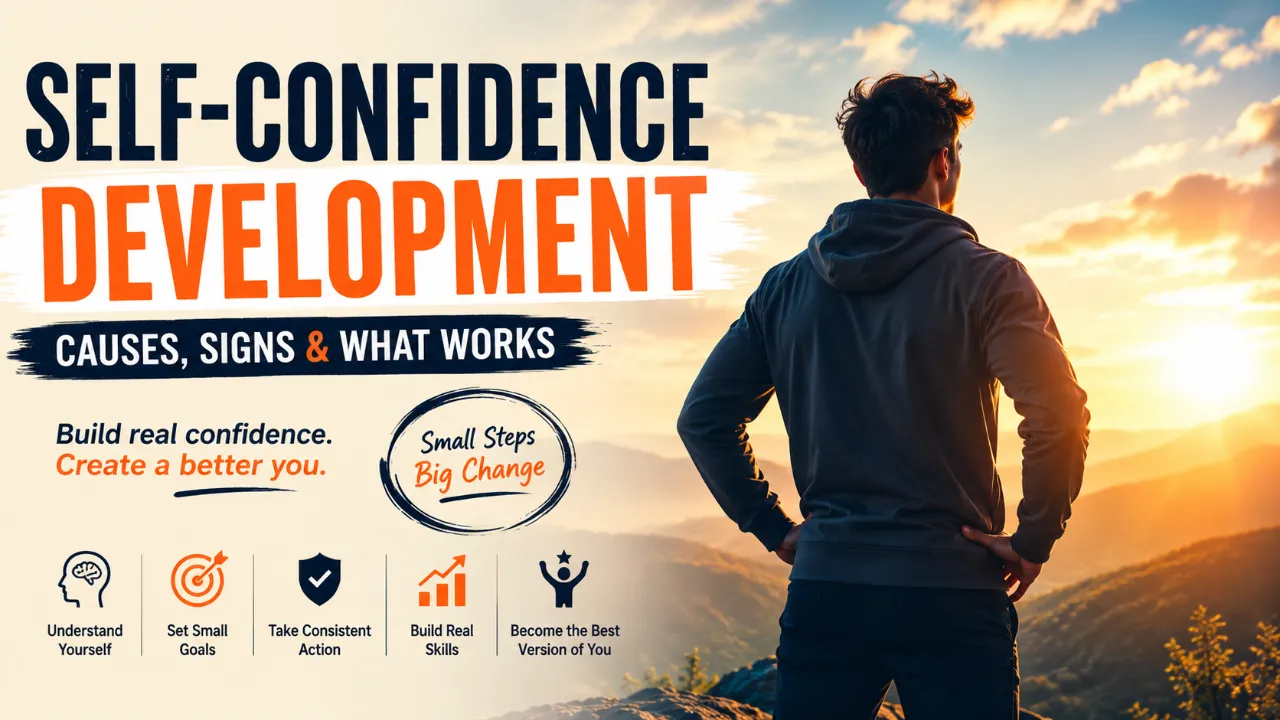
Self-confidence development means building trust in your own judgment, skills, and ability to handle what comes your way. It is different from self-esteem, which is your overall sense of worth, and from self-efficacy, which is your belief in handling one specific task. Research shows self-esteem stays flat in the early teens, then rises through adulthood and peaks around age 60. So low confidence today is not permanent. It grows through small, consistent proof that you can trust yourself.
Think about the last time you walked into a room and felt completely sure of yourself. Maybe it was an interview you had actually prepared for. Maybe it was a conversation where you finally said what you meant.
Now think about the opposite. The meeting where you had the right answer but stayed quiet. The message you wrote and deleted five times before sending nothing at all.
That gap between those two versions of you is not talent. It is confidence, and it can be built.
This guide is about self-confidence development in the most practical sense: what actually works to build it back, without the vague “just believe in yourself” advice that never tells you how.
Key Takeaways
- Confidence, self-esteem, and self-efficacy are not the same thing.
- Low confidence usually has a cause: criticism, comparison, or a skill gap.
- Self-esteem rises through adulthood and peaks around age 60.
- A February 2026 ScholarshipOwl survey found 70% of students feel very confident they will find a career.
- Small, repeated actions build confidence, not one big mindset shift.
What Is Self-Confidence, Really?
Self-confidence means trusting your own judgment and your ability to handle a situation, even an unfamiliar one. It is not the same as being loud, and it is not the same as never feeling nervous.
A quiet person can be deeply confident. A talkative person can be covering up real insecurity. Confidence shows up in how you handle a setback, not just how you walk into a room.
A line often credited to Eleanor Roosevelt says, “No one can make you feel inferior without your consent.” That line captures something real: a lot of low confidence comes from letting someone else’s opinion decide your worth.
Self-Confidence vs Self-Esteem vs Self-Efficacy
These three words get used interchangeably, but they are not the same thing, and knowing the difference actually changes what you should work on.
| Term | What It Means | Example |
|---|---|---|
| Self-confidence | Trust in your overall ability to handle situations | Walking into a new job knowing you can figure things out |
| Self-esteem | Your general sense of self-worth, separate from performance | Feeling like you deserve respect even on a bad day |
| Self-efficacy | Belief in your ability to succeed at one specific task | Believing you can pass a particular exam because you prepared for it |
Psychologist Albert Bandura, whose self-efficacy research shaped decades of work in this field, found that people who believe they can master a specific skill are far more likely to actually attempt it and stick with it when it gets hard. If you want to go deeper into what shapes your baseline self-worth specifically, our guide on factors affecting self-esteem in personality development breaks that down separately. You can also read how to build self-esteem step by step.
What Causes Low Self-Confidence?
Low confidence rarely comes out of nowhere. It usually traces back to one or more of these patterns, and knowing which one applies to you is the real starting point of self-confidence development.
Past criticism or rejection. A harsh teacher, a dismissive boss, or a relationship where you were constantly corrected can leave a mark that outlasts the situation itself. It can even make you feel like everyone is against you.
Constant comparison to others. Social media makes this worse, but the habit existed long before Instagram. Comparing your full, complicated life to someone else’s highlight reel is a losing game every time. Our guide on how to stop comparing yourself to others shows where to start.
Repeated failure without reflection. Failing at something is not the problem. Failing and never examining why, so the same mistake keeps happening, is what erodes confidence over time. If failure scares you, read how to overcome fear of failure.
Negative self-talk left unchecked. The voice in your head that says “I always mess this up” is not neutral. Left unquestioned, it becomes a belief you act on, and it is worth checking whether that voice is echoing toxic patterns you picked up from somewhere else rather than anything actually true about you.
A real skill gap in one specific area. Sometimes low confidence is not really a mindset problem. It is a signal that you genuinely have not built the skill yet, and self-efficacy research backs this up directly: competence usually comes before confidence, not the other way around. That one idea flips most generic confidence advice.
Signs You’re Dealing With Low Self-Confidence
| Sign | What It Actually Looks Like |
|---|---|
| Avoidance | Skipping situations where you might be judged, even ones you want to be part of |
| Over-apologizing | Saying sorry for things that need no apology at all |
| Deflecting compliments | Brushing off praise instead of simply accepting it |
| Staying quiet | Having something useful to say in a meeting and not saying it (learn how to speak up in meetings) |
| Constant reassurance-seeking | Needing someone else to confirm even small, low-stakes decisions |
If several of these sound familiar, that is useful information, not a life sentence. Recognizing these patterns early is often the real first move in self-confidence development, long before you reach for any specific technique. Our piece on what feels wrong when nothing seems wrong covers this exact pattern in more depth if you want to sit with it further.
Does Self-Confidence Change With Age?
Yes, and the research on this is more encouraging than most people expect.
A meta-analysis led by psychologist Ulrich Orth looked at 331 samples and nearly 165,000 people between the ages of 4 and 94. Self-esteem stayed flat between ages 11 and 15, then rose strongly until about 30. It kept rising through middle age and peaked around 60.
That means if you struggled with confidence as a teenager or in your early twenties, you were not broken. Your confidence was still under construction, and for most people it keeps growing for decades. If this stage is exactly where you (or someone you’re raising) currently are, our dedicated guide on developing self-confidence in teenagers covers age-specific strategies in more depth.
Different Areas of Confidence
Confidence is not one single thing you either have or do not have. It shows up differently across areas of life, and you can be genuinely strong in one area while still working on another.
- Physical confidence: comfort in your body and how it moves, like walking into a gym for the first time without waiting until you “look ready”
- Social confidence: ease in conversations and group settings, like starting a conversation with a stranger at a wedding instead of standing near the snack table
- Intellectual confidence: trust in your ability to learn and think through problems, like raising your hand with a half-formed idea instead of waiting until it’s perfect
- Emotional confidence: comfort expressing and handling your own feelings, like naming that you’re upset instead of pretending you are fine— this ties closely into your emotional intelligence as a whole
- Professional confidence: trust in your work and career decisions, closely tied to career and workplace growth as a whole, like asking for the raise you have actually earned— our guide on self-confidence for career success strategies goes deeper into this specific area, and strong leadership often grows directly out of it. You can also see why confidence in your skills matters in the age of AI.
- Financial confidence: comfort managing and making decisions about money, like reviewing your bank statement instead of avoiding it
- Moral confidence: trust in your own values when they get tested, like disagreeing with your manager in a meeting because you believe you are right
Most people are strong in two or three of these and shaky in the rest. That is normal, and it is far more useful than treating confidence as one single score.
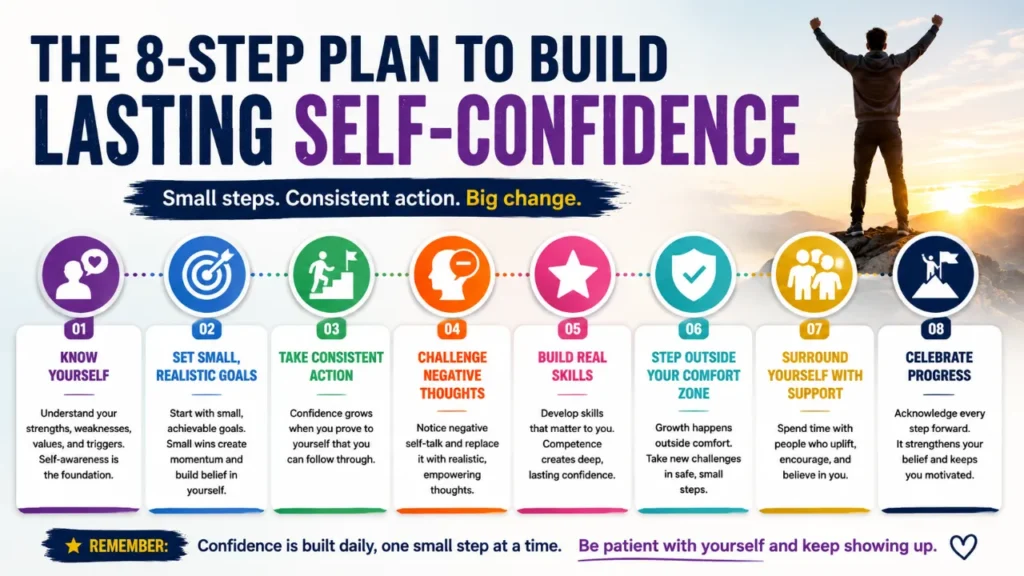
How to Approach Self-Confidence Development: 8 Steps That Work
This is the part that actually matters. Eight steps, each one specific enough to act on today, not just read and forget. For a shorter, checklist-style version of some of these, our piece on how to boost self-confidence with expert tips is a quick companion read.
1. Review your past wins with actual evidence, not vague memory. Write down ten things you have genuinely done well, with a specific detail for each one. Priya, a first-year marketing executive in Pune, kept a note on her phone titled “Proof” and added one entry every time something went right at work.
Six months in, reading it before a big client call changed how she walked into the room. The common mistake here is listing achievements too vaguely (“I’m good at my job”) instead of specifically (“I fixed the client escalation in March without anyone above me stepping in”).
2. Set small, specific goals instead of vague ones. “Get more confident” is not a goal you can act on. “Speak up once in every team meeting this month” is. Small wins compound faster than big, undefined ones.
3. Fix your body language first. How you hold your body changes how you feel before it changes how others see you. Standing straighter and making eye contact, even when you do not feel ready, signals safety to your own nervous system. Our detailed guide on body language and confidence breaks this down further. For quick posture tips, read 11 ways to have more confident body language; for a broader look at presence, see how to be a beautiful and confident woman. The common mistake is trying to fake big, dramatic confidence instead of small, consistent posture changes that actually stick.
4. Replace negative self-talk with evidence, not empty affirmations. Instead of repeating “I am amazing” on a loop, ask yourself what evidence actually supports or challenges the negative thought. If you still like affirmations, pick ones backed by proof, like these 50 positive affirmations for self-esteem. Rohan, an engineering student in Bengaluru preparing for placement interviews, kept getting stuck on “I’m not good enough for this company.” His mentor asked him to write down three specific reasons the company had even shortlisted him. That shifted the thought from a feeling into a fact he could actually use. This kind of thought is often imposter syndrome, and it fades once you track real evidence.
5. Build one real skill instead of chasing a feeling. If your low confidence is about public speaking, the fix is not a mantra. It is practicing public speaking. Confidence in a specific area almost always follows competence in that area, not the reverse.
6. Get comfortable being uncomfortable, in small doses. Volunteer for one thing slightly outside your comfort zone each week. Not a leap, a step. The goal is building a track record of surviving discomfort, which is what confidence is actually made of. Simple confidence-building exercises can help you start.
7. Manage stress directly. Chronic stress quietly erodes confidence because it keeps your nervous system in a defensive state where every small setback feels like proof you cannot cope. Sleep, movement, and simply naming what is stressing you out all help more than people expect. For fast relief, try these quick ways to reduce stress.
8. Ask for feedback instead of avoiding it. Most low-confidence habits involve avoiding information that might be uncomfortable. Asking a trusted colleague or friend for direct feedback, and actually sitting with the answer, builds a more accurate and more resilient sense of your own ability than guessing ever will.
If you are curious about newer ways to get that kind of reflection, our piece on boosting self-confidence with artificial intelligence looks at how AI tools fit into this. This is also the fastest way out of a spiral of low self-esteem specifically: uncertainty about where you stand usually hurts more than an honest answer does.
Self-Confidence and Personality Development
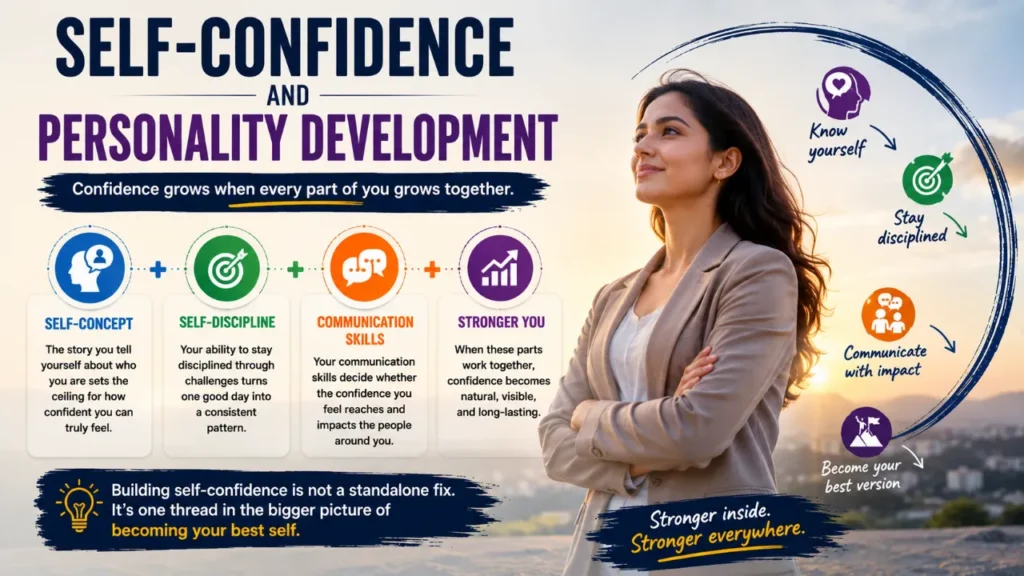
Confidence does not exist on its own. It is tangled up with almost every other part of who you are.
Your self-concept, the story you tell yourself about who you are, sets the ceiling for how confident you can genuinely feel. Your ability to self-discipline through a hard week turns one good day into a pattern. Your communication skills decide whether the confidence you feel internally actually reaches the people around you.
This is why building self-confidence rarely works as an isolated project. It grows fastest when it is treated as one thread inside a bigger picture of who you are becoming, not a standalone fix.
Explore More Confidence and Personality Guides
- How to Develop a Strong Personality at Work
- Self-Sabotage: Causes and Solutions
- How to Control Your Mind: 10 Simple Strategies for Calm
- How to Become Self-Dependent
Conclusion
Self-confidence is not a personality type you were born with or without. It is a skill, built the same way any skill is built: small actions, repeated often enough that they stop feeling like effort.
The teenager who felt invisible in class and the professional who freezes before a big presentation are often the same story at different ages. What changes is not a mindset shift. It is proof, collected one small win at a time, and that, in the end, is the whole idea behind self-confidence development. It’s also just one piece of the larger picture. For the full roadmap, our complete guide to personality development ties this together with every other skill that builds alongside it.
Your next step: Pick one habit from this guide, the wins journal, the small goal, the feedback conversation, and track it daily for the next 14 days. Do not switch to a different habit halfway through. Confidence built on real evidence, tracked consistently, lasts far longer than confidence built on hoping you feel different tomorrow.
FAQs
Q1. What are the 5 C’s of confidence?
There is no single, universally agreed version of this. Different coaches and frameworks describe different sets, ranging from communication and clarity to competence and connection. Treat any “5 C’s” list as one useful lens, not a scientific fact.
Q2. What’s the difference between confidence and arrogance?
Confidence is trust in your own ability that leaves room for other people. Arrogance is the same trust used to put other people down. A confident person can say “I don’t know” without it threatening how they see themselves. An arrogant one usually cannot.
Q3. Can low self-confidence be fixed permanently?
Confidence is not a permanent fix so much as a habit you maintain. It rises and falls with what is happening in your life, but the habits in this guide make the low points shorter and less frequent over time.
Q4. How long does it take to build self-confidence?
There is no fixed timeline. Small shifts in how you feel day to day often show up within a few weeks of consistent practice. Bigger, more visible changes, like speaking up more at work, tend to take a few months of repeated small wins.
Q5. Is low self-confidence the same as social anxiety?
No. Low self-confidence is a general lack of trust in your own ability. Social anxiety is a specific, often more intense fear centered on being judged in social situations. They can overlap, but social anxiety usually needs a different, more targeted approach, and a professional’s input is worth considering if it feels severe.
Q6. How can I build self-confidence quickly?
You cannot rush it, but you can start today. Pick one small action, like writing down three real wins from this week, and repeat it daily. Quick effort adds up faster than waiting to feel ready.

Ayanshi is the founder of PersonaGuru.in, a blog focused on personality development, career, relationships, and mental well-being. With over 3 years of writing experience, she turns psychology and everyday experiences into practical, easy-to-understand advice for real life.