
Last updated on November 1st, 2026 at 07:38 am
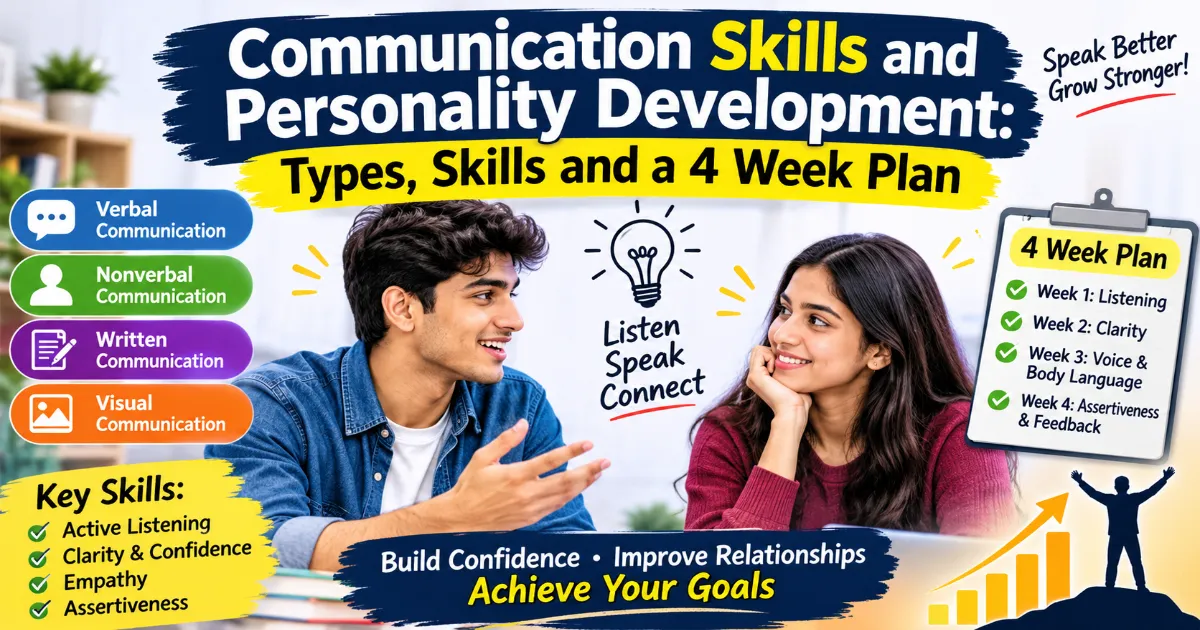
Communication skills and personality development go together. People judge your personality by how you speak, listen, write, and react. The good news is simple. Each of those habits can be learned.
You do not have to become a different person. You don’t have to let people see and hear the person you already are. This guide on communication skills and personality development shows you how, step by step. It is part of our wider personality development series.
Here is a small scene. Aarav and Meera sit in the same viva. Both studied the same chapter. Aarav looks at the examiner, takes a breath, and answers in two clear lines. Meera looks at the table and answers in a rush. The examiner remembers Aarav as calm and sure. Meera knew just as much. Her marks may even match his. But the first picture is already made.
That gap is what we will close here.
Key Takeaways
- Communication skills and personality development shape each other.
- There are four types: verbal, nonverbal, written, and visual.
- Listening is the base of all four.
- The “55 percent body language” claim is a myth.
- There are three styles: passive, aggressive, and assertive.
- Ten minutes a day for four weeks is enough to start.
What Are Communication Skills?
Communication skills are the habits you use to share your ideas and understand others. They cover speaking, listening, writing, and reading body language.
Most guides stop at the meaning. But the meaning is the easy part. What matters is whether your message lands.
How Does a Message Travel?
A message moves in steps. You decide what to say. You choose how to say it. The other person hears or reads it. Then they answer. Then the loop starts again.
A classic model came from Claude Shannon in 1948. Warren Weaver helped build on it in 1949. The Wikipedia page on the Shannon-Weaver model lists a source, a transmitter, a channel, a receiver, and a destination. It also treats noise as anything that distorts the signal. The model has one weakness. It runs in one direction, so later models added feedback.
For daily life, use this simple chain:
| Step | What happens | Where it breaks |
|---|---|---|
| Sender | You decide what to say | Your thought is not clear yet |
| Message | You turn it into words and tone | Your words and tone do not match |
| Channel | Talk, call, chat, or email | Wrong channel for the topic |
| Receiver | The other person takes it in | They are tired or upset |
| Feedback | They reply or ask a question | You ignore their reaction |
Most problems start at step one. People speak before they know what they want to say.
How Do Communication Skills and Personality Development Connect?
Communication skills and personality development connect because people see your traits through your words, voice, and reactions. Confidence, respect, and patience show up in a conversation before anywhere else.
| Trait people notice | How it shows in a talk |
|---|---|
| Confidence | A steady voice and clear sentences |
| Respect | You let the other person finish |
| Empathy | You say how they might feel |
| Honesty | You say what you mean, without harshness |
| Leadership | You give clear direction and listen back |
| Calm | You stay steady when you disagree |
It also works the other way. When you practise speaking clearly, you start to feel surer. That feeling shows up in your voice. So the habit feeds itself.
Strong communication skills and personality development rest on one loop. Read the role of communication in personality development for a closer look at this loop. If you want to know why some people stay calm under pressure, start with emotional intelligence explained.
What Are the 4 Types of Communication?
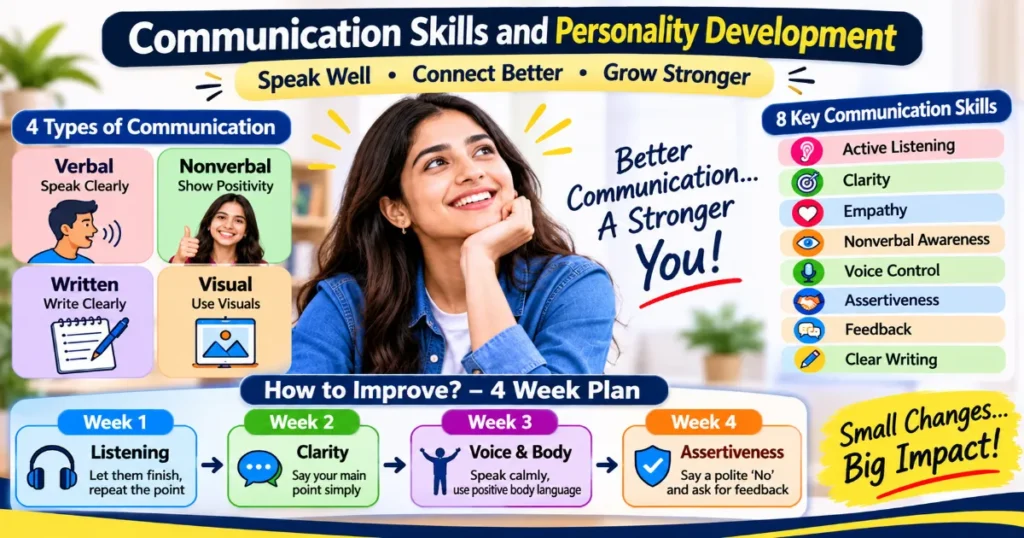
The four types are verbal, nonverbal, written, and visual. Every message uses at least one. Most use two or three at once.
| Type | What it uses | Examples |
|---|---|---|
| Verbal | Spoken words and voice | A class talk, a phone call, an interview answer |
| Nonverbal | Face, posture, hands, eyes | A nod, crossed arms, a smile |
| Written | Words on a page or screen | An email, a report, a chat message |
| Visual | Images, charts, slides | A graph, a diagram, a short video |
1. Verbal Communication
Verbal communication means sharing your thoughts through spoken words.
Three things decide how it feels to the listener. Your words. Your voice. Your timing. A warm voice can soften a hard sentence. A flat voice can make good news sound dull. Try these voice modulation exercises to train it. For real situations, see these oral communication examples.
Here is a tip you can try today. Send a 30-second voice note to a friend. Then play it back before you send it. You will hear your pace, your filler words, and your tone at once.
2. Nonverbal Communication
Nonverbal communication is everything your body says without words. It includes your face, posture, hands, eyes, and distance.
You may have read that 7 percent of communication is words, 38 percent is tone, and 55 percent is body language. This came from Albert Mehrabian. But the Wikipedia page on Albert Mehrabian says he meant it only for talking about feelings and attitudes. So do not quote it in an assignment.
What is true is simpler. When your body and your words disagree, people tend to believe the body. Say “I am fine” with a tight face, and nobody believes you. Our guide on body language in personality development shows how to line them up.
3. Written Communication
Written communication is any message in text. That means emails, chat messages, reports, and resumes.
It has one big plus. You can edit before you send. It has one big risk. The reader cannot hear your tone.
Take a small example. Meera sends a one-word reply in a team chat: “Ok.” She meant “Got it, thanks.” Her teammate read it as “I am annoyed.” Nobody said anything, but the mood changed for a week.
A simple fix is to add one warm line. “Ok, thanks. I will send it by 5.” That is all.
Before you send any important message, read it once as the receiver. If a line can be read two ways, rewrite it. For longer formal writing, see report writing skills in personality development.
4. Visual Communication
Visual communication uses images, charts, slides, and videos. A good chart can replace a full paragraph.
Keep it light. One idea per slide. Few words. If a visual needs a long explanation, it is not working. Our guide on presentation skills in personality development has slide rules and a 5-minute plan.
What About Listening?
Listening is not one of the four types. But it sits under all of them. You cannot reply well to something you did not take in. Learn how to practise active listening skills with simple drills.
What Are the 8 Most Important Skills in Communication Skills and Personality Development?
The eight skills are active listening, clarity, empathy, nonverbal awareness, voice control, assertiveness, feedback, and clear writing. Build them one at a time. I would start with listening, because it costs nothing and helps everywhere.
1. Active Listening
Give the speaker your full attention. Put your phone face down. Let them finish. Then repeat their main point before you reply.
2. Clarity
Know your main point before you speak. If you cannot say it in two sentences, you are not ready yet.
Use this line: “My main point is ___. The reason is ___.” Fill in both blanks before any big talk.
3. Empathy
Empathy means understanding how the other person feels, even when you disagree. It makes your message easier to accept. Read how empathy shapes your personality development.
4. Nonverbal Awareness
Watch your own face and posture. Watch theirs too. A person who goes quiet in a meeting may be confused. They may not be agreeing.
5. Voice Control
Slow down. Pause after your main point. A calm voice makes people trust you more. Nerves push most people to speak too fast, so slow down on purpose.
6. Assertiveness
Assertive means you say what you think, and you stay respectful. You are not silent. You are not harsh. See the difference between aggression vs assertiveness, then practise these assertiveness techniques.
7. Giving and Taking Feedback
Good feedback is specific, calm, and about the action, not the person. Say “Three numbers are missing in the report.” Do not say “You are careless.”
When you get feedback, listen first. Do not defend yourself until they finish.
8. Clear Writing
Use short sentences. Put the main point first. End with one clear ask, like “Please reply by Friday.”
Why Do Employers Care About Communication Skills and Personality Development?
Employers care because almost every job needs people to share information, solve problems, and work in teams. Good communication helps in the interview and after you join.
The National Association of Colleges and Employers (NACE) surveyed 237 employers in 2024 for its Job Outlook 2025 report. According to NACE, nearly 90 percent want proof of problem-solving. Nearly 80 percent look for teamwork. At least 70 percent want written communication. More than two-thirds want verbal communication.
Notice something. Problem-solving and teamwork both need communication. You cannot work in a team if you cannot share ideas.
Here is where it shows up:
- Interviews. Your tone and listening are judged along with your answers. See why communication skills matter in an interview.
- Career growth. People who explain ideas well get noticed. Read about effective communication skills for career growth.
- Meetings. One clear point can change how people see you. Learn how to speak up in meetings.
- Negotiation. A calm ask works better than a loud one. See how to improve your negotiation skills.
How Do Communication Skills and Personality Development Work in Daily Life?
The basic skills stay the same. Only the focus changes with the place.
| Place | Focus | What to practise |
|---|---|---|
| College | Clear answers, calm delivery | Short talks and group tasks |
| Interviews | Structure | Answer in three points |
| Remote work | Written clarity and tone | Clear messages and camera habits |
| Relationships | Listening and honesty | Ask before you assume |
| Leadership | Direction and listening | Short briefs, open questions |
For Students
Students speak in class, write answers, join groups, and present. Start small and repeat daily. Our guide on communication skills for students has simple steps. For group tasks, read group discussion in personality development. For longer talks, read public speaking skills for students.
If nerves are your main problem, read how to overcome fear of public speaking.
At Work
Workplace talk needs clear messages and good manners. On remote teams, you lose body language. So you must say more in words. Ask direct questions. Do not assume silence means yes. See communication skills for remote teams.
For disagreements, use these communication tips for effective conflict resolution. If you lead people, also learn to improve listening skills as a leader.
Across Cultures
The same gesture can mean different things in different places. Eye contact is one example. Watch how the other person behaves before you decide what is polite. Read how to improve cross-cultural communication skills.
In Relationships
Close relationships need the same basics. Listen first. Speak honestly. Ask before you assume. Read how to build successful personal relationships.
Which Small Phrases Make Talks Smoother?
Small changes in wording often fix big problems. These six are easy to try this week.
- Say “we” instead of “I”. Say “How can we get this report ready for Friday?” instead of “I need this report by Friday.” The other person feels like a partner, not a helper.
- Use a five second pause. After you ask a question, wait. Do not rush to fill the silence. People often add the more honest part of their answer after a pause.
- Start with “I feel”, not “You always”. “I feel stressed when plans change late” keeps the talk on the problem. “You always change plans” makes people defend themselves.
- Check in before you end. Say, “Just so I have this right, we will do X and then Y. Is that correct?” It takes ten seconds and saves hours of rework.
- Look at the camera on video calls. Looking at the lens feels like eye contact to the other person. Looking at their face on your screen does not.
- Pick the right channel. A quick text suits a small update. A voice note suits a longer thought. A call suits a sensitive talk.
Notice that none of these need a special skill. They only need a habit.
What Blocks a Message?
A barrier is anything that stops a message from reaching the other person. Most can be fixed once you spot them.
| Barrier | Example | Fix |
|---|---|---|
| Distraction | Phone alerts during a talk | Put the phone away |
| Unclear message | A long, rambling answer | Say your main point first |
| Strong emotion | Speaking while angry | Pause for a few seconds |
| Assumptions | “They must know this” | Ask a question |
| Language gaps | Jargon or heavy slang | Use plain words |
| Poor listening | Waiting for your turn to talk | Repeat their point first |
For more fixes, read how to overcome communication barriers.
What Are the 3 Communication Styles?
The three styles are passive, aggressive, and assertive. Assertive is the healthy one. It respects you and the other person.
| Style | How it sounds | How others feel |
|---|---|---|
| Passive | “It is fine, whatever you want” | Unsure what you think |
| Aggressive | “You always get this wrong” | Attacked and tired |
| Assertive | “I see it differently. Here is why” | Respected and clear |
Most people use all three at times. Notice which one you use when you are stressed. That is usually your habit.
Here is an example. A colleague asks Rohit to take extra work late on Friday.
- Passive: “Sure, no problem.” He then feels angry all weekend.
- Aggressive: “Why do you always dump work on me?”
- Assertive: “I cannot take this today. I can start on it Monday morning.”
The third reply keeps the peace and protects his time.
How Can You Improve Communication Skills? A 4 Week Plan
You can improve in four weeks with one focus a week and about ten minutes a day. Do not try everything at once.
| Week | Focus | Daily practice |
|---|---|---|
| Week 1 | Listening | Let the other person finish. Repeat their main point before you reply |
| Week 2 | Clarity | Write your main point in two sentences before any big message |
| Week 3 | Voice and body | Record yourself for one minute. Watch it once. Fix one habit |
| Week 4 | Assertiveness and feedback | Say one honest, polite “no” or opinion daily. Ask one person for feedback |
10 Daily Habits That Work
- Put your phone away during every talk.
- Take one breath before you answer.
- Ask one question in every conversation.
- Say your main point first. Give reasons after.
- Read each message once before you send it.
- Look at the person who is speaking.
- Name the other person’s feeling when it fits.
- Speak a little slower than feels natural.
- After a big talk, write down one thing that went well.
- Ask a trusted person, “How did I come across?”
A Quick Self Check
Answer yes or no.
- Do I let people finish before I reply?
- Can I say my main point in two sentences?
- Do I notice how the other person reacts?
- Do I stay calm when I disagree?
- Do my messages sound polite in writing?
- Can I say no without feeling guilty?
- Do I ask for feedback?
- Do I look at people when we talk?
Six or more yes answers means a good base. Fewer than six? Pick your first two no answers and work on them this week.
Want a printable version of the plan and the self-check? Download the free Communication Skills Practice Worksheet.
To grow further, read how to improve your soft skills and what interpersonal skills are.
What Mistakes Hurt Communication?
These mistakes slow down communication skills and personality development for most people.
- Speaking before thinking. Take one breath first.
- Interrupting. It tells people you do not value their words.
- Using jargon. Plain words travel further.
- Ignoring tone in writing. A short message can feel cold.
- Avoiding hard talks. Small problems grow when nobody names them.
- Never asking for feedback. You cannot fix what you cannot see.
- Trying to sound smart. Clear beats clever.
Conclusion
Communication skills and personality development grow together. Each time you listen well, speak clearly, or stay calm in a hard talk, you build a small piece of your personality. People notice that before they notice your marks or your title.
You do not need a big change. Pick one habit from this guide and practise it for a week. Then add the next one.
Start tonight. In your next conversation, let the other person finish. Then repeat their main point before you reply. It takes ten seconds, and it changes the whole talk.
FAQs
What are communication skills and personality development?
Communication skills are the habits you use to share and understand ideas. Personality development is the growth of traits like confidence, empathy, and calm. They are linked because people see your personality through how you talk, listen, and respond.
What are the 4 types of communication?
The four types are verbal, nonverbal, written, and visual. Listening supports all four.
How do communication skills improve personality?
They build confidence, respect, empathy, and calm through daily habits. Each clear talk gives you proof that you can handle people and pressure.
What is the 7 38 55 rule in communication?
It claims that 7 percent of communication is words, 38% is tone, and 55% is body language. It is a myth outside of talks about feelings. Albert Mehrabian, who ran the experiments, said it applies only when someone shares feelings or attitudes.
How long does it take to improve communication skills?
Most people see a change in communication skills and personality development in about four weeks of daily ten-minute practice. Full change takes longer. Listening and clarity usually improve first.
What is the best way to improve communication skills as a student?
Practise short talks daily, listen without interrupting, and ask a friend for one honest tip each week. Join class discussions and presentations whenever you can.

Ayanshi is the founder of PersonaGuru.in, a blog focused on personality development, career, relationships, and mental well-being. With over 3 years of writing experience, she turns psychology and everyday experiences into practical, easy-to-understand advice for real life.
6 thoughts on “Communication Skills and Personality Development: Types, Skills, and a 4 Week Plan”